A finished design can be a peculiar thing: approved, admired, and still nowhere a customer can see it. Between the file and the website sits a small procession of people. Someone must translate the design. Someone must check the translation. Someone must fit the result into the publishing system. By then, the campaign has acquired a second creative director: the calendar.
Ceros has built a business around that interval. Its proposition is practical enough to survive a meeting: let designers and marketers make interactive digital content without commissioning a fresh piece of web development every time. The interesting question is how much freedom a tool can give them while still producing something the browser, the brand and the reader can use.
- The job: turn reports, campaign pages and sales material into interactive web experiences.
- The change: Flex brings HTML-first output and responsive layout options to Ceros’s creative workflow.
- The catch: software can remove a handoff; the team still needs useful content, design judgment and a publishing plan.
A publishing problem disguised as a design problem
The history begins before the current company’s 2012 founding date. In 2009, trade coverage of Ceros described an online publication platform and named Dominic Duffy as a co-founder. Interactive magazines were already the subject. The ambition was to give a publication more to do than reproduce the printed page on a screen.
Simon Berg came through creative production and agency work. In his account of the company’s origins, the early Ceros technology converted PDFs into digital magazines. The commercial idea had promise, but an investor regarded the technology as outdated. Another portfolio company, Crowd Fusion, had engineering capability and a commercialisation problem. The 2012 combination brought the two together.
That is an unusually useful origin story. The first obstacle was the machinery beneath the idea. There is a lesson here for anyone staring at a promising prototype: a product can be attractive to customers and still need a different technical foundation. Finding the missing capability can matter more than adding another feature.
The space between Photoshop and publish
Ceros Studio occupies the gap between design tools and a content management system. Teams arrange assets on a canvas, add animation and interactions, collaborate, publish and examine engagement. They can begin with templates or build from a blank space. A report can become something readers explore; a product explanation can reveal details as the visitor clicks.
The economic appeal is repetition. One ambitious page may justify a bespoke build. A stream of campaign pages makes the handoff a recurring expense. Ceros supplies a place where creative teams can reuse assets and adjust published work. Its expertise combines visual authoring, interaction, collaboration and delivery - the unglamorous plumbing that makes the lovely thing usable.

The audience is enterprise marketing and design teams, alongside agencies. Ceros’s May 2024 announcement reported more than 900 enterprise customers and over $50 million in annual recurring revenue, with customers including McKinsey, Pepsi and Red Bull. Those are dated company disclosures, useful for scale rather than a current financial scoreboard. The same announcement named Alison Lange Engel as Simon Berg’s successor; Ceros subsequently announced Brad Paterson as CEO.
Then the canvas needed new machinery
Creative freedom has a technical bill. A layout that looks right on one screen must make sense on another. Search engines need readable structure. Accessibility needs attention. A fixed canvas provides control over placement, but the web has a tiresome habit of arriving in different sizes.
Ceros’s answer was Flex, introduced publicly in November 2025. The project began with a four-person research team and grew into a team of more than 25. The name comes from CSS Flexbox. It is a pleasingly workmanlike name for a product about making things fit.
“AI should amplify creativity, not automate it.”Daniel McGlade, introducing Flex, November 2025
Flex publishes semantic HTML and offers responsive layouts, reusable styles, components and interactive behaviours. The company’s move is architectural: preserve a visual workspace while producing content that behaves more naturally on the web. By July 2026, its education team recommended Flex for most new experiences, while describing Studio as the legacy platform.
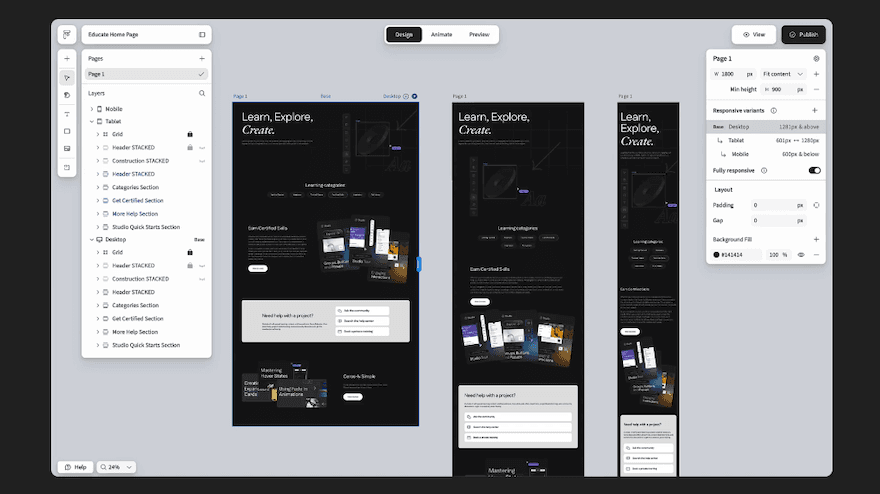
Studio still has a role. Ceros’s transition guidance says there is no planned sunset and identifies migration limits: some assets, animations and interactions do not transfer. The sensible reading is selective migration. A working experience with specialised interactions may deserve to stay put; an evergreen page needing better mobile behaviour may justify rebuilding.
A change in output architecture, with existing Studio work retained. Migration depends on feature compatibility.
What the cheque bought - and what the subscription buys
In July 2020, Ceros announced a $100 million strategic investment led by Sumeru Equity Partners, with management and existing investors participating. The investor remains listed as an active backer. Funding establishes the size of a commitment; it does not establish how much any particular product cost to build.
For buyers, the model is a software subscription. The current pricing page offers Starter, Growth and Enterprise packages. Starter lists one creator and three editors; Growth lists three creators and ten editors. Enterprise is customised. Free Starter access is advertised, while Growth and Enterprise lead to sales conversations. The distinction matters when budgeting: the public page supplies a buying route, rather than a numerical paid subscription price.
Ceros also has MarkUp for feedback on websites, PDFs and videos, Editor in its creative suite, and customer education and creative support. Its remote-first employment model describes a global team and benefits including a home-office stipend. A company selling collaboration has a practical reason to understand working together at a distance.
The useful test is what happens after the first draft
Flex AI arrived in April 2026 with a specific proposition: generated work stays editable on the canvas. The assistant works with the platform’s existing components and layouts. A designer can change the result directly. Ceros frames the assistant as help with both initial ideas and production chores, including layer organisation and responsive formatting.
That gives a buyer a better test than asking whether the first output looks impressive. Change the headline. Replace the image. Adjust the mobile arrangement. See whether the team can finish the work with the controls it already understands. The cost of generation includes the cost of correction.
Ceros’s year-end report counts work across Studio and Flex. It also reports 16.8K users. Activity measures use; it does not prove a campaign’s return.
Those reported activity figures help place Ceros in the market. It serves ongoing content production. Webflow and other full-site builders overlap with its visual approach, while Ceros concentrates on interactive marketing experiences. The buying question is whether the team needs to manage a whole website or repeatedly create content inside its existing web estate.
Borrow the workflow before buying the promise
Pick one stubborn piece of content: a report nobody finishes, or a sales explanation that requires too much narration. Decide what a reader should be able to do. Build that action into the structure. Make reusable sections, put feedback next to the thing being reviewed, and measure completion rather than congratulating the page for receiving clicks. These are editorial recommendations, and they work as a trial brief for Ceros.
Also decide where the experience will live. Ceros documents standalone HTML export; its beta server-side rendering route requires implementation in your own server or framework. No-code authoring can coexist with technical deployment work. If the job is a plain text page, or a custom application with complex business logic, interactive marketing software may add work without solving the central problem.
Ceros is most interesting when the bottleneck is clear: good creative work waiting to become a live experience. Give the reader a reason to interact, and a faster publishing workflow has something worth accelerating. The waiting room can empty. Someone still has to make the appointment worthwhile.