Tomer Shiran’s daughter had a question about the Sun. For her homework, she needed to know how much larger it was than Earth. She used Google and got an answer. Her father, who spent his working life around enterprise data, noticed the awkward comparison. A child could ask about the solar system. Employees could have a considerably harder time asking about the business that paid them.
The anecdote explains the impatience behind Dremio, the company Shiran co-founded with Jacques Nadeau in 2015. Businesses had collected enormous quantities of information. Getting it into the hands of someone who wanted to ask a question remained a separate undertaking. There were systems to connect, transfers to arrange, specialists to consult. The answer might be somewhere in the building. It still needed an escort.
Shiran’s career has followed that distance between possession and usefulness. He has worked as an engineer, a product executive, a founding CEO, and then a chief product officer. The titles changed. The desire to make an ordinary question less of an organizational event kept turning up.
An education in too much machinery
His own route crossed the Atlantic early. Born in Israel, he moved to the United States at about one while his father pursued a PhD at Stanford. He spent much of the next decade in the Bay Area, returning to Israel around eleven. Later came military service and computer science at Technion. His postgraduate education took him to Carnegie Mellon, where he earned a master’s in electrical and computer engineering.
At IBM Research, he worked in software engineering. At Microsoft, his work included security products and a move into product management. It was a useful change of vantage point: building software puts its mechanisms in view; managing a product also requires attention to the person expected to operate them.
In 2009, he joined MapR as employee number five and became its VP of Product. During his tenure, the business grew to more than 300 employees and 700 enterprise customers. That gave him repeated exposure to the practical difficulties of big data. Storage and processing were advancing. The experience of using the resulting systems could still be painfully elaborate.
He later recalled the pressure to add more open source components to the Hadoop distribution. Hive, Pig, ZooKeeper: the names had charm. Keeping the collection running required rather more than an affection for animals. His conclusion was that customers needed a product with fewer things to adjust. He described the goal as the “minimum knobs possible.”
Two years before the first invoice
Dremio began with a partnership rooted in that technical world. Nadeau brought experience with Apache Drill and Apache Arrow. Shiran was also part of the Drill community; the Apache Software Foundation identified him as a member of its project management committee. They understood the machinery well enough to have opinions about how much of it customers should have to see.
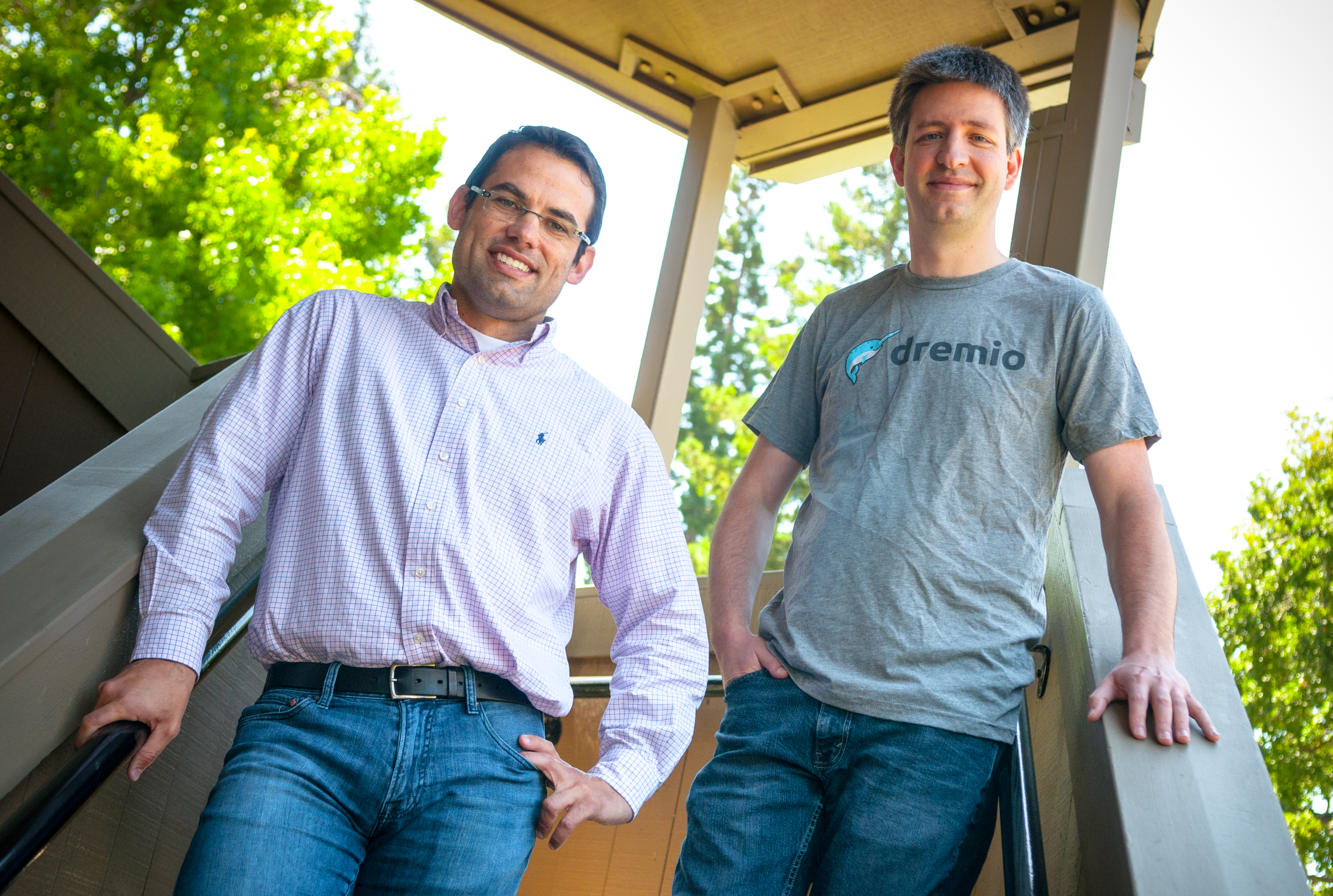
In the middle of 2015, Lightspeed and Redpoint co-led a $12 million Series A. Shiran already knew Lightspeed through MapR. He also checked references on a prospective investor. The person buying into the business would become someone he worked with; he treated that relationship as something to investigate.
The company then spent two years building its product and team. There was no instant procession from presentation to finished software. The first task was recruiting engineers. “We went one engineer at a time,” Shiran recalled. Meanwhile, he spent time with potential customers, including Intel and TransUnion, working on the problem of making data in modern systems accessible to their internal users.
“We went one engineer at a time.”
Tomer Shiran, on Dremio’s early team
That early customer work matters to the story. A founder can describe a world in which access becomes simple. A customer supplies the existing systems, internal habits, and awkward requirements that the description has to survive. Shiran’s work involved bringing those two worlds together before there was a mature sales organization to carry the conversation.
The product changed along the way. Shiran has described an early emphasis on SQL queries over NoSQL databases, followed by a decision to concentrate on cloud data lakes and self-service analytics. The change disappointed some early customers and forced engineers to discard work. Choosing simplicity for future users could make the present distinctly uncomfortable for the people building it.
Dremio publicly launched its self-service data platform on July 19, 2017. It began asking customers to pay that summer. Shiran recalled a handful of early customers, with annual spending ranging from $100,000 to $500,000. By 2018, the organization was adding the other parts a software business needs: marketing, an enterprise sales team, and support. The engineering project was acquiring the responsibilities of a company.
- 2009Joins MapR as employee five
- 2015Co-founds Dremio
- 2017Public product launch
- 2020Moves from CEO to product chief
- 2026Dremio joins SAP
The founder who sold the CEO job
In February 2020, Shiran made a different kind of announcement. Billy Bosworth would become Dremio’s CEO. Bosworth had joined its board the previous July. A series of weekends together, filling whiteboards, persuaded Shiran that he wanted him inside the company.
Recruiting him took some doing. Shiran joked that it had become one of Dremio’s longest sales cycles. A founder accustomed to persuading customers had found another substantial prospect: the person he wanted to take his own job.
By then, Dremio had more than 100 employees and offices across the United States, EMEA, and India. Shiran said annual recurring revenue had grown more than 3.5 times in the preceding year. The decision arrived during expansion, with more company to manage and more product to build.
His description of leadership is similarly concrete. He has said that when someone estimates a task will take two weeks, he challenges them to consider how it might be done in two days. He presents urgency alongside results and respect, acknowledging that speed can come at the expense of consideration for colleagues. The qualification gives a fuller picture of his working philosophy: the schedule matters, and so does the experience of the people expected to meet it.
He explained that becoming chief product officer would give him more time for his own passion: product strategy and execution, alongside work with strategic partners. There is something refreshingly practical about the choice. The reward for founding a business need not be spending every subsequent year doing exactly the same job.
A shared language for the lake
To understand the work he chose, imagine information kept in several different places. An analyst wants to ask a question using a familiar tool. A conventional approach may require engineers to prepare and copy data into another system first. Every additional destination creates work before the question gets its turn.
Dremio’s approach is to let people query across sources and work directly with data in the lake. Its architecture separates stored data from the computing used to analyze it. Open formats, including Apache Iceberg, help make that information usable by different engines. The ambition is to give a business more choice about which tools it uses and where its data lives.
The word self-service carries a complication in a large business. Information comes with permissions, and the same figure can mean different things to different departments. Giving more people access also requires ways to preserve the rules around it. At Dremio’s launch, Shiran explicitly coupled his access argument with governance and security. The product’s usefulness depended on accommodating those responsibilities. An analyst needed enough independence to explore, while the organization needed confidence that the exploration respected its controls. That tension helps explain why a seemingly simple request can occupy a product team for years.
Open source was already part of his professional circle. In an early technical talk, he described working with Nadeau and architect Julien Le Dem, co-creator of Apache Parquet. Such connections locate Dremio within a wider community of people developing ways for analytical systems to exchange and process information. The company’s product depended on a world larger than its own engineering team.
Shiran also became a technical author. With Jason Hughes and Alex Merced, he co-authored Apache Iceberg: The Definitive Guide, published by O’Reilly in 2024. The book covers the table format’s architecture, operations, and practical use. It is a fitting companion to a career spent explaining why the arrangement of data changes what people can do with it.
In 2024, he appeared on the other side of the microphone as host of Data Disruptors. Guests included Maersk’s Mark Sear, RWE’s Nick Plassmann, FactSet’s Greg Ruhnow, and Vanguard’s Sanjay Reddy. The conversations covered self-service, governance, and the work of making data useful inside large organizations. Those are the customers’ problems in their own vocabulary, with the organizational complications left in.
The question gets a new audience
On July 6, 2026, SAP completed its acquisition of Dremio. The deal brought Shiran’s company into a business whose software already sits inside many enterprises. Dremio’s current leadership page lists him as Founder, a short title following a succession of rather demanding longer ones.
The intended direction had been laid out that May in a post Shiran co-authored with CEO Sendur Sellakumar. They described enabling knowledge workers and autonomous agents to find, understand, and use enterprise data. They also described the importance of context: an agent needs to know what information means, as well as where to find it.
The audience for the product is expanding, but the underlying question remains recognizable. Someone wants an answer. The information exists. Between those two facts stand systems, definitions, permissions, and the time of other people. Making that interval shorter has occupied Shiran through several chapters of his career.
The homework anecdote survives all the changes in terminology because it sets an unusually plain expectation. His daughter had a question. She could ask it and keep going. For the adults at work, that modest convenience has required a great deal of engineering.
Keep the conversation going
- Dremio’s website · Shiran on LinkedIn · Twitter / X · GitHub
- Watch: Shiran in conversation with Maersk’s Mark Sear
- His account of the CEO handoff · The early-life and founding interview
- Apache Iceberg: The Definitive Guide · SAP’s acquisition announcement
- Shiran and Sellakumar on Dremio’s next chapter · More of Shiran’s writing