Tom Toomey put his accounting professor’s name on an endowed professorship. There are more economical ways to say thank you. A letter would have done. But Mary Ellen Phillips had helped him become a professional, and years later he could give another generation of students access to the kind of teaching that had mattered to him. It is a useful place to begin with an executive whose working life is usually measured in apartment homes, transactions and shareholder returns. Follow the money back toward Oregon State, and a different set of calculations comes into view: the value of a teacher, the cost of working through college, the opportunities a student misses when every hour is already spoken for.
The professor’s name on the door
Toomey grew up in Oregon, worked in agricultural fields as a teenager and became the first in his family to attend college. At Oregon State he worked at Fred Meyer while pursuing accounting. The subject was a choice he had made in high school. Paying for the opportunity to study it became part of the education.
“My college experience was always a financial fight.”
Tom Toomey, recalling his student years
Phillips taught intermediate accounting. Toomey remembered a demanding professor who took an interest in him and pushed him to improve. He graduated in 1982 and headed to Texas to work at Arthur Andersen. In 2007, the relationship acquired a permanent institutional address: the Mary Ellen Phillips Professor in Financial Accounting.
His subsequent giving spread across the machinery of a university. A $1 million commitment in 2010 divided support between a faculty endowment and construction of Austin Hall. The split is telling. Faculty need time and resources; students need places where the work can happen. A building dedication makes an agreeable photograph. Funding the people inside it gives the photograph something to live up to.
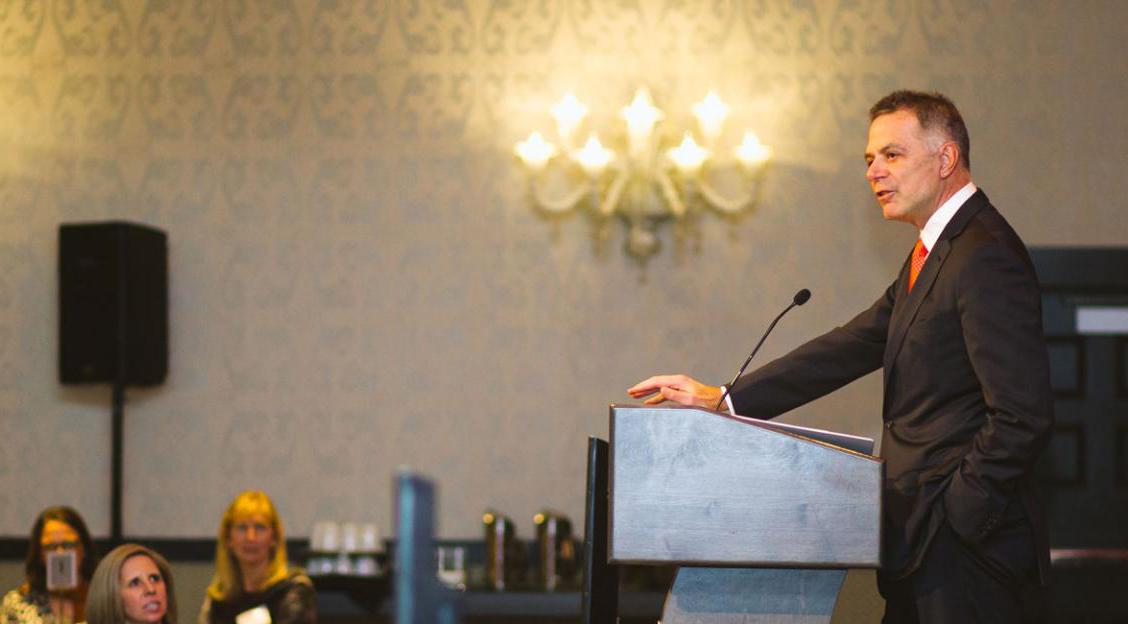
An accountant learns to change the holdings
Accounting was the beginning of a career that moved into both the financial and operating sides of property. Toomey spent five years as a senior vice president at Lincoln Property Company. At AIMCO, his jobs included chief financial officer and chief operating officer. The combination meant learning how the enterprise was financed and how it actually ran.
He joined UDR as president, chief executive and director in 2001. The company already existed; his task was to decide what it should become. That distinction matters in a business where an executive’s biography can start to resemble a list of acquisitions. Selling is part of the job, too. A portfolio carries yesterday’s decisions into tomorrow until somebody changes it.
In January 2018, Toomey became board chairman, succeeding James Klingbeil, who moved into the lead independent director position. The appointment formalized a longer relationship with the company. By then, Toomey had spent seventeen years directing UDR through changing markets. The board paired his combined leadership roles with a separate position for independent oversight.
A city inside an investment decision
By 2012, UDR’s direction was visible in its geography. The company was describing a shift away from suburban markets toward core urban locations, with New York, Washington, California and Dallas among its areas of attention. The underlying proposition was that the location and quality of the apartments deserved constant reconsideration.
That January, UDR and MetLife formed their second real estate joint venture. Each held half of a $1.3 billion portfolio of twelve operating communities containing more than 2,500 homes. The partnership acquired Columbus Square on Manhattan’s Upper West Side. An apartment business headquartered in suburban Colorado was buying into a very different daily life.
The investment was also a decision about the customer’s surroundings. A renter chooses a home and, with it, a route to work, a neighborhood and a collection of ordinary errands. The financial model has to accommodate that stubbornly physical reality. A convenient street does useful work before an apartment manager has answered the telephone.
Later that year, Toomey discussed UDR’s recent investments in Boston and New York and the scale of its preceding transformation. He spoke about a company well along in its repositioning while still having work ahead. Long tenures can be associated with settled habits. His public account of this one kept returning to adjustment.
The rent check goes digital
By 2010, UDR was building mobile apartment searches and expanding electronic rent payments. The period’s device list now has the charm of a museum drawer: iPhones alongside BlackBerrys and Palm Pre handsets. The renter’s desire to see an available home, check a price and make a decision has aged rather better.
There was an unromantic operating logic underneath. Less paper meant fewer checks to process. Mobile access let a prospective resident investigate an apartment without fitting the entire search into office hours. Technology entered the business through repeated tasks, the kind that become expensive when multiplied across thousands of homes.
In a 2010 leadership questionnaire, Toomey identified empowerment and accountability as his philosophy. He also reported reading two books at a time and listening to Tom Waits. A public-company executive may have a spreadsheet waiting on the desk; there is no obligation for the soundtrack to sound like one.
By the second-quarter 2025 earnings call, his discussion had moved to AI. He emphasized collecting data and learning from it, and the infrastructure UDR had put in place to do that. The vocabulary had changed, but the sequence was familiar: understand the work, assemble the information, then find a better way to perform the task. A useful tool still needs an organization capable of using it.
A local puzzle, shared around the world
Toomey’s industry work took him beyond UDR’s holdings. In June 2017, he began a two-year term as global chairman of the Urban Land Institute, becoming its first global chair to lead a public company. The role brought him into a network spanning the Americas, Europe and Asia Pacific.
“Real estate is an ever-evolving local puzzle.”
Tom Toomey, on taking the ULI global chair
His agenda included extending advisory services, connecting members through technology and making the organization’s knowledge more useful in daily work. He worked alongside regional chairs Patricia Healy, Jon Zehner and Seek Ngee Huat. It was a form of coordination: people in different cities could exchange experience without pretending that their cities were interchangeable.
When his term drew to a close in 2019, former global chair Randy Rowe described him as analytical and decisive, with a sense of humor. ULI’s chief executive, Ed Walter, recognized his leadership and financial support for its global strategic plan. Those were colleagues describing a volunteer leader, adding a different perspective to the corporate biography.
His comments about Hurricane Sandy offer a less abstract picture of adaptation. After the storm affected UDR, the company moved co-generating electrical equipment out of basements and first floors to roughly 100 feet in the air. The lesson required an actual change in elevation. In real estate, a debate about resilience can end with somebody having to move the machinery.
A gift with two clocks
In February 2020, Oregon State announced Toomey’s $1 million commitment to students’ basic needs, including emergency housing and food assistance. It established the university’s first endowed fund dedicated to that purpose. He also designated $50,000 for immediate help and to encourage other donors to contribute.
The arrangement used two clocks. An endowment could keep supporting students over time. Immediate assistance could reach someone before that longer process produced income. The university reported that more than 700 people joined him in giving during its Giving Tuesday effort.
It is an unusually concrete expression of what opportunity costs. Someone can gain admission, arrive ready to work and still struggle with the conditions required to stay. Paying attention in a classroom is easier when the night’s accommodation is settled. Toomey’s gift addressed that practical barrier. His earlier faculty and building commitments supported the institution; this one supported students’ ability to make use of it.
Still changing the ownership
Toomey’s responsibilities expanded again in September 2025, when UDR’s board appointed him president following Joe Fisher’s departure. In October 2026, the company announced that Blackstone executive Scott McCallum would join as chief investment officer on November 5, reporting to him. The investment team was changing as the portfolio continued to change.
On October 21, UDR and Apollo announced their intention to form a joint venture involving nineteen apartment communities, 7,059 homes and approximately $2 billion in property value. Apollo-managed funds and affiliates would invest $1.34 billion for about two-thirds ownership. UDR would retain one-third and continue operating the properties for a fee. Closing was expected October 29, subject to documentation and customary conditions.
That structure keeps ownership and operations in the same conversation. UDR would release capital while retaining a stake and the management work. Toomey identified access to equity as a strategic priority. The proposal belongs to the same long-running discussion of what UDR should hold, how it should fund itself and where its experience is useful.
The next day’s perspective is necessarily unfinished. UDR’s newly released third-quarter figures were preliminary, with final results scheduled for November 2. The partnership had been announced, rather than closed. After twenty-five years in the CEO job, Toomey was still working on the next arrangement. Back in Oregon, the professorship bearing his mentor’s name offered a quieter measure of duration: an investment designed to keep doing its work long after the original thank-you.