A software company can run out of engineering capacity before it runs out of customers. That is the awkward situation APOORVA has built a business around: a platform people still need, supported by code that nobody particularly wants to touch. The repair bill arrives just when the owner has the least room to pay it.
- Rebuild struggling SaaS platforms.
- Share future revenue.
- Or adopt specialized business tools.
In a February 2025 appearance on The Cyber Business Podcast, founder Nagesh Anupindi described how a customer crisis changed the commercial arrangement. A company needed development work and had no cash. APOORVA’s answer was to tie its compensation to revenue. A constraint became an offer: keep the business moving, rebuild the technology, share the proceeds.
The interesting part is the diagnosis. Anupindi discussed bad data, unsuitable development teams, and hosting choices that become difficult to scale. These are failures underneath a business, rather than proof that nobody wants its product. APOORVA sells the possibility of separating the two. That distinction is worth a founder’s attention before signing a purchase order for a complete replacement.
01The invoice moves into the future
APOORVA calls itself a technology-investment partner. Its published rescue offer promises no upfront costs through revenue sharing. The work can include rebuilding legacy applications, repairing architecture, integrating payments, and improving infrastructure. It addresses a peculiar customer: the SaaS operator whose commercial opportunity has outgrown the machinery serving it.
Consider the incentive. A conventional development engagement buys a defined amount of work. A revenue share creates an ongoing interest in the customer’s receipts. That can give both sides a reason to care about what happens after deployment. It also commits some future revenue to the relationship. Moving a bill into the future changes when a business pays; it does not make engineering free.
For a buyer, the useful comparison is total cost across several revenue scenarios. Define which revenue counts, the agreement’s duration, ownership of the rebuilt code, and the exit arrangements. Those are questions to settle in a contract, rather than assumptions to import from a slogan. A fast-growing business could eventually pay more through sharing than through a fixed development fee.
02A whiteboard, then the plumbing
Anupindi founded APOORVA in 2001. Its early work centered on data warehouses and web applications. The company describes a subsequent move toward SaaS rescue as clients encountered technical debt, limited resources, and scaling problems. This is an evolution from building systems to taking responsibility for systems that already have a history.
That history explains the breadth of the offering. APOORVA Cloud provides hosting and support; its cloud page describes load balancing, security controls, and infrastructure that can expand with demand. The company also develops software and embeds payments. The practical proposition is that an application’s code, hosting, and money flow can be examined together. Fixing one while ignoring the others may leave the original bottleneck intact.
The market position sits between a custom software shop and an owner of business applications. Buyers can commission engineering, discuss a rescue partnership, or adopt a named product. Those are different purchases. The common expertise is connecting the systems and workflows that an operating business has accumulated.
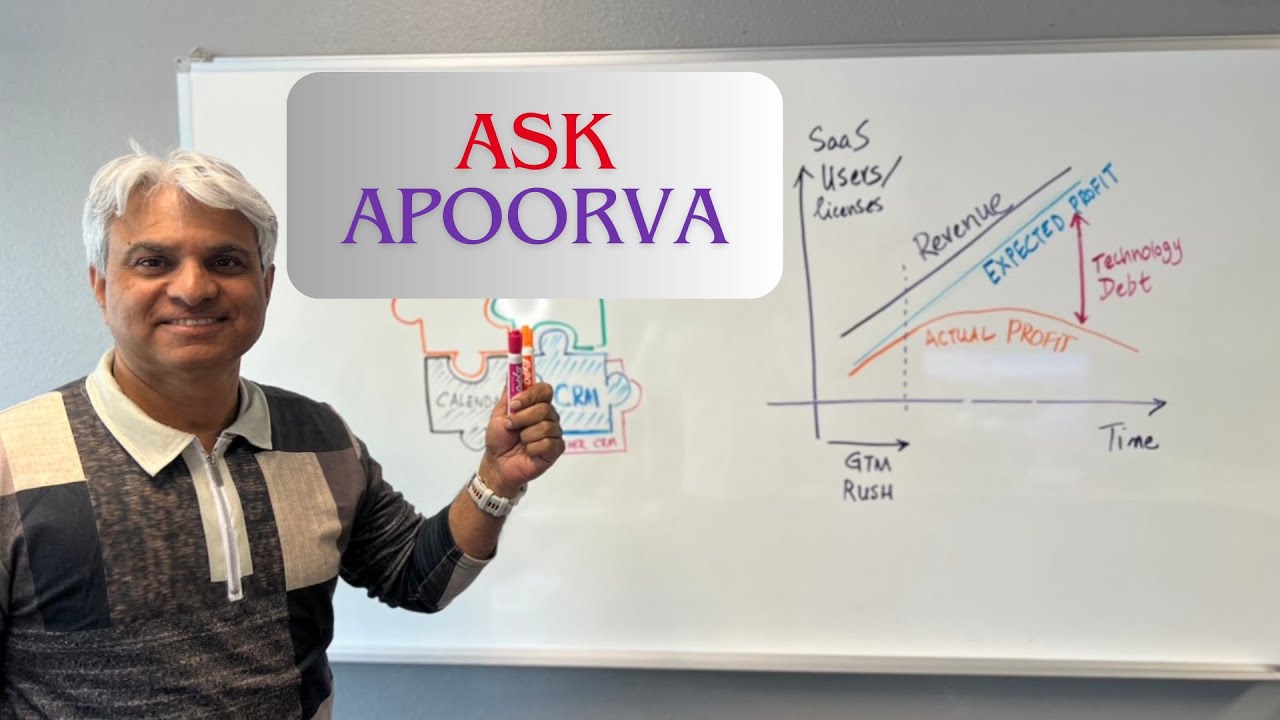 ▶ WATCH THE WHITEBOARD SESSION
03The clipboard has unfinished business
SiteWare makes the argument tangible. A facility inspection finds a problem. Someone records it. Then comes the dangerous interval: who assigns the repair, and who checks that it happened? The product connects audits, tasks, work orders, vendors, and asset records so an observation can become assigned work with a traceable resolution.
Its audience includes self-storage operators, property managers, and maintenance teams. On SiteWare’s website, USA Storage Centers operations director Brian Ward calls it an “operational hub and companion to your PMS.” The phrase matters. The product works alongside a property management system, handling operational follow-through that can otherwise disappear into spreadsheets and email.
SiteWare’s listed partners include 6Storage, QuikStor, Tenant Inc., and Storeganise. That places it within an existing industry software ecosystem. The problem it tackles is wonderfully unglamorous: a gate, a maintenance job, a missed handoff. Software earns its keep here when someone can tell whether the job got done.
“Think of it as an operational hub and companion to your PMS.”
BRIAN WARD / USA STORAGE CENTERS
Testimonial published by SiteWare
04From one dental office to many doors
On July 1, 2026, APOORVA announced the acquisition of the Maestro Platform customer base and the launch of MaxDrips. Maestro had served dental practices and franchise networks; the announcement named integrations with Denticon and the Freshcoat Painters network. APOORVA presented MaxDrips as a way to extend those communications capabilities across more kinds of multi-location businesses.
The current MaxDrips site describes a four-stage workflow: capture events from existing business software, sequence the follow-up, deliver texts or emails, and report results. An appointment reminder and a storage-payment nudge have different wording, but a similar mechanism. Headquarters supplies consistent sequences; locations adjust details such as hours and contact information.
MaxDrips advertises a starting price of $19 per month per location, with final pricing depending on industry, location count, and channels. That is product pricing, separate from a negotiated software rescue. It gives a prospective customer something concrete to compare with the staff time spent chasing the same follow-ups every week.
- 01CaptureRead the event
- 02SequencePlan the follow-up
- 03DeliverSend text or email
- 04ReportReview the result
05Follow the work. Follow the money.
Other products extend the pattern. Invento is a policy administration system for insurers, managing work such as issuance, endorsements, renewals, and billing. In June 2024, Apoorva Insurance joined the AAIS Partner Program, with a stated focus on helping carriers and managing general agents improve processes and migrate to AAIS programs. Insurance is a specific practice within the business, with its own data and workflow requirements.
BillWare brings merchant onboarding, invoicing, and online payment collection together. Its public terms identify it as a trade name of Apoorva Corporation. A partnership announced by airSlate SignNow describes turning completed agreements into invoices, including recurring invoices, with selected options mapped to products. The appeal is easy to understand: stop typing the deal into a second system after the customer signs it.
The lesson a reader can copy is to inspect the handoff before buying another dashboard. Find the point where information gets retyped, a task loses its owner, or an aging platform blocks work customers already value. Then choose between an integration, a product, and a rebuild. Revenue sharing is most plausible when there is a business worth sustaining and revenue worth sharing. If the underlying problem is absent demand, repaired software alone will not supply it.
Open a few more doors
Explore APOORVA.