Before Owen Thomas had office towers to worry about, he had fences to fix. He grew up on a working dairy farm near Staunton, Virginia, and helped in his father’s property brokerage. His teenage introduction to real estate involved courthouse records: buyers, sellers, mortgages. At 18, he obtained a Virginia real estate license. The buildings became taller later. The business already had his attention.
That beginning offers a useful way into a career usually described through institutions: Morgan Stanley, Lehman Brothers, Boston Properties, now BXP. Thomas has worked on the investment side of property and on the side responsible for what happens after the money arrives. In between are an engineering degree, a spell at Texas Instruments and an MBA. His route to the corner office included a fairly early discovery that engineering employment did not suit him.
Today, as BXP’s chairman and chief executive, he faces a question that would have sounded peculiar when he earned that license: what must an office offer to persuade people to use it? A lease can bind a company for years. Getting its employees through the door is a separate achievement. Thomas’s answer puts the journey, the building and the daily experience into the same calculation.
A useful wrong turn
Thomas graduated from the University of Virginia’s engineering school in 1983. He subsequently attended Harvard Business School from 1985 to 1987. His experience at Texas Instruments sits between the farm and the finance career, an interval that makes the polished résumé more interesting. Discovering a mismatch is an education with a salary attached, though it rarely feels quite so convenient at the time.
He has spoken about the value of trying a job and learning from it even when it fails to fit. That is sensible advice from someone whose eventual occupation combined several disciplines. Property demands calculations, certainly, but also negotiation, judgment about places and an understanding of the organizations that occupy them. A technically trained graduate can carry useful habits into a different profession without carrying the original job title.
He joined Morgan Stanley in 1987 and stayed for 24 years. The assignments grew to include leadership of its real estate business, the presidency of its investment management business and the chief executive role at Morgan Stanley Asia. From 2008 to 2011 he lived in Hong Kong, also serving as chairman of Mitsubishi UFJ Morgan Stanley Securities. Geography became part of his professional education alongside finance.
- 1983UVA engineering graduate
- 1987Joins Morgan Stanley
- 2012Chairs Lehman’s successor board
- 2013Becomes BXP chief executive
Learning what remains after a deal
Lehman Brothers brought a different kind of assignment. Thomas became chairman of its successor company in 2012, several years after the investment bank’s collapse. That chronology matters: he was helping handle the aftermath. One major piece of work was the sale of Archstone Enterprise to Equity Residential and AvalonBay Communities for $15 billion. His Lehman board service ultimately continued through December 2025.
There is an unglamorous side to that work which makes it revealing. Buying an asset permits a persuasive story about its future. Resolving an estate requires attention to the claims, obligations and ownership structures already in existence. The task offers fewer opportunities for grand architectural gestures. It does, however, give a property executive considerable practice in finding a path through complicated arrangements.
The next move brought him into a company that developed, leased and managed its own buildings. When Thomas became Boston Properties’ CEO in April 2013, he inherited an operating organization as well as an investment portfolio. Choosing a building and running it are connected skills, but the second keeps issuing fresh assignments. The transaction closes. The tenant’s requirements continue.
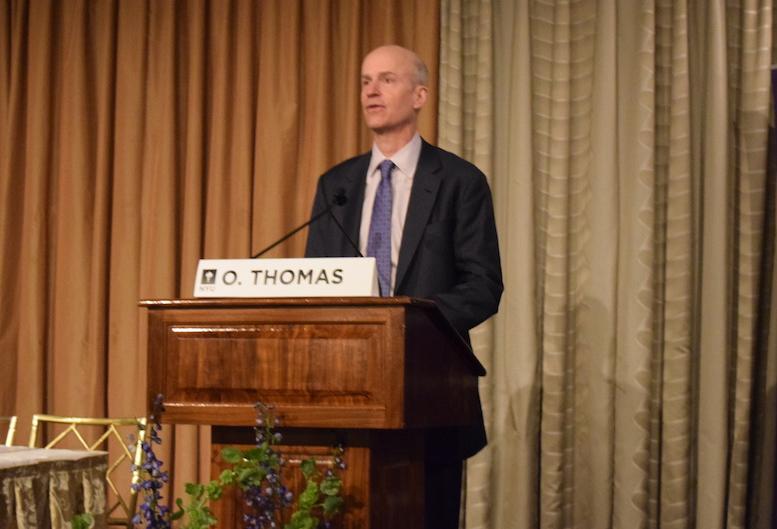
The delicate art of following a founder
Thomas succeeded Mort Zuckerman, who had built Boston Properties with Edward Linde. Joining from outside a company with a long-tenured team made the appointment unusual. There is an obvious temptation in such a job: arrive with a conspicuous new direction so that everyone can see the appointment has made a difference. Thomas described a more patient opening, learning the people and the business before making refinements.
His explanation of the succession contained a useful admission: “I wasn’t going to be Mort Zuckerman.” A founder’s history cannot be acquired with the office keys. Thomas had his own background in capital allocation and institutional management. The practical question was how to put it to work inside a company with an established culture and development expertise.
“I wasn’t going to be Mort Zuckerman.”
Owen Thomas, reflecting on the succession
Douglas Linde, the company’s president and Edward Linde’s son, remained central to the business. Thomas described their delegated capital decisions as joint decisions. It is a detail worth keeping in view when considering a chief executive’s influence. Large property companies operate through teams whose knowledge is accumulated building by building. Continuity can be a commercial resource, as tangible in its way as a well-positioned site.
The commute enters the balance sheet
Thomas’s recent account of tenant preferences begins before anyone reaches the lobby. Access to transport has become an important consideration for employers trying to bring people together. Shared meeting rooms matter too: companies want the ability to convene people without permanently leasing every room they might occasionally need. The office proposition extends from the train platform to the conference table.
For a landlord, those preferences create decisions about where to invest and what to provide. BXP has been adding conference facilities, clubs and food offerings to urban properties. It has also pursued residential entitlements for suitable suburban sites. The distinction makes the strategy more specific than a general expression of faith in offices. Some locations justify further office investment. Other land can serve a different use.
Thomas had already been talking about changes in the tenant base at a 2017 real estate symposium, pointing to technology companies and demand for mixed-use places. At that time he also emphasized holding urban property over long periods and bringing in partners through partial ownership sales. His approach allowed the company to retain a role in buildings while releasing capital. An office tower can have more than one financial life without changing its address.
A test taking shape beside Grand Central
At 343 Madison Avenue, the argument has a construction schedule. The planned tower sits beside Grand Central Terminal, with direct access to Grand Central Madison. As of October 14, 2026, BXP described a roughly 930,000-square-foot, 46-story development costing approximately $2 billion. Completion was expected in the third quarter of 2029. About 56 percent was pre-leased, including commitments from Starr and McDermott Will & Schulte.
That month BXP sold a 10.6 percent equity interest in the project to AVRS Partners. It retained decision-making authority and its development, leasing and property management roles. The arrangement links the investor and operator sides of Thomas’s career: share the required equity while continuing to run the work. A $1.2 billion construction loan had closed in July. The tower is a physical project with a carefully assembled financial structure.
The wider company’s figures offer a less photogenic but necessary test. During the second quarter of 2026, BXP signed approximately 1.8 million square feet of leases. Revenue rose to $895.7 million from $868.5 million a year earlier, while net income attributable to BXP fell to $68.6 million from $89 million. Leasing momentum and accounting profit can move in different directions. A handsome rendering settles neither question.
Beyond the property line
Buildings also give Thomas a route into questions that extend beyond an individual lease. As Urban Land Institute global chair from 2019 to 2021, his priorities included connecting its regions and supporting education and sustainable development. A donation from Thomas helped launch ULI’s Net Zero Imperative, a program providing practical assistance for reducing emissions from buildings. It takes an industry concern into the slower work of changing existing places.
His educational connections have continued as well. He chairs the trustees of Woodberry Forest, the school he attended, and serves on the advisory board of UVA’s real estate center. In 2023, he hosted a university alumni gathering at the GM Building’s Savoy Club. The program paired his account of the building’s history with a presentation on reinventing cement. Property history and material science made surprisingly compatible dinner companions.
All Stars Project honored him in 2025, describing a decade of BXP support that included donations, office events and employee volunteering for youth development. In July 2026, he began a three-year term chairing the Real Estate Roundtable. That position adds national policy work to his company responsibilities, bringing him into debates over investment, development and how communities use space.
Room for the next chapter
BXP’s board extended Thomas’s employment agreement through December 31, 2029, aligning his tenure with its multi-year strategic plan. The date also puts him on a similar horizon to the expected completion of 343 Madison. Such plans give an executive time to execute, and investors a period over which to judge the result. They leave plenty of room for events to interfere.
Away from work, Thomas has described distance running and completing the Adirondack 46er challenge. Asked about a vice in a 2020 interview, he named Graeter’s ice cream. Neither detail explains a leasing strategy, but both restore some scale to a life otherwise measured in square feet. Even someone responsible for towers can have an entirely ordinary weakness at the freezer.
The farm, the engineering job, the years in Asia and the succession at BXP resist a tidy career formula. What connects them is repeated exposure to the practical demands beneath an impressive title. At BXP, the next judgment will arrive through signed leases, completed projects and the everyday experience of the people inside them. The office still has to earn its place in their day.
Keep the conversation going
- Watch: Thomas on No Cap, with Jack Stone and Alex Gornik ↗
- Watch: Transit access and the changing workplace ↗
- The October 2026 update on 343 Madison Avenue ↗
- Thomas’s new role at the Real Estate Roundtable ↗
- The Closing: a conversation about career and life ↗
- Thomas on joining Boston Properties, 2014 ↗
- ULI’s Net Zero Imperative ↗
- The All Stars Project’s 2025 gala honoree ↗
- BXP’s second-quarter 2026 results ↗