Tom Itin had a plain answer to a fashionable question. As the internet began changing industrial sales, customers could go online and configure parts themselves. Would the people who sold those parts still earn commissions? For an executive running a controls manufacturer, this was a question about the machinery of business as much as the machinery in a truck.
He said the commissions would continue and credited the sales representatives with keeping the company in business. The website could help the customer specify a component. Someone still had to win the order and look after the customer afterward. A shopping interface was useful; it had yet to master the follow-up call.
That exchange offers a useful entrance to a career whose company names can otherwise overwhelm the reader. Williams Controls. Roadmaster. Ajay Sports. LBO Capital. TWI International. Across them, Itin’s work has included acquisitions, corporate development, financing and operating responsibilities. He has dealt with products that require factories, distribution, customers and money, often all at once.
His story is best approached through those connections. A technology can be technically persuasive and commercially stranded. An established business can have a useful product and an awkward balance sheet. Itin’s professional territory has repeatedly been the space between what a business can make and what it takes to make that business work.
“Without our sales reps, we wouldn’t be in business.”
Tom Itin, on industrial sales
Night school, then North Africa
Before those companies came Cornell. Thomas William Itin earned his bachelor’s degree in industrial and labor relations in 1957. He also played football: Cornell’s letterwinner record lists him as a center, number 54, for the 1955 and 1956 seasons, with Newtown, Ohio, as his hometown. The position belongs in the biography without being turned into a theory of leadership. Sometimes a center is simply a center.
The degree’s subject is more immediately relevant. Industrial and labor relations concerns the people inside organizations, a useful starting point for someone whose later work would involve buying, funding and managing them. An enterprise comes with employees and obligations as well as equipment. Those obligations do not disappear when ownership changes.
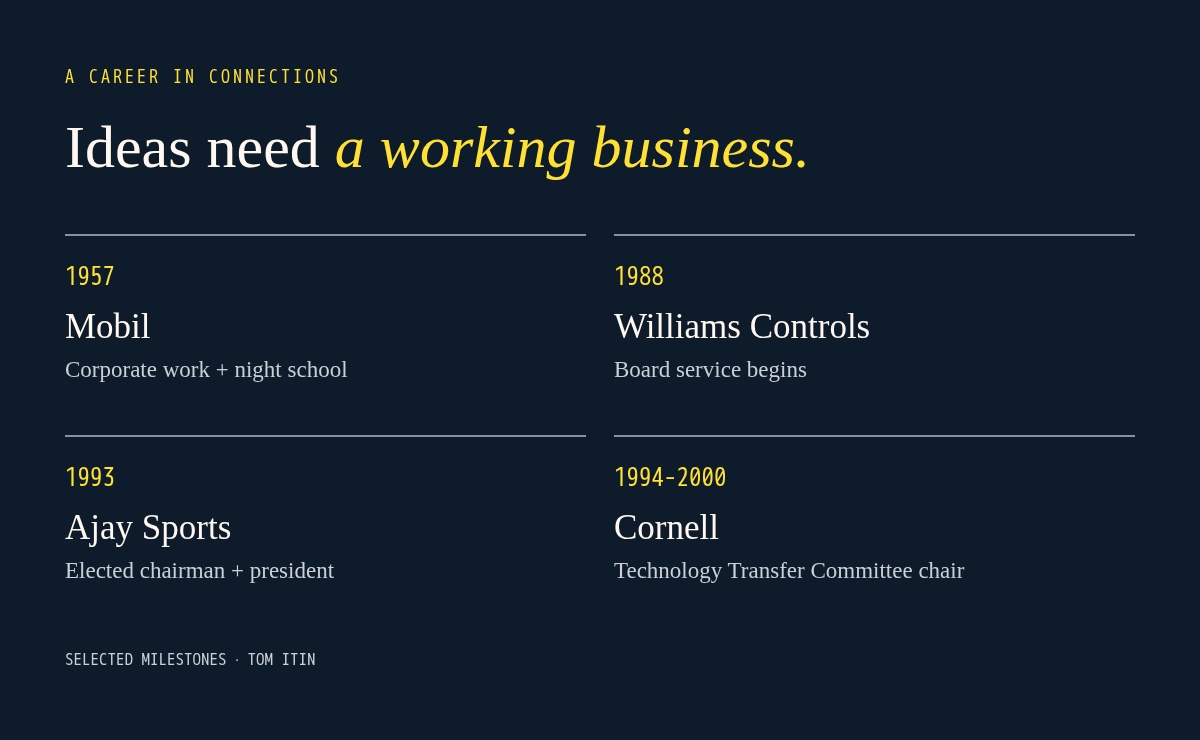
After Cornell, Itin worked at Mobil in New York while attending New York University’s business school at night. He earned an MBA in 1959. His own professional profile describes studying business management under Peter Drucker while fully employed. It is a compact picture of an early career: a corporate job in the daytime, management study after it.
He went on to postgraduate work, but an overseas assignment intervened. Mobil transferred him to Tripoli, Libya. His career included employee-relations work in Europe and North Africa, and teaching economics and business at the University of Maryland’s North African branch between 1960 and 1962. The move gave his working life an international dimension before he began assembling his own ventures.
There is a temptation to describe every interrupted doctorate as a grand rejection of the classroom. Here, the practical detail is more interesting. An employer offered a foreign position; Itin took it. Work redirected the education rather than waiting politely for the education to end.
Buying into the working world
Itin left Mobil for private ventures after roughly five years. His subsequent businesses included insurance, consulting and international trade. He was among the founders of Alexander Hamilton Life Insurance Company in Michigan. TWI International became another vehicle for his entrepreneurial work. The variety arrived early, well before the later public-company roles.
By the late 1980s, acquisitions were central to the story. Itin acquired Williams Controls from Dana, and his Williams board service began in November 1988. The more precise executive dates place him as chairman and CEO from March 1989 through January 2001, with the president and treasurer roles added in June 1993. Several titles, one desk’s worth of responsibility.
Williams put him in industrial controls. Roadmaster brought a different set of products and relationships; he was a co-founder and board member. Ajay, which he acquired from Fuqua for Roadmaster in 1988, took the career further into sporting goods and leisure. These were businesses with operating histories, rather than ideas awaiting their first customer.
The distinction matters. Acquiring an existing company means entering a structure already occupied by other people’s decisions. Customers expect deliveries. Employees expect wages. Lenders expect repayment. An acquisition announcement can fit in a paragraph; the work it sets in motion rarely does.
Itin’s responsibilities also reached beyond manufacturers. His corporate-development work included funding the development and construction of Michigan International Speedway and Windsor Raceway in Canada. A truck component and a racetrack offer very different sights and sounds. Both, however, have to become financeable projects before anyone can use them.
The golf business had rough ground
At Ajay Sports, Itin was elected chairman and president in June 1993. The company’s golf interests included Pro Golf of America and an online business. By 2004, the portfolio put a retail franchise operation and e-commerce under the same corporate umbrella. The internet was part of the selling system, just as it had been in the earlier conversation about industrial sales.
In May 2004, he also assumed interim chief operating officer responsibilities while the company accelerated its search to replace an outgoing executive. It is a small but revealing career detail. Corporate development can sound comfortably removed from everyday operations. An interim operating assignment brings the work back to the business that has to open, trade and pay its bills.
This chapter included a serious employment dispute. Former finance executive Ronald Silberstein challenged his January 2004 dismissal. The corporate defendants argued that performance and workforce reductions justified the termination. Silberstein alleged that he had been dismissed for refusing unlawful accounting entries.
A jury found in Silberstein’s favor, and the Michigan Court of Appeals affirmed the judgment in April 2008. Itin had originally been named individually but was dismissed from the case. That distinction matters, as does the outcome against the companies. A profile of the executive should keep both in view.
Itin testified that the Ajay companies had suffered financially from 1999 to 2003. The episode gives this part of the career a harder outline than a list of chairmanships provides. Operating a collection of businesses involves decisions about money and people, with consequences that can travel well beyond the boardroom.
A patent needs somewhere to go
LBO Capital extended the career into intellectual property and technology development. Founded in 1987, the Michigan company described a strategy of acquiring technologies and pursuing commercialization through licensing, spin-offs, mergers or buyouts. The product could be a process or a patent rather than a finished object on a shop shelf.
Its 2008 activity included Global Tech International, a development-stage subsidiary working on plastics-related intellectual property. Powder Impression Molding was one of the systems described, alongside a surface-acoustic-wave tire sensor intended to monitor pressure. These are concrete examples of the technical terrain around Itin’s financing and development work.
The financial scale deserves to stay attached to its date. LBO reported $5,000 in revenue for 2008 and a working-capital deficit of about $2.08 million at year-end. The technologies were in development; commercial ambition and an established revenue stream were different things. A patent does not settle the electricity bill by virtue of being a patent.
The same distinction helps explain his Cornell involvement. Itin chaired the university council’s Technology Transfer Committee from 1994 to 2000 and served on the Cornell Research Foundation board from 1996 to 2000. Technology transfer concerns how research finds a route into use, often through licensing and commercial partnerships.
That creates a direct connection between his university service and his business interests. In both settings, technical work must meet an organization able to develop it, pay for it and find customers. The necessary conversations cross professional boundaries. A scientist, a manufacturer and a financier can look at the same invention and ask three perfectly reasonable, entirely different questions.
The people who remain in the story
The companies changed, but Cornell remained. Itin’s connection to the university stretches from the football field and the ILR degree through council work, research commercialization and alumni life. In a 2014 alumni note, his opening update was just two words: “Still working.” It was an economical answer to a question that often invites a great deal of retirement philosophy.
Sport continued beyond his college years. He co-founded Ski Racing Patrons of Michigan, which supported better coaching, training and participation in sanctioned events for young alpine racers. He also served on the Orchard Lake Village city council in 1975 and 1976. These activities placed him in local institutions alongside his international business work.
His recollections give those affiliations a more personal texture. In a 2023 message to the Gribbs family, he recalled skiing with them in the 1960s at Timberlee Hills near Traverse City. In September 2025, a message signed by Tom and Shirley Itin remembered meeting writer Edward Jay Epstein in Cornell’s dorm 9 in 1953 and remaining friends afterward.
Those details are quieter than acquisitions, and they deserve their place. A residence hall, a ski hill, an alumni note: each records a connection that survived long enough to be recalled decades later. The business biography is full of companies. The personal history also has people who kept appearing in it.
In 2021, Itin received the Albert Nelson Marquis Lifetime Achievement Award from Marquis Who’s Who. Yet the phrase from his alumni update is the livelier ending. “Still working” leaves the verb in motion. Through night school, overseas assignments, operating companies and technology development, Tom Itin’s career has repeatedly returned to the practical question he answered about salespeople: who will help the business happen?
Follow the connections
Explore the interviews, company history and university connections behind this career.
- Tom Itin on LinkedIn
- LBO Capital company profile
- Ajay Sports interview
- The industrial-sales conversation
- Cornell football letterwinners
- LBO Capital historical leadership filing
- LBO Capital 2008 business and financial record
- Ajay-related employment appeal
- The 2014 alumni update
- Lifetime achievement award announcement