In February 2023, Todd Huffman announced that a laboratory was up and running. The team had been recruited. Equipment was producing data. A facility that had been near the end of construction had become a functioning place to do science. For a founder, this would ordinarily be an occasion to settle more comfortably into the chief executive’s chair. Huffman used the announcement to explain why he was leaving it.
He called his position at E11 Bio the “starter/mentor CEO” role. Andrew Payne, his co-founder, would take over. Huffman would remain a senior adviser and turn toward longer-term planning. There was pride in his account, particularly in the scientists they had brought together. There was also a clear boundary around the assignment: help get the organization started, then let the person who would lead its next phase lead it.
That small piece of organizational housekeeping is a useful entrance to an unusually varied career. Huffman has helped organize a conference with an open invitation, worked on communications projects in Afghanistan, and co-founded 3Scan, the imaging business that combined with Transcriptic to form Strateos. Across those settings, the interesting question is often who gets to participate once the equipment, room, or institution exists.
A résumé sorts those activities into separate boxes. The more revealing arrangement puts them beside one another. A conference needs a way for people to contribute. Field communications need connections people can actually use. A scientific instrument needs an organization capable of sustaining its development. The work changes scale; the practical problem of making participation possible keeps returning.
The E11 handoff / 2023
A lab ready for its next leader
- 1Build the teamHuffman and Payne recruit scientists
- 2Get it runningFacilities and equipment in operation
- 3Pass the chairPayne becomes CEO; Huffman advises
02 / BIL, TED, and a very serious beard competition
The conference began with a rather less solemn proposition. In late 2007, Cody Marx Bailey suggested to Huffman and Bill Erickson that they go to Monterey and crash the social scene around TED. Their prospective expedition grew from a handful of people to nearly thirty. At that point, holding an event of their own began to make sense. An unofficial gathering was acquiring the inconvenient dimensions of a real one.
Huffman and Reichart Von Wolfsheild proposed the name BIL. The reference to Bill & Ted’s Excellent Adventure supplied a joke before anybody had stepped up to a microphone. Planning happened through a public wiki, allowing interested people to help. When the first gathering arrived in March 2008, at Monterey’s El Estero Park Complex, a casual idea had become a date, a venue, and a roomful of participants.
The first program had the range one might expect from people who had declined to wait for an invitation. There were talks about airships, philosophy, photography, open source journalism, social networks, and the future of transit. Huffman was both an organizer and a speaker. On the page, those subjects can look like an unruly contents list. In a room, they create opportunities for people who would otherwise attend different conferences to meet.
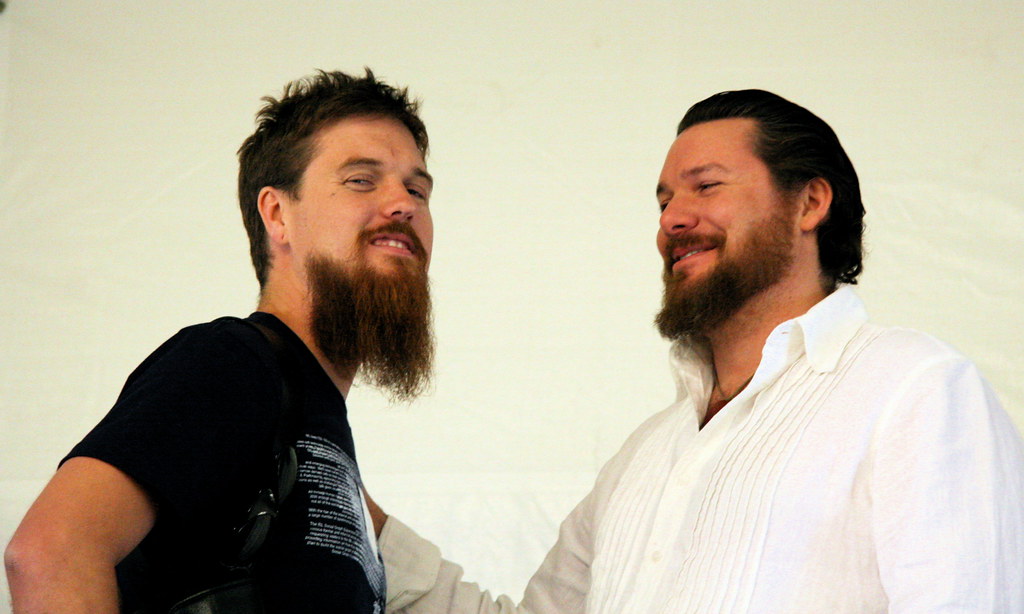
A photograph from that weekend records Huffman and Von Wolfsheild conducting a beard off. Both appear to be enjoying the gravity of the contest. It is a small, useful corrective to the solemnity that often settles over gatherings about the future. People were there to exchange ideas; they were also quite capable of looking ridiculous together. The whiskers required no explanatory slide.
03 / A connection has to reach somebody
By April 2010, Huffman was giving a San Francisco talk titled The Front Lines of Geek Imperialism. The deliberately awkward title put a question inside the enthusiasm: what happens when technologists take their ideas and methods into other communities? His description asked whether geeks could help build a kinder world. It was a question about influence as much as invention, presented by someone whose work ranged across communications, mobile technology, and the developing world.
In Jalalabad, he was part of the circle known as the Synergy Strike Force. Afghan students helped develop a local wireless network using point-to-point antennas and ordinary routers. Huffman described students replacing laser-cut fabrication with dishes made from tin cans and other available materials. The detail matters because the ingenuity belonged to local participants, too. It would be misleading to turn a network assembled by many hands into a visiting American’s solo achievement.
A 2011 photograph provides another view of that work: children around Huffman as he demonstrates an internet-connected computer from the One Laptop Per Child program. The picture is modest in scale. There is a person, a machine, and a group trying to use it. For all the language that surrounds connectivity, that encounter is where a network acquires a purpose.
The fieldwork also involved the less photogenic business of moving information between systems. A 2009 Camp Roberts exercise report describes Huffman preparing to take GeoChat to Afghanistan for election exit-poll reporting. GeoChat used text messages to move field observations into a shared geographic view. The report’s account of the exercise included both quick solutions and stubborn technical problems. That is a more useful picture of deployment than a frictionless demonstration: tools have to function amid the conditions people already inhabit.
04 / The instrument needed a company
Huffman’s scientific training gave him another route into that problem. He earned a bachelor’s degree in neuroscience at California State University, Long Beach, and a master’s in computational biosciences at Arizona State University. His education also included entrepreneurship and innovation studies at Nanyang Technological University in Singapore. Computation, experiments, and the practical machinery of an organization were all within his field of view.
He had worked with Bruce McCormick, who pioneered knife-edge scanning microscopy. By 2005, Huffman was working with the technology that would underpin 3Scan. After McCormick’s death, he worried that its development would stall. The origin story is unusually concrete: an instrument had promise, and continuing the work required a durable home for it. Founding a company became a way to keep the project moving.
In 2011, Huffman co-founded 3Scan with Megan Klimen, Matthew Goodman, and Cody Daniel. He served as CEO. The San Francisco team combined robotic microscopy with software that could turn successive images into detailed digital representations. In practical terms, the machine and the computation belonged to one workflow. Capturing an image was one step; arranging and interpreting the resulting data were others.
The distinction is easy to miss when an invention has a memorable piece of hardware. The microscope attracts attention. The workflow determines what people can do with its output. Engineers, scientists, and data specialists therefore had to work on a connected process. Huffman’s company occupied the space between an experimental technique and something other researchers could repeatedly use. That space contains a good deal of unglamorous work, which is one reason it deserves attention.
A technique finds a home
Huffman is working with the technology behind 3Scan.
3Scan is founded. Huffman, Klimen, Goodman, and Daniel build the company.
Strateos takes shape. 3Scan and Transcriptic announce their combination.
05 / Two companies, one next chapter
On June 3, 2019, Transcriptic and 3Scan announced their combination under the name Strateos. Transcriptic brought a robotic cloud laboratory platform; 3Scan brought automated imaging, computer vision, and spatial analysis. The announcement also named Mark Fischer-Colbrie president and CEO. Huffman’s place in the company’s history is as a founder and former CEO of predecessor 3Scan.
The combination connected two approaches to organizing scientific work. One let researchers access laboratory processes remotely. The other made physical structures available as digital data. Their merger placed those capabilities in the same business. The financing announcement included an additional $16.5 million from investors including DCVC and Lux Capital, with support from Dolby Family Ventures. That figure belongs to the combined company’s financing, rather than to Huffman personally.
It is tempting to make the merger the natural ending of the story. Founder builds company; company reaches transaction; curtain. Huffman’s subsequent work makes that ending feel premature. There were other laboratories to establish and other arrangements for research to try. The corporate milestone matters, but it sits within a longer sequence of projects rather than neatly closing it.
06 / Building the conditions for somebody else’s work
E11 Bio was established in 2021 as a focused research organization. Its home in the Convergent Research ecosystem gave it a different institutional arrangement from a conventional venture-backed startup. Huffman helped found it with Payne and other colleagues. The organization’s work required a scientific team, instruments, facilities, and coordination across specialties. The familiar founder task returned: make a place where a difficult project can proceed.
His 2023 handoff is especially revealing against that background. In his own account, recruiting the team and bringing the laboratory into operation were central accomplishments. Payne’s move into the CEO position was part of the transition Huffman described, and he stayed involved as a senior adviser. Leaving the chair did not require leaving the undertaking. It allowed his contribution to change as the organization changed.
“An agile mind with a thirst for experiment and challenge.”
PETE MOORE / LINKEDIN RECOMMENDATION
Colleague Pete Moore offered a compact description of him. It fits the public record’s range, from conference logistics to laboratory systems. The record also suggests that restlessness can have an operational expression. Sometimes it produces another question; sometimes it produces the room, equipment, and team with which other people can investigate one.
At Episteme, a later chapter gives that operational interest an unusually direct title: Head of Rapid Execution. A December 2025 gathering during NeurIPS introduced him in that role alongside founding program manager Hiro Rose. Episteme, founded by Louis Andre and Sam Altman, describes an in-house research environment supported by funding, infrastructure, and operations. Its stated ambitions belong to the organization; Huffman’s advertised assignment concerns the work of getting things moving.
The continuity with the earlier projects is appealing without requiring a grand theory of his personality. A wiki let people help build BIL. Field tools moved observations between people and maps. A company gave an imaging technique a continuing home. A laboratory needed people hired and equipment working. These are tangible contributions, each with a different setting and a different group of collaborators.
The beard off remains a welcome image to carry through all of this. Here is someone whose career involves expensive instruments and serious organizational questions, caught enjoying an exceedingly low-cost competition. The same biography has room for a public wiki and a robotic microscope, for a founder’s authority and a planned handoff. In that February announcement, success had a practical shape: the lab was working, another leader was ready, and Huffman could take up a different part of the job.
Keep the conversation going
- Todd Huffman on LinkedIn
- Todd Huffman on X
- His photographs on Flickr
- Episteme: the research organization
- How BIL began
- Huffman’s E11 Bio leadership announcement
- Watch: Todd Huffman at BIL in Long Beach
- Watch: Huffman’s 2023 Foresight workshop talk
- Further reading: Jalalabad’s wireless network
- The Strateos company story