In 1961, a chemist at Dow Chemical asked Jim Waters for something smaller. His detector used a one-milliliter flow cell. Dow wanted one-tenth of that volume. Waters argued for what he already sold, then reconsidered when Dow offered to fund the work. It is an excellent opening to a business story: the customer understood something the supplier had yet to see.
- Waters helps labs separate, identify and measure what is in a sample.
- The business includes chemistry, software and maintenance alongside machines.
- A February 2026 deal added biosciences and diagnostic testing.
That request helped open a market in polymer analysis. Today, Waters sells the tools behind pharmaceutical quality checks, contaminant testing and biological research. Its expertise spans chemistry, physics and, increasingly, biology. The interesting question is how a company makes a sophisticated measurement useful enough to become somebody else’s daily routine.
First, fix the thing that drifts.
Waters began in 1958 beneath a police station in Framingham, Massachusetts. An early liquid chromatography design licensed from Shell had a refractive-index detector that drifted. Waters changed to ultraviolet detection and different column packings; the ALC 100 followed in 1967. The early Dow technology license cost $10,000 plus a 10 percent royalty. Progress involved listening, paying for access and changing an approach that failed.
“We believe LC can become a mass market”
James Waters, 1965 internal document
Liquid chromatography separates the ingredients in a mixture as they travel through a column. Different compounds emerge at different times. A detector turns that separation into information; a mass spectrometer adds measurements based on ions’ mass-to-charge ratios. Scientists can investigate identity, impurities and quantity. For a medicine manufacturer, those answers help determine whether a batch meets its specifications.
- 01PrepareMake the sample ready
- 02SeparateResolve the mixture
- 03MeasureDetect and quantify
- 04RecordKeep the evidence
The missing molecule might be inside the machine.
Consider an awkward possibility: a substance is present, but some sticks to metal surfaces before reaching the detector. Waters documents this problem with metal-sensitive compounds, including phosphorylated peptides. The result can be a distorted peak, reduced recovery or poor reproducibility. Buying a more sensitive detector does not, by itself, remove that upstream loss.
ACQUITY Premier addresses the surfaces the sample encounters. Its MaxPeak technology uses a barrier designed to reduce unwanted adsorption. The benefit depends on the compound and method; this is a targeted engineering answer to a particular problem. It is also a useful purchasing lesson. Ask where the sample disappears before asking which machine has the biggest specification.
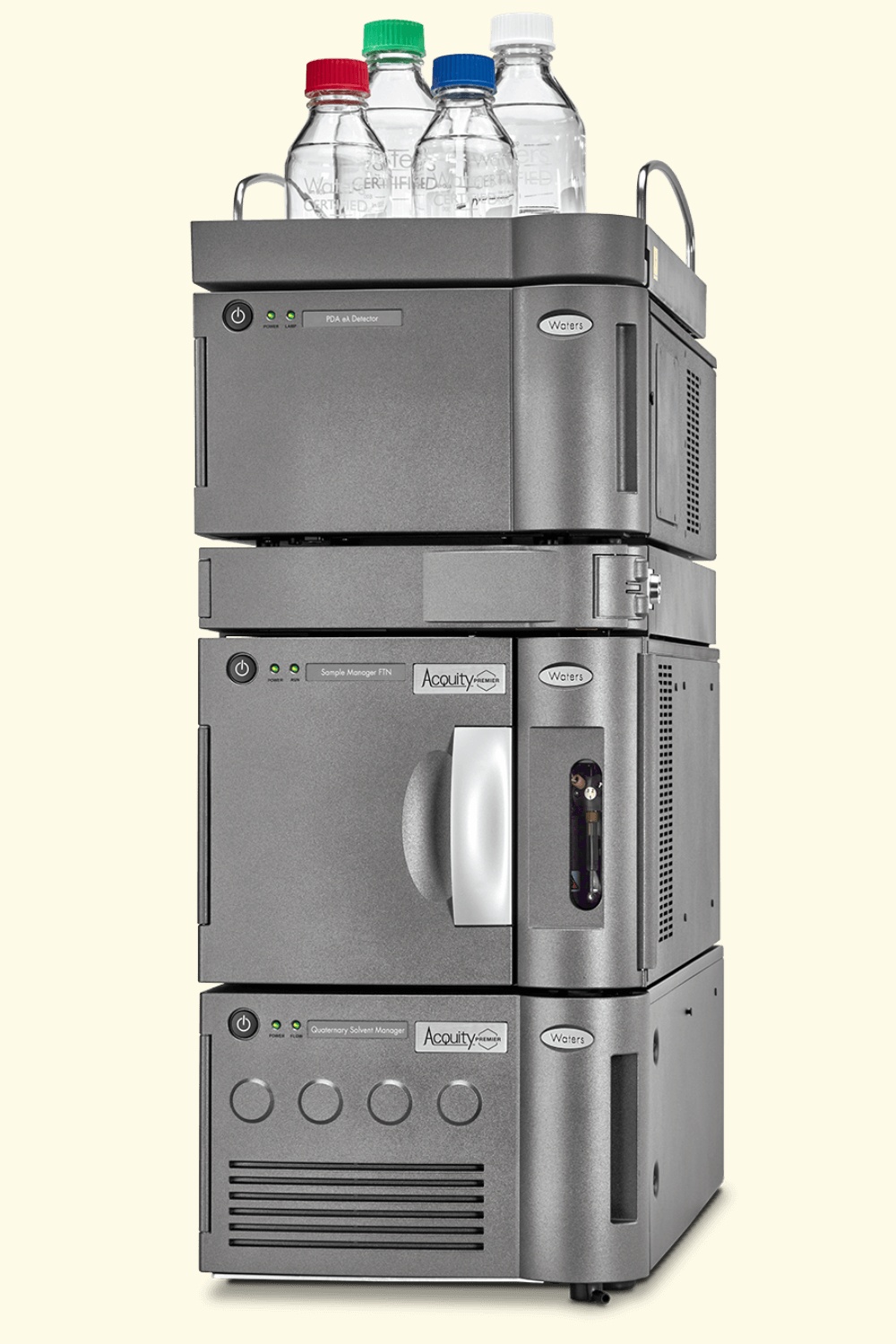
A carefully managed journey.
Solvent, sample, column, detector. Premier’s surface technology addresses interactions along that journey.
02 / ACQUITY PREMIEROther products handle other jobs. Alliance iS serves routine HPLC work with guided operation and pre-run checks. BioAccord combines liquid chromatography and mass spectrometry for biopharmaceutical analysis. Wyatt instruments characterize molecules and particles using light scattering. The materials portfolio measures thermal behavior and rheology, including how materials deform and flow. These are tools for different questions, rather than interchangeable laboratory furniture.
The sale continues after installation.
The business becomes clearer when the purchase order is put away. Columns and other consumables need replacing. Instruments require maintenance. Analysts need training. Software controls equipment and preserves the records behind results. Empower, Waters’ chromatography data system, records project activities such as method creation, data acquisition and result generation. Its audit trails help a reviewer reconstruct what happened.
Waters also sells waters_connect informatics and acquired Andrew Alliance’s laboratory automation technology in 2020. Preparing liquid samples and reviewing data can consume time even when the measurement runs quickly. Connecting those jobs gives Waters more places to help a laboratory, and more products and services to sell into an existing relationship.
Waters’ stated mix after the BD combination, including consumables and service. This is broader than software subscriptions.
The alternatives include Agilent, Thermo Fisher Scientific, Shimadzu, Bruker and SCIEX, depending on the application. Waters’ proposition brings instruments, separation chemistry, informatics and service together. An established method and trained staff also make switching consequential. Buyers should compare performance on their samples, compatibility with existing systems and the full operating bill. A list price cannot settle those questions.
For a lab manager, that means writing a buying brief around the work: which compounds, what concentration range, how many samples and how quickly results must be reviewed. Include consumables, utilities, qualification and service in the calculation. Waters offers leasing and rental options, too. The sensible experiment is a demonstration using representative samples, followed by a realistic account of who will run the system and maintain it.
A larger wager on biology.
In May 2023, Waters completed its purchase of Wyatt Technology. The announced cash price was $1.36 billion before closing adjustments. Light scattering and field-flow fractionation expanded its tools for characterizing biological therapies. A collaboration with Sartorius tackles another practical delay: moving quality measurements closer to biomanufacturing, rather than waiting for samples to work through a central laboratory.
The larger change arrived on February 9, 2026. Waters combined with BD’s biosciences and diagnostic solutions businesses. At completion, the acquired business was valued at $18.8 billion; BD received $4 billion in cash and its shareholders owned 39.2 percent of the combined company. Waters now organizes around analytical sciences, biosciences, advanced diagnostics and materials sciences.
The enlarged portfolio reaches cellular analysis, microbiology and molecular diagnostics. July brought a new Xevo TQ Absolute XR IVD mass spectrometer for clinical workflows. In August, Waters reported second-quarter revenue of $1.645 billion. That includes the acquired businesses: it should not be read as a sudden doubling of demand for the old company’s products.
President and CEO Udit Batra has a personal connection to the less familiar materials business: he used TA equipment as an undergraduate chemical engineering student. Waters’ published careers material emphasizes collaboration, scientific expertise and inclusion; benefits include education support and employee stock purchases where applicable. Those are employer commitments. The broader test of its culture is whether people with different specialties can help a customer make the entire workflow work.
The transferable lesson is practical. Follow the sample, find the loss, make the method repeatable and keep its history. The approach needs skilled people, appropriate methods and resources for upkeep. Better equipment cannot rescue careless preparation. Waters’ opportunity lies in all the work required to make a laboratory answer worth using.