The distance between a sample and an answer is easy to ignore if one has never waited on a factory floor. A swab is taken. A vial is labeled. Somewhere else, a large instrument occupies a room and performs its sober magic. The result eventually returns to the people who needed it earlier. Ching Wu has spent much of his career shortening that distance - sometimes to a benchtop, sometimes to a field instrument, and always toward the place where the decision is waiting.
Wu is the founder, president and chief executive of Excellims, an analytical-instrument company in Acton, Massachusetts. Its central technology, high-performance ion mobility spectrometry, sounds forbidding enough to require a passcode. The basic idea is friendlier. Molecules are turned into ions and sent through a gas under an electric field. They move at different rates according to their size, shape and interactions with the gas. Their travel is measured in milliseconds. A complicated mixture begins to introduce itself.
The method had already found a practical home in security detection when Wu began his work. Before founding Excellims in 2005, he was a research leader in GE Security's chemical, biological and explosives detection operation. He led and joined the development of ion-mobility systems used for security and illicit-drug detection, including the familiar setting of airport screening. This was not chemistry performed at a leisurely distance. A field detector had to be compact, quick and sufficiently selective to be useful amid noise.
The first transferA checkpoint education
That security background gave Wu an unusually practical view of an analytical instrument. In a research paper, an elegant separation can be its own reward. At a checkpoint, a detector lives among luggage, deadlines and the possibility of a false alarm. It must do its work under fluorescent lights while everyone would prefer to be somewhere else. The setting is not incidental. It writes part of the specification.
When Excellims began, it operated as a technology-development business for the security sector, closer in temperament to an academic research group with contracts than to a conventional instrument manufacturer. Wu's team extended work that reached back to his graduate research interests, developing ion mobility and mass-spectrometry hardware while solving detection problems for government-related customers.
Then the category began to loosen. In the mid-to-late 2000s, ion mobility moved beyond handheld field detection and into research laboratories. Coupled to mass spectrometry, it could give a second view of a molecule. Mass spectrometry distinguishes ions by mass-to-charge ratio. Ion mobility adds information related to size and shape. Two molecules that appear similar through one lens may separate through the other. Chemistry, like drawing, improves when it gains perspective.
“Clearly a higher performance instrument was needed in the field.”Ching Wu
Wu and his colleagues also noticed that security did not have exclusive rights to difficult mixtures. Pharmaceutical manufacturing needed rapid quality checks. Chemical plants needed measurements close to a process. Food and beverage operations had their own targets hidden among many other compounds. The actors changed, but the plot remained: find the molecule that matters among the molecules that do not, and do it soon enough to affect the next decision.
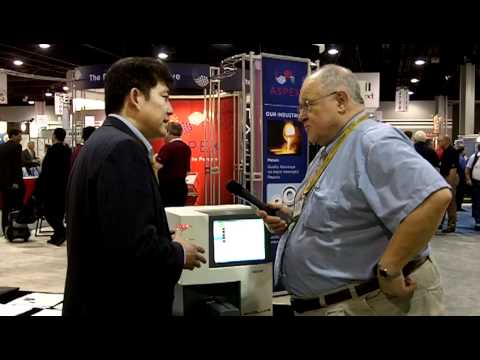
A company changes shapeThe instrument leaves its room
Excellims gradually became an instrument maker. Its systems pursued higher resolving power in a compact footprint, and its product names acquired the clipped confidence common to laboratory equipment: GA2200, MA3100, MC3100. Each represented a variation on the same migration. One worked as a stand-alone high-performance ion mobility instrument. Another paired the separation with an Orbitrap mass spectrometer. A compact system brought the combined approach to a benchtop.
The partnership that made the migration conspicuous arrived in 2014, when Thermo Fisher Scientific selected Excellims to provide a high-performance ion mobility module for its mass spectrometers. For a small company, the arrangement joined a specialized separation technology to one of analytical science's established instrument platforms. For Wu's larger argument, it showed that mobility did not have to compete with mass spectrometry. It could arrive as an extra dimension.
One practical consequence: reported time per cleaning-verification sample
Relative bar lengths visualize figures reported in a 2020 product interview. Exact workflows and results vary by method.
Speed is most persuasive when it changes the choreography of work. In cleaning verification, manufacturers check equipment for residue before another production run. A result in less than a minute, compared with roughly twelve minutes cited for a typical high-performance liquid chromatography workflow, is not simply eleven saved minutes. Multiplied across samples, it can alter when a line is released, where tests are performed and how quickly a questionable result is examined.
Wu gave this destination a plain name: point of analysis. It means placing serious analytical capability where the sample is, whether that is a manufacturing line, a chemical bench or a field site. The phrase avoids the romance of miniaturization for its own sake. A smaller box matters only if it carries enough performance with it. Pocket-sized disappointment remains disappointment.
The engineering recordPatents as a running notebook
The patent trail shows how physical the problem is. Wu appears as inventor or co-inventor on work involving ion gates, drift tubes, sample introduction, preconcentrators and the control of combined instruments. One design uses helical resistive material to create the electric field that guides ions, with an eye toward lower weight, power and manufacturing cost. Another addresses the interface between mobility separation and mass analysis. These are not slogans cast into metal. They are the metal, voltage, timing and airflow beneath the slogan.
The same record also reveals collaboration. Mark Osgood appears repeatedly beside Wu, as do colleagues including Eugenie Hainsworth, Clinton Krueger, Taeman Kim, Jianglin Wu and others. Earlier scientific papers connect Wu with Herbert Hill, William Siems, Prabha Dwivedi and a wider ion-mobility research community. The founder may occupy the title line, but instruments are crowded objects. They contain the decisions of teams.
The publications form their own compact history of expanding ambition. In 1998, Wu, Siems, G. Reid Asbury and Hill described an electrospray ionization instrument whose mobility resolving power approached the theoretical diffusion limit in favorable cases. The following years brought work on surface ionization, isomeric peptides and the detection of illicit drugs. In 2006, Wu and collaborators reported a method for separating chiral compounds - chemical mirror images that can share a formula and still behave differently. A 2008 paper with Abu Kanu and Hill examined quick preseparation methods intended to reduce the kinds of interferences that cause false positives in field detection.
Read in sequence, those papers show a researcher worrying at the boundaries of the same technique. Can resolution improve? Can nearly identical structures be distinguished? Can an ion source become simpler? Can an interference be removed before it fools the detector? The questions are technical, but each carries a practical shadow. Better separation is useful because mixtures are stubborn. Fewer false positives matter because a field alarm interrupts real people. An easier sample introduction matters because instruments eventually meet operators who have other things to do.
A technology moving through contexts
- Published work describes high-resolution electrospray ion mobility coupled with mass spectrometry.
- Wu founds Excellims after leading security-focused detection research at GE.
- Excellims begins its instrument collaboration with Thermo Fisher Scientific.
- The company's high-performance IMS receives a Frost & Sullivan technology leadership award.
- Excellims receives an Analytical Scientist Innovation Award as Wu outlines the point-of-analysis strategy.
- Further U.S. patents are granted for practical ion-mobility detection and controlled spectrometer systems.
The long viewOne question, several markets
By 2020, Wu could look back on close to three decades in ion mobility. His public account of that period is strikingly consistent. The application list grew, but the problem did not scatter. Complex samples required better separation. Useful instruments needed to reach the field. Security systems still needed fewer false alarms. Manufacturers needed answers close to production. Researchers wanted another coordinate for telling molecules apart.
There is a founder's lesson in the sequence. Excellims did not abandon its first field and perform a fashionable pivot. It recognized that the hard-won properties demanded by security - speed, selectivity, compactness and operation near the event - were valuable elsewhere. The company carried a capability across a border between markets. Such borders often look sturdier on a slide than they do to an engineer holding the same underlying problem.
Wu's 2018 lecture in Beijing captured the open-endedness neatly in its title: ion mobility and mass spectrometry still had more secrets to disclose. The setting was an academic forum co-hosted by units at Peking University. The speaker, by then both scientist and chief executive, occupied the useful territory between explaining a method and making it work for somebody on Monday morning.
Awards marked the route - a Frost & Sullivan technology leadership award in 2016 and recognition from The Analytical Scientist in 2020 - but they are less revealing than the repeated return to place. Where should analysis happen? How much instrument can be brought there? What must be redesigned so the answer arrives before its usefulness expires?
In Wu's career, the smallest travelers are the ions crossing a drift tube. The more consequential traveler is the laboratory itself. It has moved from a fixed room toward a production line, a field site and a compact bench, shedding distance without surrendering the demand for a credible answer. That journey has taken decades. Measured against the milliseconds inside the instrument, it is gloriously slow. Measured against the habits of an industry, it may be right on time.