A good laboratory result can be a poor guide to a factory. Heat has to escape. Gases have to reach the liquid. A reaction that looks cooperative in a small vessel can become much harder to manage when the quantities grow. H.E.L Group occupies this awkward stretch between discovering that chemistry works and establishing how to make it work at scale.
The British manufacturer supplies the equipment for that investigation: automated reactors, instruments that measure heat, parallel bioreactors and the software that controls experiments. Its market stretches across pharmaceutical development, industrial chemicals, biotechnology and batteries. These are laboratories where an extra measurement can change a process decision, and where repeating a mistake more efficiently is nobody’s idea of progress.
H.E.L’s appeal lies in a practical combination. It builds physical instruments, writes control software and adapts systems around customers’ experiments. The question behind the catalogue is refreshingly plain: what does the scientist need to learn before making more of this stuff?
First, test the hazard. Then, sell the tool.
Dr. Jasbir Singh founded Hazard Evaluation Laboratories in 1987 to perform hazard testing for customers. By 1990, the company’s history records its first hazard-testing instrument, allowing customers to undertake investigations themselves. That shift established a business built around putting specialist capability on somebody else’s bench.
The portfolio widened in steps. Reaction calorimetry, automated synthesis and parallel screening joined the business. Battery testing and the FlowCAT continuous-flow platform arrived in 2010. Following the acquisition of Magellan, H.E.L began developing BioXplorer systems for biological process development in 2014.
The initials have their own modest origin story. Customers and suppliers already called the business H.E.L; in 2003, the company made the abbreviation official. Its current leadership page lists Singh as managing director again. The technical director, Mark Appleton, joined in 1991 after completing a doctorate at Imperial College London. In this corner of manufacturing, an engineer’s accumulated knowledge of awkward customer problems can be a substantial part of the product.
A laboratory bench with several questions running
PolyBLOCK makes the company’s approach easy to see. Its four or eight reaction zones can operate under independently controlled conditions. Researchers can compare temperatures or experimental protocols side by side, using different vessels and fittings according to the work. Parallel operation gives a development team more opportunities to compare a process without lining every experiment up in a single queue.
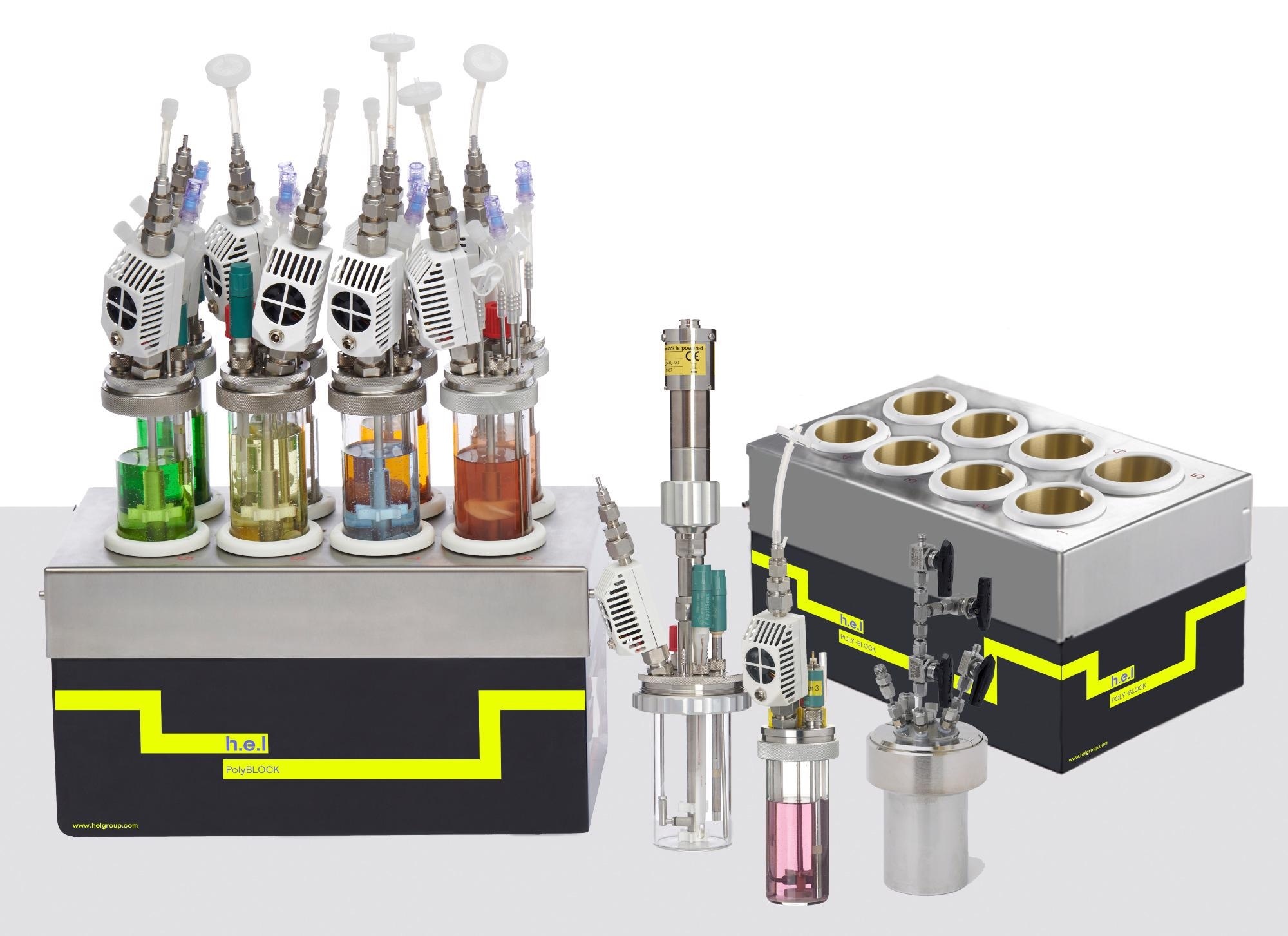
The base is also the starting point for other configurations. Add the appropriate sensors, pumps and gas-control equipment, and it supports applications represented by ChemSCAN, BioXplorer and CrystalSCAN. For a buyer, that makes configuration a central part of the conversation. A vessel’s size is only one of the choices; the experiment also dictates what goes through the lid and what the software must watch.
The range follows different experimental jobs. ChemSCAN addresses pressure reactions and catalyst screening. FlowCAT lets researchers investigate continuous-flow chemistry. AutoLAB provides configurable automated reactor systems, while CrystalSCAN supports crystallization studies. A pharmaceutical developer might need to investigate both a reaction and the conditions under which its product forms crystals. H.E.L sells tools for those separate questions.
“The PolyBLOCK has increased throughput by allowing us to easily and efficiently run multiple reactions.”
Secant Medical · customer testimonial published by H.E.L
Other customer accounts add texture. Almac describes more repeatable process control and reduced use of a valuable intermediate through smaller experiments. LIKAT, the German catalysis institute, describes returning for a second high-pressure system and later expanding it. Those are vendor-published testimonials, but they identify tangible reasons for buying: experimental consistency, material use and room to add capacity.
Heat is the part of the recipe you cannot ignore
H.E.L’s safety instruments divide the investigation into different kinds of measurement. The TSu screens thermal and pressure hazards. Phi-TEC adiabatic calorimeters investigate runaway behavior, with the low-phi-factor version intended to bring laboratory testing closer to manufacturing conditions. Simular measures reaction heat for process development. Choosing among them starts with the question being asked.
For process teams, the distinction matters. Screening a material for warning signs and characterizing the heat released by a proposed production process are related tasks, but they produce different evidence. The equipment helps specialists investigate the operating conditions and consequences that need attention before scale-up. It does not turn a laboratory result into blanket permission to manufacture.
Complementary questions, not a universal testing protocol.
Battery research gives that heat-measurement expertise another customer. H.E.L’s battery portfolio includes isothermal performance testing and thermal-hazard characterization. In April 2026, the company reported completing BTC-500 thermal-runaway testing on a 790 amp-hour utility-scale cell. That announcement is a specific illustration of where the business has travelled: from chemical hazard evaluation to the behavior of large energy-storage cells.
The tiny stirrer that complicates the big result
One of the most useful pieces of H.E.L’s recent writing concerns a very small mechanical problem. In a June 2026 article, Singh describes a pressure-reactor experiment using just 5 millilitres of liquid. The vessel still has to accommodate probes and effective agitation. There is not much elbow room inside a tiny reactor.
H.E.L reports comparable hydrogenation results at 5 and 500 millilitres using a particular suspended stirring arrangement in the smaller vessel. The larger liquid volume is 100 times the smaller one. It is an encouraging demonstration for that setup, rather than a promise that every reaction will scale by the same factor.
100× liquid volume. Comparable results reported for the tested arrangement; mixing and chemistry determine transferability.
The qualifications are revealing. Magnetic stirring favors less viscous liquids, and catalysts such as Raney nickel can cling to magnetic stirrers. The practical lesson is to investigate whether the apparatus is limiting the result. A chemistry team can copy that habit immediately: examine mixing before assuming a disappointing scale-up has exposed a flaw in the chemistry.
In Berlin, the reactor has robotic colleagues
At TU Berlin’s KIWI-biolab, BioXplorer 100 sits within an automated microbial research facility. H.E.L describes fermentations lasting up to seven days, with the reactor connected to a Tecan liquid-handling station, off-gas analysis and a mobile laboratory assistant that moves samples toward analytical instruments. The work includes microbial processes relevant to proteins and enzymes.
That arrangement shows why “automated” needs a little unpacking. Holding temperature steady is one task. Delivering a feed, taking a sample, measuring its contents and connecting the result to a running experiment requires several systems to cooperate. The university’s platform, also described in a published research paper, makes the integration visible.
H.E.L says its technical team supplied software adaptations and function extensions as the facility developed. For buyers, the useful question is therefore broader than whether a reactor can run overnight. It is whether that reactor can work with the liquid handling, cooling, analytics and experimental procedures already in the laboratory.
The company returned to this subject in September 2026, discussing automated bioprocess workflows and feedback control. Its example of optical biomass monitoring adds another condition: at high biomass, the sensor response becomes nonlinear and requires appropriate calibration. A controller can hold a reading beautifully while the relationship between that reading and the culture needs more work.
The commercial product includes the people
H.E.L operates as a specialist business-to-business equipment supplier. Customers discuss requirements and request quotations; the offering extends through installation, training, maintenance, calibration and repair. Custom engineering sits alongside standard product families. For procurement teams, the meaningful comparison is the configured system and its support requirements over time.
Alternatives depend on the application. Mettler Toledo offers RC1mx reaction calorimetry, while Parr Instrument sells stirred pressure reactors and multiple-reactor systems. H.E.L’s competitive argument is the combination of configurable equipment, automation and application support across several related disciplines. Published customer accounts repeatedly emphasize accommodating specific requirements. That is a more useful distinction than treating every instrument maker as interchangeable.
The company describes a team of 90 and states values centered on experience, collaboration, persistence and progress. Its engineering biographies give those claims some substance: several senior staff have worked across consultancy, manufacturing, installations and technical support. A customer buying a bespoke system benefits when those functions can talk to one another.
What the money changed
Connection Capital invested £5.9 million in March 2018 in a transaction that allowed the founders to realize value and step back from full-time management. The investor describes adding senior executives, strengthening operations in China and the United States, and implementing an enterprise resource planning system. A 2020 refinancing supported working capital and returned some capital to investors.
Those details make the expansion less mysterious. Alongside new instruments came the management and operating systems needed to sell, build and support them internationally. H.E.L moved to Hemel Hempstead in 2023. Connection Capital reports that the business was sold in August 2025. The £5.9 million figure describes the investment transaction, rather than the development budget of a particular machine.
A calorimeter earns a place in the classroom
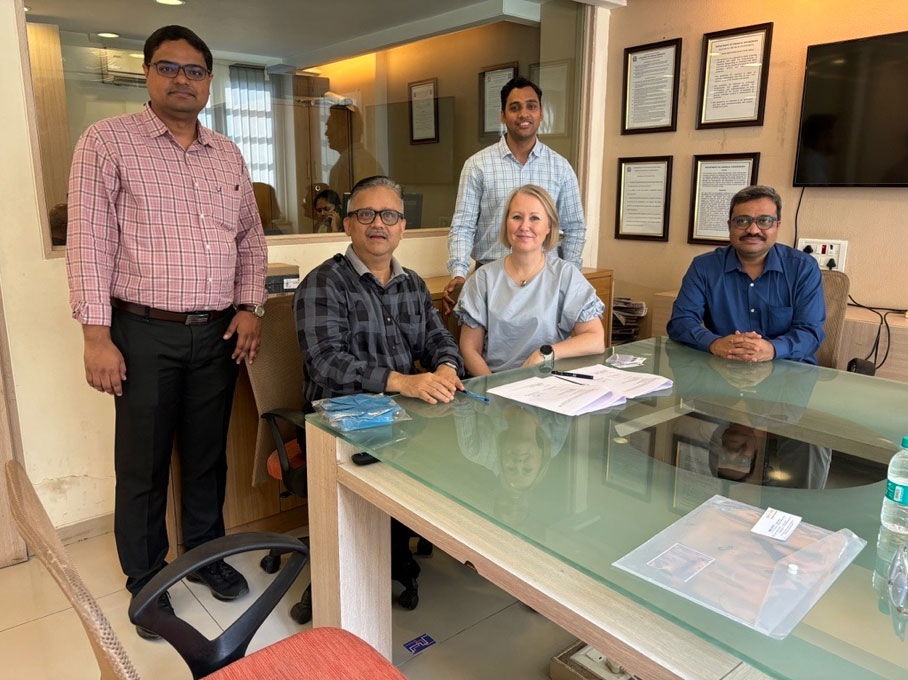
Research relationships extend the company’s reach. A 2023 agreement with IIT Kanpur focused on battery testing and protocol development. In March 2025, H.E.L announced a three-year agreement with ICT Mumbai that included supplying a Simular reaction calorimeter for research and education in chemical process safety.
For a laboratory considering these tools, the clearest starting point is a bottleneck: too few comparative experiments, uncertain heat behavior, laborious sampling or a reactor that cannot reproduce the conditions under study. Define the measurement, then specify the equipment and support needed to obtain it. H.E.L’s history offers a business lesson as well: years spent understanding a customer’s technical problem can become the foundation of a product range. The work still has to survive the next experiment.