A laboratory can own an impressive machine and still have a very ordinary problem: nobody can trust the answer. Perhaps the sample was mislabeled. Perhaps the instrument needs attention. Perhaps the software recorded a result without enough information to reconstruct it. Each problem sits between the equipment purchase and the scientific conclusion. Agilent Technologies has built much of its business in that space.
- The work: instruments, supplies, software, and support for laboratories.
- The customers: drugmakers, researchers, pathology labs, and food and environmental testers.
- The revealing detail: Agilent also services eligible instruments made by competitors.
Its products help separate mixtures, measure molecules, examine cells, and analyze tissue. The customer might be testing water for contaminants or checking a pharmaceutical batch. The underlying purchase is similar: a way to turn something uncertain into a result that can survive scrutiny. Buying the instrument begins that process. Keeping the process dependable creates years of additional work.
The inheritance, and the pruning
Agilent began with an unusual advantage. It inherited businesses rather than inventing one from scratch. In 1999, Hewlett-Packard separated its measurement operations from its computing and printing operations. Agilent’s November initial public offering raised $2.1 billion. Bill Hewlett and David Packard belong to the ancestry; calling them founders of a new 1999 startup would flatten a much more interesting corporate family tree.
The inheritance was broad. Agilent once sold optical mouse sensors as well as scientific equipment. Over time, it narrowed its attention. The electronic measurement business became Keysight in November 2014. Agilent retained the laboratory-oriented businesses. The useful question became which kinds of measurement belonged together, and which demanded a separate company.
One expensive experiment supplies an answer. Agilent paid approximately $1.5 billion for Varian in 2010, adding several analytical businesses, including nuclear magnetic resonance, or NMR. In October 2014, it stopped accepting new NMR system orders. Agilent said the unit had fallen short of its growth and profitability targets. The exit filing estimated roughly $77 million in combined personnel, impairment, asset-write-down, and other charges. That was an estimate of exit costs, separate from the acquisition price.
“The business has not met growth and profitability objectives.”
Agilent’s NMR exit announcement, October 2014
Agilent had already retreated from related magnet and MRI activities. It said investment should go toward higher-value life sciences, applied markets, and diagnostics. This was a decision to abandon a product business after buying technical capability. Scientific sophistication alone had not delivered the economics management wanted.
The machine is the beginning
CrossLab reveals the other side of that judgment. It combines consumables with services such as maintenance, repair, and compliance support. Crucially, its multivendor offering covers eligible chromatography and mass-spectrometry equipment from other manufacturers. A customer can ask Agilent to help maintain a mixed laboratory rather than replace everything with Agilent-branded machines.
That changes the relationship. An equipment order arrives occasionally; supplies and upkeep follow the work. In fiscal 2025, CrossLab generated $2.908 billion of Agilent’s $6.948 billion revenue, about 42%. That figure includes consumables. Treating it as pure service revenue would exaggerate the case. Even with that distinction, the size of the business makes the after-sale relationship hard to dismiss.
CrossLab includes consumables and services. Rounded segment figures; USD.
The spending cycle offers a useful test. In fiscal 2024, product revenue fell 7% as customers faced capital-expenditure pressure, while services and other revenue rose 3%. Maintaining an existing instrument and buying a new one are different budget decisions. This distinction helps explain the appeal of service revenue without pretending it is immune to customers’ financial problems.
A sample has a long journey
Consider what a laboratory actually has to do. Liquid chromatography separates components of a mixture. Mass spectrometry helps identify or quantify compounds. Agilent publishes workflows for measuring PFAS in water using its 6495 LC/MS system. The instrument belongs inside a larger procedure involving sample handling, preparation, analysis, and review. A sensitive detector cannot rescue a contaminated sample.
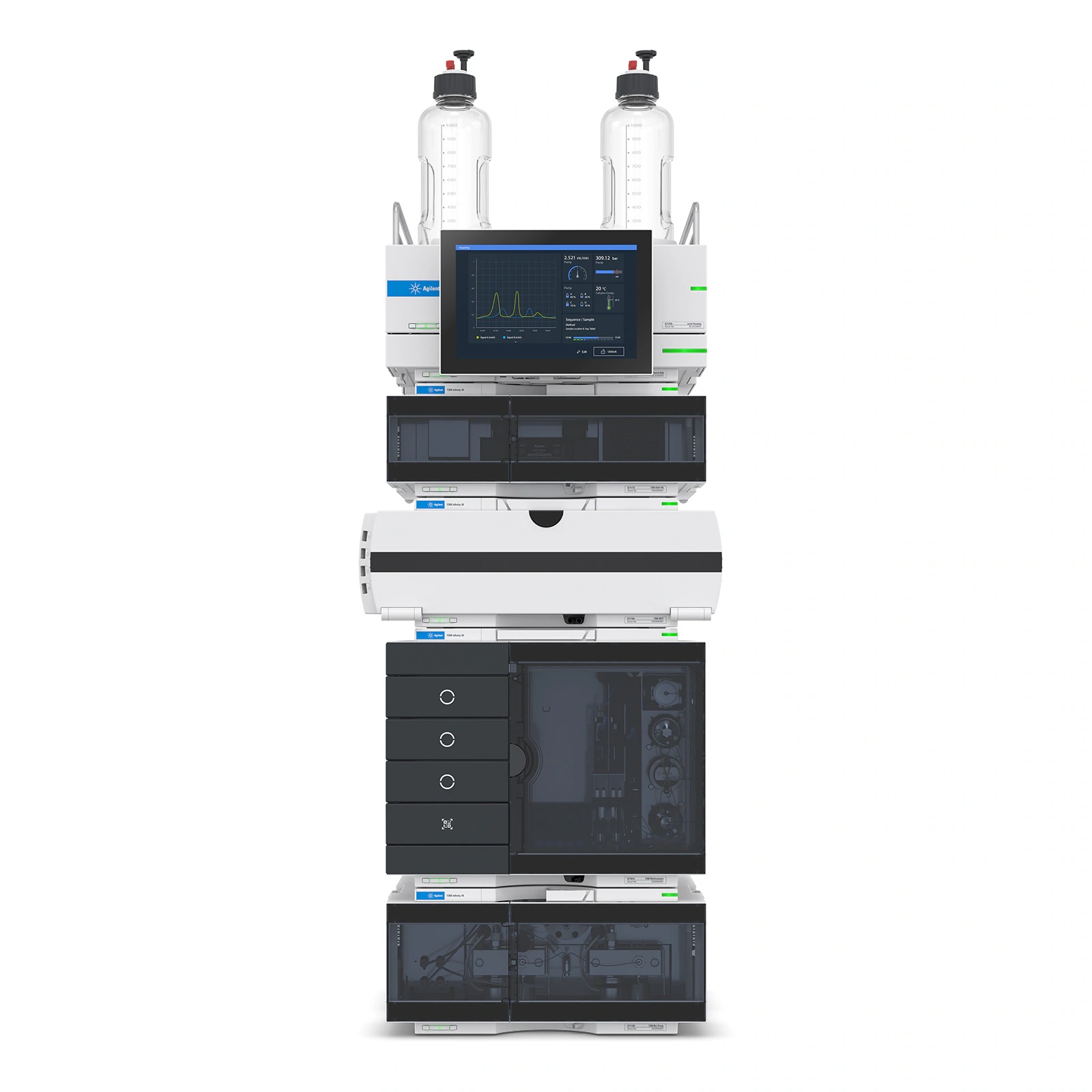
The Infinity III liquid chromatography systems, introduced in October 2024, address some decidedly human problems. InfinityLab Assist guides operation and maintenance; barcode and camera-based sample tracking aims to reduce mix-ups. Compatibility with earlier methods and upgrade paths for Infinity II systems also matter. A laboratory has invested in procedures and training as well as hardware.
Software extends that logic. OpenLab CDS brings supported instruments and their data into a common environment, including selected equipment from other vendors. Elsewhere in the portfolio, Seahorse XF analyzers measure oxygen consumption and extracellular acidification to investigate cell metabolism. Dako supplies pathology instruments and reagents. These products serve different questions; no single machine answers them all.
For a buyer, the sensible starting point is a defined job: which samples, which compounds, how many runs, and what evidence must accompany the result? Ask for a demonstration using representative material, then price the software, supplies, training, and support alongside the instrument. A specification sheet describes capability. A working method shows whether that capability fits the laboratory.
Following the slide
Pathology shows where Agilent is placing fresh bets. Its announced 2012 Dako deal was valued at $2.2 billion. In June 2026, it completed the Biocare Medical acquisition, announced at $950 million, adding antibodies, reagents, and instruments. On October 13, it announced an agreement to acquire digital pathology software company Proscia for $240 million at closing, with up to $30 million more tied to performance milestones.
The proposed transaction extends a distribution relationship dating to 2022. The strategic connection is straightforward: tissue preparation and staining produce material that digital pathology software helps laboratories manage and analyze. The announcement establishes intent, not completed ownership. It also shows how far the business has traveled from an identity centered on measuring electronics.
The organization describes its culture through eight values, including integrity, accountability, and speaking up. In this setting, those words have a concrete application: problems need to be reported before they become accepted results. The company’s stated mission, advancing quality of life through trusted answers, depends on work that happens well before a discovery reaches the headlines.
Build for the second purchase
Agilent competes with Thermo Fisher, Waters, Shimadzu, Bruker, and specialist businesses within Danaher, among others. Its case rests on the combination of equipment, applications knowledge, consumables, software, and service. The practical lesson for another business is to map the customer’s work after delivery. Which recurring difficulty is important enough that someone will pay to remove it?
The conditions matter. Supplies sell when experiments run. Maintenance contracts need useful equipment to maintain. Compatibility, local service coverage, and a validated method can outweigh a familiar brand. A small laboratory doing occasional tests may reach a different buying decision from a pharmaceutical site running continuously. Agilent’s story rewards attention to those dull particulars. They are where the instrument becomes useful, and where the next purchase begins.
Keep looking
Explore instruments, community, and company news.