The first server was also a footrest. Timur Valishev kept it under a table at home, a piece of equipment doing two jobs in a company where everyone was doing several. An office would come later, presumably. First there was software to write and someone to persuade to use it.
That arrangement offers a useful introduction to the JivoChat co-founder. His business began with the sort of complaint programmers are particularly ill equipped to leave alone: he wanted to buy a tool, disliked the available choices, and believed he could build something better. The complaint became a product. The product became a company. The office remained negotiable.
In his early writing, Valishev described the advantage of making software simple enough to explain and support itself. Limited money made that an immediate concern. Every confused user represented another question for a founder already occupied with development. A pleasing interface had an economic purpose, as well as an aesthetic one. There was nobody spare to explain a bad button.
An expensive habit: noticing bad software
Before JivoChat, there was telephony. Valishev studied at Bauman Moscow State Technical University and co-founded Octoline in 2007 while still a student. It provided virtual telephone systems for small businesses. He understood the machinery, but the economics frustrated him: software effort ended up being sold through a service where customers scrutinized the price of a minute.
When Octoline needed a website chat tool, he tried dozens. The prices seemed excessive; the design and usability disappointed him. He was a programmer shopping with a programmer’s dangerous confidence. His own description included an internal perfectionist who objected to products that felt awkward or unfinished.
He and his partner could write the first version themselves. That made the initial outlay unusually modest. In his early account, roughly 120,000 rubles covered essentials including registration, servers and a WordPress website template. The question became whether other businesses shared his irritation enough to try their answer.
A customer list with familiar names
Valishev’s first sales territory was his phonebook. He called friends and colleagues and offered them the chat tool free. The first customer arrived in December 2011; the company’s founding is generally dated to 2012. In a business concerned with conversations, the opening move was satisfyingly literal: call somebody you know.
He later went to web developer forums with a recurring commission offer. Developers who put the tool in front of their own customers could participate in the revenue. The relationships were different, but the principle was familiar. Find someone who already has a reason to listen.
The free widget also displayed its maker’s name. Visitors could encounter the software while talking to a shop, rather than while looking for software. A business owner might experience it as a customer, then want the same thing for their own website. The demonstration arrived attached to a real task, with no appointment required.
- 01A business installs the free chat.
- 02A visitor uses it and sees the Jivo credit.
- 03Another business discovers the product.
A product demonstration, built into an ordinary customer conversation.
Free has a job to do
Valishev treated the free version as a balancing problem. Restrict it too severely and fewer people would use or recommend it. Give away too much and there would be little reason to pay. The useful middle depended on understanding what customers could accomplish before an upgrade became worthwhile.
He applied similar reasoning to the interface. Clear instructions could reduce support demands; a comprehensible difference between versions could help a customer choose. He put responsibility for a confused user squarely on the people who designed the product. It is a brisk performance review for a piece of software.
“It isn’t their problem, it’s yours.”
Timur Valishev, on confusing interfaces
His own assumptions needed revision, too. Selling individual features created repeated purchase decisions. JivoChat moved toward a simpler free-and-paid arrangement. And although the product attracted users, hiring a sales team improved paid conversion. The engineer had to allow for the possibility that a useful product could still benefit from a human explanation.
Approximately, as reported by Valishev in August 2019. A historical milestone in a business grown without outside investment.
The product itself also moved beyond text. In January 2014, JivoSite added browser calling through Voximplant. Customers could move from a chat to a call without downloading another application. Valishev discussed reliability and WebRTC support when explaining the choice of partner. The original chat window was becoming a place where more of a business conversation could happen.
There is a recognizable continuity with his telecom years. Voice had returned, this time as part of a tool built around the customer’s interaction with a business. Buying an existing communications component also spared his team from doing every piece of engineering itself. Knowing how to build something can be an excellent qualification for deciding which parts to buy.
The office that kept failing to become necessary
The first remote employee was a known quantity. During the Octoline years, a young man from Kazakhstan named Emil had come for an internship and impressed Valishev with his responsibility. When Jivo needed part-time help, Valishev called him. In a new working arrangement, an old relationship offered some reassurance.
Valishev remained skeptical as the company grew. Even at ten people, he expected to discover the point at which working through Skype would stop being practical. That point kept failing to arrive. The team continued hiring outside Moscow, while he continued expecting an office to become unavoidable.
Eventually, in August 2013, they rented one for sales. A physical workplace served a particular part of the company. Engineering and support could carry on elsewhere. The compromise was less photogenic than an absolute declaration about the future of work, and considerably easier to fit around an actual business.
By his 2020 account, the remote arrangement helped Jivo compete for programmers against larger employers. Some candidates actively wanted that option. What began as a way to manage limited resources had become a reason to join. The company could offer something useful without first acquiring the budget or buildings of its larger rivals.
It also suited a business reaching customers in different markets. Local colleagues understood how people discovered and bought software in their own countries. Hiring across borders brought that knowledge closer to the daily work. Translation was one task among several; choosing the right way to reach customers required people who knew the place.
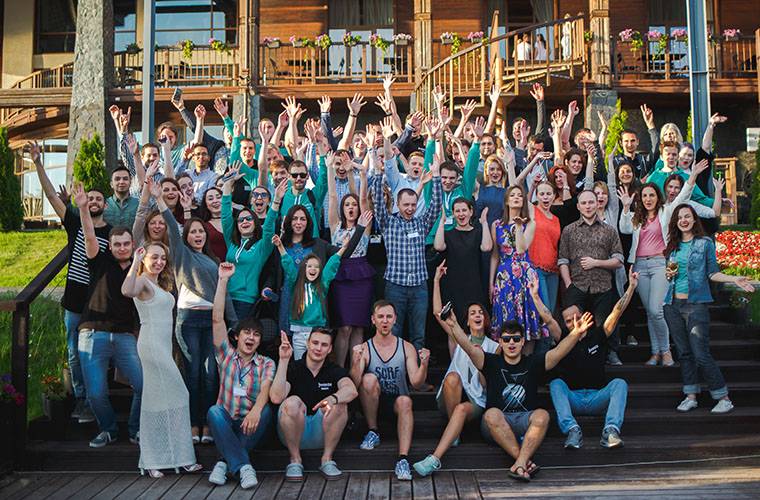
A company needs somewhere to waste five minutes
There was a less formal side to the arrangement. In 2015, Valishev described a Skype space for chatting and fooling around, plus Cat Fridays, when pictures of cats filled the conversation. Evidently, a software company can distribute itself across six time zones without escaping the internet’s preferred animal.
Colleagues also met in person. By then, company gatherings had taken place in Greece, Montenegro and Egypt. The meetings gave a dispersed team time together beyond the practical business of handing over tasks. Geography could be flexible; knowing the people on the other end of a message still mattered.
In a later account of company culture, Valishev described beginning daily meetings with five or ten minutes of friendly conversation. People exchanged personal news and jokes. Informal Friday video calls offered another place to talk without a strict work agenda. The company used its own group chat, which gave colleagues a place to socialize while also trying the product they were building.
The more formal rhythm included meetings every two weeks to share progress and discuss what came next. Department leaders met weekly with Valishev involved. Those habits made room for both the task and the person doing it. A business selling communication tools still had to remember to talk.
Learning to leave the keyboard
As the team expanded, Valishev found himself managing managers. In 2019, he described that as harder than he had expected. He needed capable leaders with plans of their own, and he could not simply do their jobs for them. He joked about becoming a talking head.
He still wanted enough technical familiarity to understand the problems brought to him. Helping colleagues configure Google Analytics, reading documentation and looking through reports kept him connected to the work. So did customer conversations. He described opening the app, entering chats and reading reviews, and giving programmers time answering customers themselves.
That combination is revealing: delegate the work, keep enough contact to understand it. The founder who once handled development, sales and support could no longer occupy every chair. He could still recognize what the people in those chairs were trying to accomplish.
 WATCH THE CONVERSATION ↗
Three offers, after one disappeared
The Sber deal in 2021 brought a different kind of conversation. An earlier interested buyer had gathered information and walked away. Valishev and his advisers continued discussions elsewhere. By the time the founders chose, they had three offers to consider. He said he had thought that sort of situation happened only in California.
He described the attraction of keeping the company’s business model while gaining access to the buyer’s resources and integrations. The sale made sense to him at that moment. His stated ambition had been to build a working, profitable business, create value for clients and become financially secure. An acquisition was a possible outcome along the way.
His later public activity includes a place on the other side of the funding relationship: self.space, a Dubai photography venture, names him among its angel investors. His public profile now lists Dubai. The programmer who built with his own resources has also become someone another founding team thanks for early support.
The footrest was a modest beginning. What followed required learning which jobs software could do, which needed people, and which the founder himself needed to relinquish. Even an office could be judged that way: give it a useful job, and then decide whether to keep it.