The antivirus was already installed. That is the useful detail in the Malwarebytes origin story. As a teenager, Marcin Kleczynski infected his family’s computer while looking for games online. The machine had protection. It still needed rescuing. Help eventually came from strangers on an internet forum, the sort of people who could read a diagnostic log and recognize trouble hiding inside it.
- Cleanup built the reputation. The basic malware scanner remains free.
- Prevention pays the bills. Subscriptions add ongoing protection and privacy tools.
- The target is moving. Scam checking brings security closer to the decision to click.
There was an opening here, although it hardly resembled a business plan. A familiar product had missed something. A small community understood it. Someone needed to turn that expertise into software that an ordinary person could use without becoming the family’s unpaid computer technician.
The antivirus was already installed
Kleczynski began making removal utilities and listening to the people who used them. One frequent contributor, Bruce Harrison, was so quick to identify threats that Kleczynski briefly wondered whether he worked for the attackers. He invited Harrison to help build a product. The offer had one conspicuous omission.
“I can’t pay you right now, we don’t have any money.”
Marcin Kleczynski, recalling his pitch to Bruce Harrison in a 2012 interview
Harrison worked on the threat database; Kleczynski handled the rest. Their first Malwarebytes Anti-Malware release arrived on January 21, 2008. The forum supplied both missed infections and false alarms. Users were helping improve the thing that helped them. That feedback loop mattered more than a polished origin myth.

Give away the rescue
The bargain was easy to understand: remove an existing infection for free, charge for ongoing protection. That distinction survives. Malwarebytes Free is an on-demand cleanup tool. Premium Security adds real-time defenses against threats including malware, ransomware and malicious websites. Exact features depend on the operating system.
A free scanner can be useful after a suspicious download. It should not be mistaken for an always-on shield. Someone has to run the scan, and finding no infection does not establish that a payment request is legitimate. A convincing liar does not necessarily need to install anything.
The commercial turning point, Kleczynski explained in 2012, came when organizations wanted to buy in bulk. They needed support and a product built for their environment. The same underlying expertise had acquired a different buyer, with a different reason to pay.
Malwarebytes subsequently announced $30 million from Highland Capital Partners in 2014, $50 million from Fidelity in 2016 and a $100 million minority investment from Vector Capital in 2022. Those rounds total $180 million. They describe capital raised, rather than the cost of building the company or its current revenue.
Two kinds of worried customer
A person trying to clean a laptop and an administrator responsible for hundreds of machines share a problem, but their working days differ. One wants the warning to stop. The other needs to know which device triggered it, what happened next and whether anyone is investigating.
In November 2023, Malwarebytes gave its business portfolio a separate name: ThreatDown. It offers endpoint protection, endpoint detection and response, and managed detection and response. That last service supplies people to monitor and investigate threats, a meaningful distinction for organizations whose IT staff already have several jobs.
ThreatDown’s positioning emphasizes fewer management complications, with one agent and one console. The consumer range competes with Microsoft Defender, Norton, McAfee and Bitdefender. Business buyers also encounter Microsoft, CrowdStrike and SentinelOne. Malwarebytes’ distinctive route into this crowded market remains its cleanup reputation and its appeal to people with limited time for security administration.
The suspicious message becomes the product
The portfolio now reaches beyond infected files. Browser Guard blocks unwanted and unsafe browser content. Privacy VPN protects network traffic. Identity protection adds monitoring and recovery assistance; Personal Data Remover requests deletion from supported data-broker sites. These solve related problems, but buying one does not automatically solve the others.
In November 2024, Malwarebytes acquired Sweden’s AzireVPN on undisclosed terms. In June 2025, it introduced Scam Guard, which accepts suspicious messages, screenshots, links and numbers for assessment. The company is following danger into places where the computer itself may be functioning perfectly.
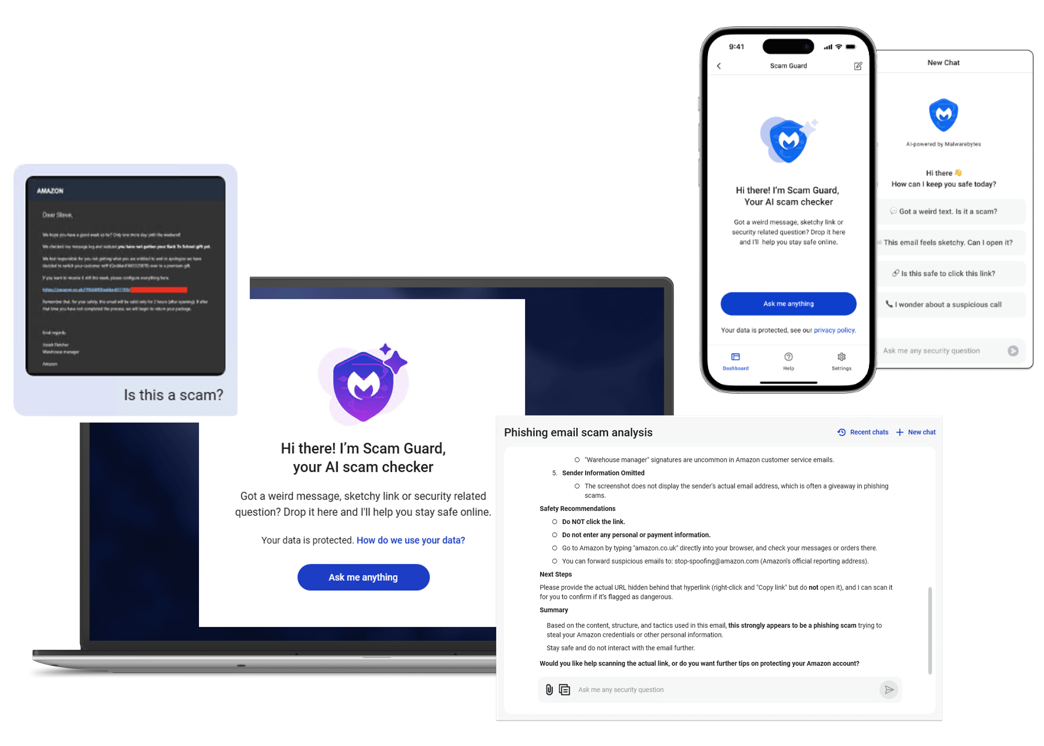
That shift also changes distribution. A 2025 strategic partner program offered consumer protection through organizations such as financial institutions and internet providers. In February 2026, Malwarebytes announced scam checking inside ChatGPT. On October 5, it launched free Scam Link Check, requiring neither an account nor a download.
The new tool checks signals including phishing pages, domain freshness and redirect chains, then returns a verdict and explanation. Its possible answers include unknown. That small word deserves attention. New scams keep arriving; a database and an assessment cannot certify every unfamiliar request.
A map of product roles, not a guarantee that every threat is caught.
Trust has a maintenance bill
Security software has its own capacity to cause trouble. In January 2018, a malformed Malwarebytes protection update drove excessive memory and CPU consumption. An initial fix failed to resolve the problem for affected users; further corrective work followed. Software entrusted to keep a machine usable had interfered with using it.
Trust also requires checking promises. In April 2026, Malwarebytes announced an independent X41 D-Sec audit of its AzireVPN infrastructure. An outside assessment offers evidence about a defined system at a particular time. It cannot make every future release infallible.
The lesson readers can copy is modest: match the tool to the job. Scan for infections, check suspicious requests and compare subscription features before paying. A VPN cannot establish a sender’s honesty. For builders, the original lesson is equally practical: solve a painful problem people already have, let them test the result, and listen when they say something still looks wrong.