An old classmate, an unfamiliar caller, a name from a dating app: each is a small mystery with a potentially paying audience. PeopleConnect has assembled a business around those moments. Its collection of consumer websites promises to make people easier to find and their histories easier to inspect. Then it offers another doorway for the person being inspected: a way to hide a background report.
That combination makes PeopleConnect more interesting than its corporate name suggests. TruthFinder, Instant Checkmate, Intelius and US Search belong to the same family. So does Classmates, where teenage photographs can enjoy a longer public life than their subjects anticipated. OmniWatch adds identity monitoring and scam protection. Together, the brands cover several feelings about personal information: curiosity, nostalgia, apprehension and the wish to regain control.
The products do different jobs. Their shared commercial territory is the gap between information existing somewhere and a consumer being able to use it. A searchable report, a digitized yearbook and a breach alert each make scattered details more accessible. What follows from those details is the difficult part.
01 The yearbook meets the background report
PeopleConnect’s history is an assembly of businesses. Classmates dates to 1995; Intelius to 2003. In July 2015, private-equity firm H.I.G. Capital invested in Intelius. Classmates followed, in a transaction reported at $30 million. United Online had paid $100 million for Classmates in 2004. That price comparison describes two transactions eleven years apart, rather than a valuation of today’s PeopleConnect.
H.I.G.’s announcement explained the attraction: combine an established alumni network with people-search technology while retaining separate divisions. A remembered school, an old surname and a face in a yearbook can help someone make a connection that a name alone cannot. The portfolio put those complementary activities under one owner.
Another branch arrived in January 2020. PubRec merged with PeopleConnect, bringing TruthFinder, Instant Checkmate and technology business The Control Group. Financial adviser Livingstone identifies Kris Kibak and Joey Rocco as PubRec’s founders and dates that business to 2010. It singles out experimentation and split-testing technology as a distinguishing capability. PeopleConnect gained a practiced consumer-marketing operation alongside more search brands.

The archive remains a substantial part of the proposition. Classmates now advertises more than 480,000 digitized yearbooks. Its member experience includes finding school connections, sharing life updates and organizing reunions. The appeal is specific: the people who remember you before your current job title. A broad social feed does not automatically reproduce that context.
02 Several doors, several reasons to pay
People search serves consumers trying to reconnect, identify a caller or investigate their own online footprint. PeopleConnect presents Intelius as a service for names, telephone numbers, addresses and public-record searches. TruthFinder and Instant Checkmate sell access to background reports. The customer is usually an individual pursuing a personal question, rather than an enterprise buying a general-purpose data platform.
The business model turns that question into recurring access. TruthFinder’s US App Store listing, for example, includes an All-Access Unlimited purchase at $27.99. That is an app-store price point, not a universal website quote. Plans, purchase channels and additional report types can differ. The distinction matters when a consumer arrives wanting one answer and encounters a subscription.
Classmates sells access around an existing community and its memories. OmniWatch sells continuing monitoring and help responding to threats. These are different reasons to return: another person to research, another school connection, another alert to review. Subscription economics depend on those repeat reasons being worth the bill.
Instant Checkmate · US Search
School communities + yearbooks
Identity risks + scam alerts
Supported name-search reports
Competitors sit in several markets. BeenVerified and Spokeo offer alternative consumer people searches; LifeLock competes for identity-protection customers. Alumni groups and social networks compete for reunion attention. PeopleConnect’s distinctive feature is the combination of businesses. A reader comparing TruthFinder with Intelius should recognize that these are sibling brands, not independent owners corroborating one another.
A useful comparison starts with the task. For a reunion, the school community and archive matter. For a mystery caller, the relevant lookup matters. For identity monitoring, the question is what happens after an alert. Counting the number of features on a sales page will not tell a consumer which service fits the occasion.
03 The expensive gap between a record and a claim
The hard question is what a report establishes. The Federal Trade Commission’s 2023 action against TruthFinder, Instant Checkmate and affiliates alleged that marketing sometimes suggested criminal or arrest records when the underlying information was a traffic ticket. It also challenged accuracy claims and the companies’ handling of disputed information.
The problem had an earlier warning. Instant Checkmate’s 2014 FTC case produced a $525,000 penalty involving alleged failures under the Fair Credit Reporting Act. That preceded the PubRec merger. The history shows that regulatory trouble did not first appear after the current portfolio came together.
Civil penalty imposed on TruthFinder, Instant Checkmate and affiliated defendants.
A court entered the 2023 stipulated order in October. The defendants neither admitted nor denied the complaint’s allegations, apart from jurisdictional facts. Along with the $5.8 million civil penalty, the order required compliance monitoring and restrictions on misrepresentations. The FTC had alleged that marketing for employment and tenant screening brought the companies within consumer-reporting obligations despite website disclaimers.
For the reader, the practical lesson is to separate a lead from a conclusion. For a product team, it is to review the promise surrounding a result as carefully as the result itself. A notification, a disputed-data button and a paid search advertisement can all shape what a customer thinks the service has established. Those details belong in the product review, not just the advertising meeting.
04 A free exit with a defined boundary
PeopleConnect’s Suppression Center offers a useful control: free suppression of name-search background reports across TruthFinder, Instant Checkmate, Intelius and US Search. The process begins with an email verification link. It gives the subject of a report a route to manage visibility without buying a search subscription.
The scope is narrower than disappearing from the internet. PeopleConnect says suppression does not erase information at its original sources, does not cover Classmates and can leave information visible through other features, including phone, address or email reports. It also distinguishes public-report data from information collected about customers using its services.
That boundary explains the apparent contradiction in the portfolio. A company can make information findable and offer controls over a particular display of it. Whether that feels sufficient depends on the person. For someone seeking complete erasure, a name-search control cannot deliver the desired result. For someone trying to limit one prominent route to their report, it has a concrete use.
05 From finding a person to watching for a scam
OmniWatch takes the business into another kind of personal-data service. Launched in 2023, it combines identity and credit monitoring with dark-web alerts. In a March 2024 paid Forbes BrandVoice article, PeopleConnect described growing identity-theft risks as part of the motivation for launching it. This was an expansion into protection, not an exit from people search.
“Hackers can be surprisingly patient.”
Steven Gray, identified as PeopleConnect CEO
Forbes BrandVoice paid program, March 2024
The current OmniWatch offering includes tools to check suspicious messages and links, identity-restoration help and insurance with benefits determined by the plan and its terms. The product asks customers to act on warnings and complete setup. Its usefulness depends on that follow-through; an alert sitting unread cannot change what happens next.
Before you
tap the link.
OmniWatch brings suspicious messages into the identity-protection conversation.
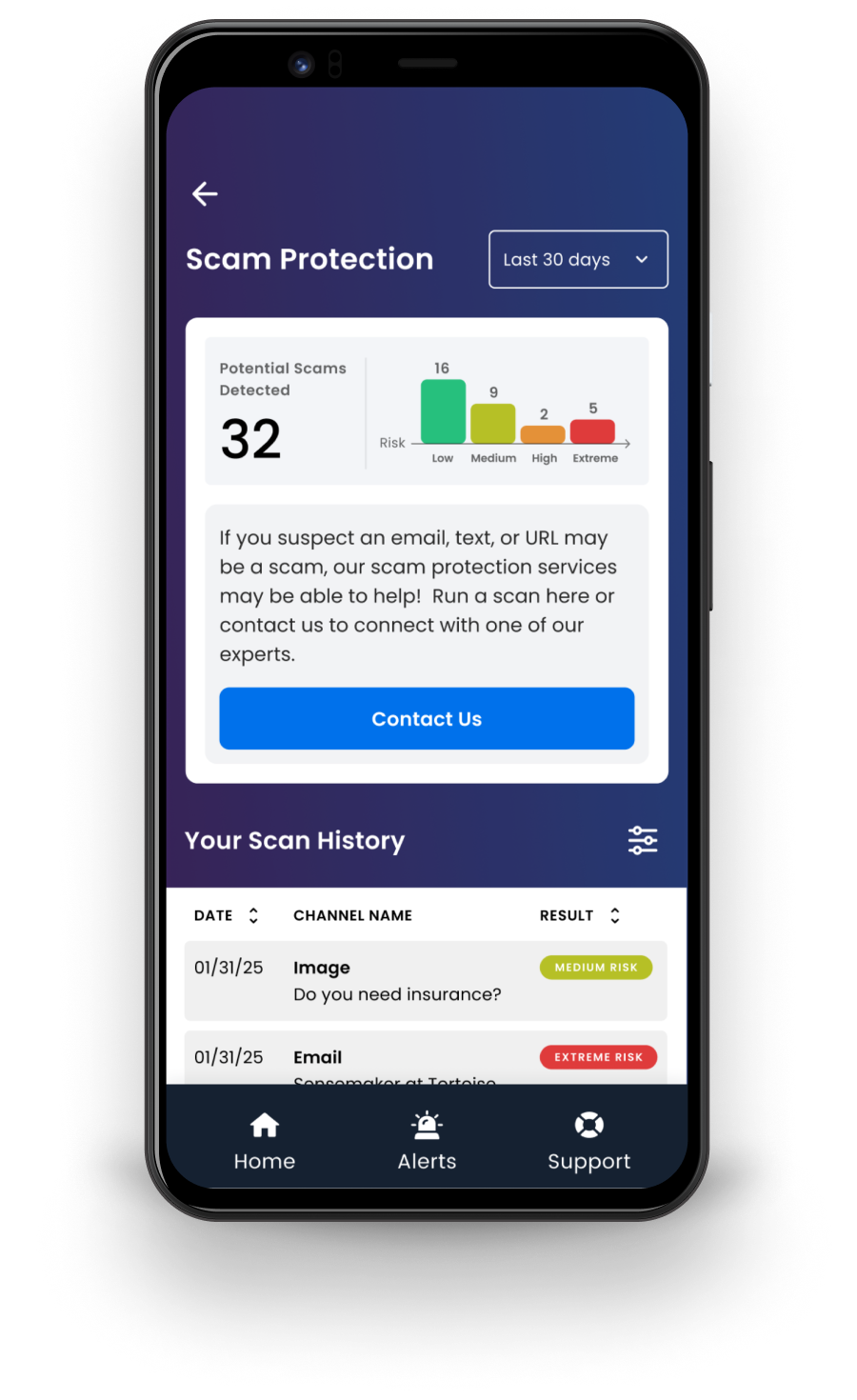
By April 2025, PeopleConnect was describing a recently launched mobile app and Scam Protection Center. That month it announced OmniWatch’s Gold Stevie award for a medium-sized computer-services company. A family plan was then described as forthcoming; the current site offers one. Those changes show the service broadening from individual monitoring into more everyday situations where people encounter fraud.
06 The testing habit behind the search box
PeopleConnect’s published values include a blunt instruction: “Fail early, fail often.” The employment proposition gives that line some substance. Its People Search careers material advertises split-testing bonuses and contributions of $100 a month toward student-loan principal or a 529 plan. Experimentation appears both in the predecessor’s deal history and in how the company describes rewarding employees.
There is a quieter sign of engineering work beyond the marketing pages. PeopleConnect’s public GitHub organization includes tools for the Ember web framework, shared code-checking configurations and a project called brie, short for Business Rules Integration Engine. These repositories give the company a visible software footprint alongside its consumer brands. They are useful evidence of technical work, rather than proof that any particular report is correct.
Distribution gets similarly close attention. A September 2024 partnership with Konnected Lives put TruthFinder background-check access inside a dating app for working professionals. The commercial logic is easy to follow: place the service beside the moment of uncertainty. A report can supply context, although it cannot certify that a date is safe.
In August 2026, PeopleConnect recognized partnership marketers Scott and Lexi, describing a network of hundreds of affiliates and influencers. Its September workplace-award announcement followed. These updates reveal a company still investing attention in customer acquisition and its working culture, alongside product development.
The useful idea to copy is the matching of a product to a precise occasion: a school reunion, an unknown number, a suspicious message. The acquisition history also suggests a second lesson: established audiences can remain valuable when their purpose stays clear. Neither lesson excuses vague claims or makes public information infallible.
PeopleConnect’s portfolio gives consumers several ways to approach the same subject: themselves and the people around them. Its value rests on making the next step easier to understand. Find the right person. Read the report with care. Know what suppression changes. Decide whether an ongoing service earns an ongoing payment. Personal information becomes useful when its limits are as legible as its contents.
Keep exploring
PeopleConnect website · Company news · Free Suppression Center · OmniWatch · Classmates
LinkedIn · Instagram · Facebook · X / legacy Control Group · GitHub · Company YouTube