Tim Gaunt has been renovating a fifteenth-century farmhouse since 2013. It is a useful occupation for someone who builds software: both offer ample opportunities to discover what a previous decision really cost. A quick repair and a careful one can look equally satisfactory on the day they are finished. Give them a few years. The distinction becomes less academic.
Gaunt uses the renovation to explain his approach to commerce personalisation. It also offers a way into his working life. He founded TSD in 2003, after building his first e-commerce site in the late 1990s. Since then, there have been client projects, products, a sale, abandoned experiments and an expanding collection of lessons about what needs looking after. His story gets interesting when the launch party is over.
A shop that outlived its moment
One piece of evidence still takes orders. TSD began working with Umbraco around 2004. In the early days, before a suitable commerce plugin was available, the team built its own commerce engine on top. The giftware distributor Joe Davies still trades on that engine. An old software decision continues to have a working day.
That survival matters to Gaunt because he has watched several generations of commerce technology arrive. His team subsequently adopted Ucommerce, worked with Tea Commerce, and later added Umbraco Commerce. New arrivals earn trust through contained projects before being asked to handle larger ones. The people building and supporting the systems have substantial influence over which platform gets chosen.
There is a temperament in that sequence. Curiosity gets a new tool into the room; experience decides how much responsibility it receives. For a client whose business depends on the checkout, an engineer’s caution can be a rather attractive personality trait. The interesting question is how well the shop will trade on an inconvenient Tuesday.
The invitation he hadn’t expected
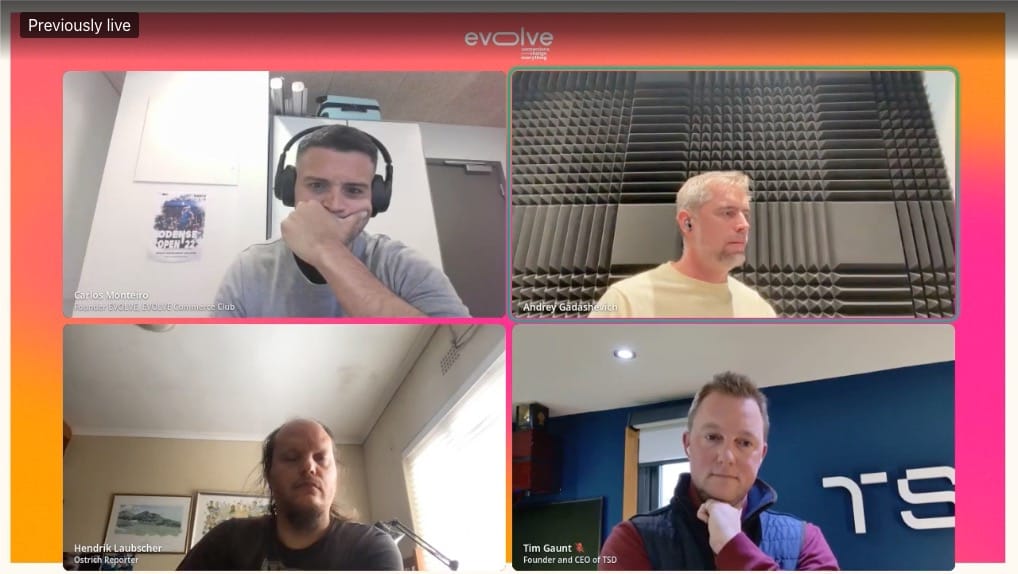
In October 2025, Gaunt joined an EVOLVE Commerce Club discussion about agencies building products. Andrey Gadashevich and Hendrik Laubscher were talking; about twenty minutes in, Gaunt found himself taking part. He later described feeling as though he had slightly gate-crashed the session.
He had something specific to contribute. For more than fifteen years, TSD had been trying to develop its own products alongside paid client work. The attraction was easy to understand. An agency sees similar problems across several businesses and has the people to build an answer. The difficulty arrives when that answer has to compete for time with a customer who is already paying.
Gaunt also admitted to a less flattering emotion: the frustration of helping clients grow while waiting for them to authorise the next piece of work. Their success could be real, and his pleasure in it real, while the agency’s growth remained dependent on someone else’s spending decisions. Entrepreneurship, in this telling, includes a certain amount of waiting by the telephone.
“First to market often beats perfect to market.”
Tim Gaunt, on building agency products
The ideas that met a calendar
Crisis Cover began with a customer question during the banking crisis: what would happen if the provider went bankrupt? A recurring concern became a product, which Gaunt says was sold in 2016. The idea had come directly from the work.
Other ideas received a less permanent welcome. At one point, TSD tried to develop four products simultaneously. Attention scattered. Client work took precedence. The experience led to a limit of two product launches a year and a more demanding test of whether an idea deserved a place.
Gaunt’s selection process deliberately bruises the optimistic estimate. Assume more effort than the team first predicts and a smaller reachable market. Look for a route to recovering the initial investment within twelve to eighteen months. Talk to customers early enough that an unenthusiastic answer can still save the business time.
There is even a holding place for ideas that fail the present test. A promising thought can wait without becoming a project. For someone whose company can build software, choosing what to leave unbuilt is a consequential part of the job.
When the marketplace went quiet
TrendSeam supplied a different lesson. Launched for Shopify in 2017, the reporting product initially gained multiple installs a day with little marketing. Then reviews began mentioning a breaking API integration. TSD had fallen behind Shopify’s changes. Marketplace visibility dropped, and the flow of new installs stopped.
The unpleasant discovery was how quickly distribution could disappear. A product could remain the team’s intellectual property while its route to customers depended on rules and rankings elsewhere. The marketplace that made an early audience accessible also required continuing attention.
Gaunt’s response was to make that dependence explicit. TSD reviews a quarterly scorecard covering releases, marketplace conditions, competing features, reviews, installs and churn. It keeps agency income alongside product income. It also distinguishes the reporting and segmentation logic from the connector that ties a product to a particular platform.
That is a founder’s education with fewer celebratory photographs. A product has to remain usable, current and findable. Missing any one of those can spoil the others.
The part after “finished”
Keeping a product alive required changes inside the agency too. Gaunt describes booking product work into the calendar, assigning developers and protecting the allocation. Otherwise, an urgent client request could borrow the afternoon, then the week, then the product’s future.
The rhythm needed changing. Client projects tend towards a launch, a migration or another recognisable finish. Products need smaller improvements, continuing support and repeated decisions about what comes next. Some developers prefer the satisfaction of completing a client project. Gaunt has learned to account for that preference when assigning work.
Then there is everything surrounding the code. Instructions need writing. Support questions need answering. Customers need a way to discover the product. TSD now budgets thirty to forty percent of product time for documentation, support and marketing. In Gaunt’s account, those tasks had once arrived as unwelcome surprises. They now have a place before the building begins.
A price tag with an argument attached
At Codegarden 2026, Gaunt took this interest in operational reality onto the stage. His talk, The €200k Sweet Spot, addressed commerce projects in the €150,000 to €300,000 middle. He argued that these businesses were poorly served between simpler shops and enterprise projects.
The questions afterwards concerned enterprise resource planning connections, discovery and costs concealed beneath the storefront. He turned the talk into a series, giving the details more room than a conference slot allowed. One of his examples was a CSV process built in 2006 that was still running.
The resulting argument concerns what a business is actually paying to change. A store can reduce manual order entry, prevent copying mistakes or save staff from checking stock by telephone. Those gains sit inside everyday work. A proposal becomes easier to assess when it names them.
Gaunt’s commercial position follows naturally from his engineering interests. The price needs a connection to a business problem. An impressive list of features cannot do that accounting on its own.
The checkout remembers what matters
His September 2026 writing narrowed the lens to a customer who cancelled a payment, then returned and paid. TSD’s investigation found that an order number had changed and earlier payment information had been overwritten in the order’s properties.
The technical distinction became a customer-service problem. A person answering the retailer’s telephone might see the successful order without the history explaining the customer’s difficulty. Gaunt compared how the commerce platforms stored attempts, then described ways to retain an accessible history.
It is a revealing choice of subject for a CEO. The detail is small enough to disappear inside a platform comparison, yet large enough to make a working day harder. His concern follows the information from database to support desk. Somebody needs to explain what happened to the customer. The system ought to give them a fighting chance.
Letting go of the lid
By October 2026, Gaunt was applying his interest in delivery to AI agents. He described developers moving from initial amazement through close inspection and micromanagement towards delegation. The useful work shifted into defining the outcome, setting constraints and reviewing what came back.
His analogy came from low-and-slow cooking: repeatedly lifting the lid interferes with the job. Barbecue also appears in his invitation to argue after the Codegarden talk. Software management has acquired a brisket.
The practical application extends beyond coding. In an October 23 account, he described AI-assisted log review, incident investigation and dashboards at TSD. He also insisted that a proposed explanation of an incident remained something a person had to check. Faster investigation creates room to test more possibilities. It still needs someone who understands the business and the evidence.
The industry expert gets a co-founder
That relationship between knowledge and building now runs through TSD AI, the fund and studio Gaunt co-founded with Gareth Mann. Its proposition starts with people who understand a B2B market and have earned the trust to sell into it. The studio supplies software delivery and operational support alongside capital.
Retail and commerce, market research and data, and financial services and insurance are its initial areas of operating depth. The industry specialist remains the lead and face of the business. Gaunt brings the experience of turning a business requirement into something that can be built and maintained.
It is a continuation of a long-running question: how does useful knowledge become a working product? His career supplies both encouragement and friction. Some things sell. Some things stop. Some are still taking orders decades later. The farmhouse offers its own version of the same test. The work has to stand up after the excitement of doing it has passed.