A generator is an unusual piece of equipment to put at the center of a software founder’s story. It has no elegant interface. Nobody congratulates it on its product strategy. Yet a generator, a Starlink connection and a shared office in Kyiv help explain Denys Maksymenko’s work more clearly than a collection of technology badges ever could.
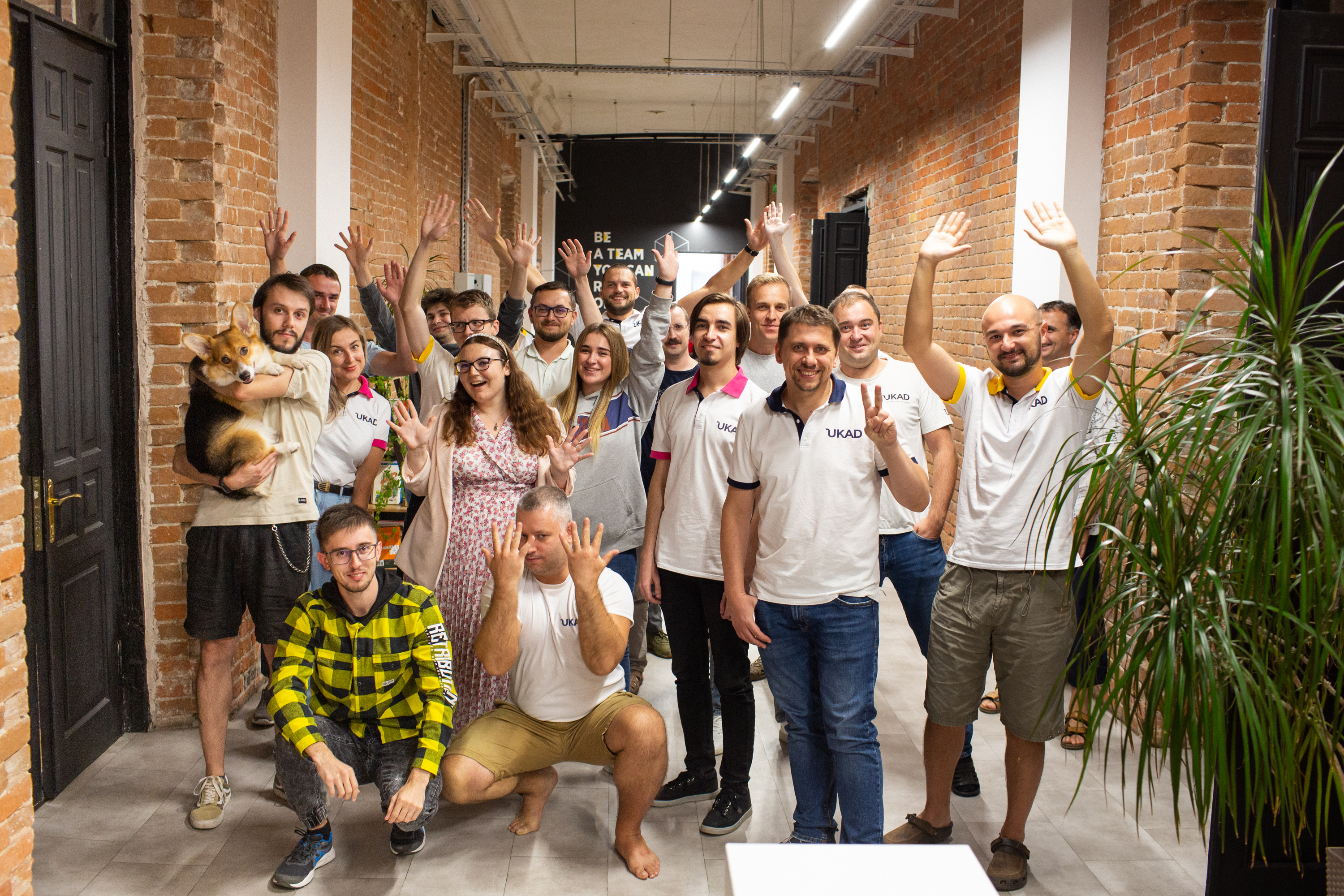
After UKAD’s team had to leave its workspace in Kharkiv, the company needed somewhere its people could carry on with client projects. Maksymenko and friends from other Kharkiv IT companies pooled their efforts to create a shared hub. Finding suitable premises involved the decidedly physical requirements of installing backup power and satellite internet.
Software travels easily. The people who make it have rather more luggage. They need somewhere to sit, a connection that holds, and colleagues they can rely on. In the Kyiv hub, the arrangements also included table tennis. A business continuity plan can apparently leave room for a backhand.
That episode offers a useful way into Maksymenko’s career: the recurring work of giving a team the conditions to stay useful, even when the conditions around it change.
The engineer behind the title
Maksymenko is UKAD’s founder and CEO. His professional profile places him in Sammamish, Washington; his company’s origins are in Kharkiv. Between those two locations sits a business serving customers across national borders, with a particular connection to Northern Europe.
He studied at Kharkiv National University of Radioelectronics from 1996 to 2001. His career has included software development, business analysis and project management. Those are different vantage points on the same awkward moment: when an apparently simple request meets the system that must actually deliver it.
A developer encounters the code. An analyst asks what the business needs. A project manager has to reconcile the answer with the calendar. Having worked across those roles gives his present job a practical context. A promise made by a software company eventually becomes somebody’s engineering task.
His own writing has stayed close to those tasks. In 2019, he published articles about Docker containers for .NET and the advantages and drawbacks of Umbraco. These are subjects with working consequences for developers and website owners, rather than much potential for dinner-party glamour. There is a certain reassurance in that.
A garage, then the work after launch
UKAD began in 2005. Maksymenko has described its beginnings as a garage startup. By the time of an executive interview discussing its 2019 business, it had grown to more than 180 developers. He also said he still took on project management work himself.
The revealing detail in his description of client relationships was their visibility: customers knew the people working on their projects and who was accountable for quality and timing. He called it a “cozy and safe approach.” An unexpectedly domestic phrase for a business involving databases, integrations and deadlines.
It is also a legible promise. A client can ask who owns a problem. The answer ought to be a person who understands it. The organizational chart has to survive contact with an actual question.
Today UKAD works with .NET, Azure, Umbraco and Optimizely, among other technologies. Its offering spans dedicated teams, additional specialists for existing teams, and custom software delivery. Those arrangements differ in scope, but all require people to learn how somebody else’s business works.
The customer who is still there years later
Consider AJ Produkter, the Swedish workplace furniture and equipment business. Its partnership with UKAD dates to 2012. The work has covered an ecommerce environment serving 19 European markets, including modernization with .NET and React and content management using Optimizely.
One challenge was wonderfully unglamorous: editors across those markets depended on an aging desktop application. Replacing that workflow with an interface for managing campaigns and banners is the sort of change customers may never notice directly. The editors, one suspects, would have opinions.
Product information, search, recommendations and delivery calculations also formed part of the engineering work. UKAD reports that online sales grew 2.5-fold following the platform modernization. That is an outcome of a client engagement, rather than a personal sales trophy for its CEO.
For understanding Maksymenko’s business, the start date is as interesting as the sales figure. A relationship continuing from 2012 must accommodate a succession of requirements. The launch becomes one event in a much longer conversation. Someone still has to understand the platform when the next request arrives.
The coffee has to fit in the box
Another UKAD engagement brings the principle down to the size of a parcel. Danish coffee retailer Kaffekapslen, now Kaffek, needed technical support as it expanded across Europe. UKAD supplied a team including developers, designers, machine learning specialists and content editors working with Kaffek’s management.
The work included connecting business systems, improving recommendations and coordinating product information across markets. It also addressed packaging: reducing empty space in parcels to lower shipping costs. A website can look immaculate while a company spends money posting air.
UKAD reports that the retailer expanded from 13 to 22 countries during the cooperation, supported by its technical solutions. Expansion was the retailer’s achievement; the engineering team’s role was to help its systems keep pace.
That distinction matters in a founder profile. Maksymenko leads the organization supplying the expertise. The delivery belongs to teams working with clients. Following the actual work makes the business easier to understand than pretending its CEO personally designed every screen or connected every payment system.
Before people could stay, they had to arrive
In July 2021, Maksymenko wrote about a different obstacle to building teams: moving developers to Ukraine. UKAD had explored bringing developers from Belarus to Kharkiv. What looked like a plausible destination became complicated by the practicalities of residency and employment.
His argument concerned the friction between arrangements familiar to Ukrainian IT contractors and the requirements faced by foreign professionals. He advocated simpler routes for companies to bring developers into the country and for those developers to establish themselves.
This was an employer making an argument about the labor market, with an employer’s interest in access to talent. He also argued that incoming professionals could bring skills and spending into the local economy. The proposal connected company growth to a wider question about who could participate in Ukraine’s technology industry.
Read alongside the later Kyiv hub, it gives his story an unexpected geographical thread. In one case, the problem was helping people arrive. In the other, it was helping a displaced team keep working. Both demanded attention to the arrangements around the job.
Argues for easier relocation of developers to Ukraine.
Describes a shared Kyiv hub after the team’s move from Kharkiv.
More than a spare connection
The shared hub brought cooperation between companies into the same physical space. Maksymenko described joining friends from Kharkiv’s IT community to establish it. In that arrangement, a relationship outside the company helped sustain the work inside it.
“We joined forces with our friends from Kharkiv IT companies and created a shared IT hub for our employees.”
Denys Maksymenko, on the Kyiv workspace
There is no need to decorate that decision with a heroic office scene. The practical details carry their own weight: suitable premises, power and connectivity, shared between people who already knew one another. Reliability had become a question about a building as much as a codebase.
His stated hope was that the generator and satellite connection would cease to be necessary. Backup equipment is unusual that way. The purchase is successful when it can remain idle. For a company selling dependable delivery, planning for interruption had acquired a very concrete meaning.
Learning the new tools, keeping the judgment
In a 2026 post, Maksymenko said he had completed Anthropic’s Claude Code training to gain practical familiarity with AI coding tools. His emphasis was on their place in engineering delivery and on the continued need for experienced technical oversight.
His phrasing was direct: “AI accelerates parts of delivery.” He also wrote: “It does not replace engineering judgment and ownership.” For someone whose earlier public writing concerned containers and content management systems, hands-on exploration of another development tool fits an established professional interest.
The question running through these episodes is responsibility. A customer needs someone accountable for the software. A developer needs workable conditions. A new tool needs a person capable of assessing its output. Speed creates more occasions to exercise that responsibility.
Maksymenko’s career offers a view of software entrepreneurship measured across those ordinary obligations. A partnership begins in 2012 and continues. A team needs a new workspace and finds allies. The tools change, and the founder goes back to learning. There is always another request, another release, another person who needs the connection to hold. The company’s history gives those small obligations a long horizon. They accumulate across projects and places, with much of the effort hidden from the eventual customer. A working checkout, a usable editing screen and an uninterrupted conversation are modest things to ask for. Supplying them consistently is a substantial occupation.