At Tillo, speed once depended on somebody looking at the money. Customers sent funds. People checked receipts, reconciled transactions and updated balances. The company could approve incoming funds within an hour, according to an HSBC case study, but daily finance work was consuming half the finance team’s capacity. The reward could be digital while the work behind it remained stubbornly manual.
- Tillo supplies the connections behind business gift cards and rewards.
- Buyers use its API or a branded storefront; retailers gain distribution.
- The useful lesson: simplify the steps before and after the reward.
That tension helps explain the company. Founded in 2016 by Alex Preece and Gareth Gillatt as Reward Cloud, Tillo set out to simplify gift cards. Its own banking process needed the same treatment. HSBC’s treasury APIs and virtual accounts helped automate incoming-funds processing. A promise to the customer had forced a redesign behind the scenes.
“It was clearly not a scalable solution.”
Lee Spencer, CFO, on manual reconciliation
A grocery shop, with fewer clicks
Consider Blue Light Card, the membership service for frontline workers. A discounted gift card can make everyday shopping cheaper. But a saving has competition: the effort required to collect it. A customer standing near a checkout is unlikely to admire a complicated purchasing journey.
Tillo’s Blue Light Card case study describes a reduction from 15 clicks to three. The Shopping Cards experience moved inside the membership app. Members select a retailer, choose an amount and buy without leaving it; the digital card stays in their account. Tillo reports 88 percent more orders year on year after the streamlined experience. The figures describe a customer case, rather than a controlled experiment, but the design choice is concrete.
The company’s product is easiest to understand here. Blue Light Card owns the member relationship. Retailers supply places to spend. Tillo supplies the connection that allows the experience to happen inside somebody else’s product. The recipient need never become interested in the infrastructure.
Two doors into the same network
One entrance is the API: software that lets a business request and manage gift cards from its own application. A cashback provider can turn a balance into a reward; an employee-recognition service can fulfill a thank-you. Instead of assembling individual retailer connections, the buyer connects to Tillo.
The other entrance is StoreFront, a white-label gift card marketplace. It supplies the browsing and checkout experience under the customer’s branding. Businesses can sell at face value, offer discounts, provide cashback or support points. Tillo says launches can take a few days, depending on customization and readiness. That is a product claim with conditions, not a deadline every buyer should put in a project plan.
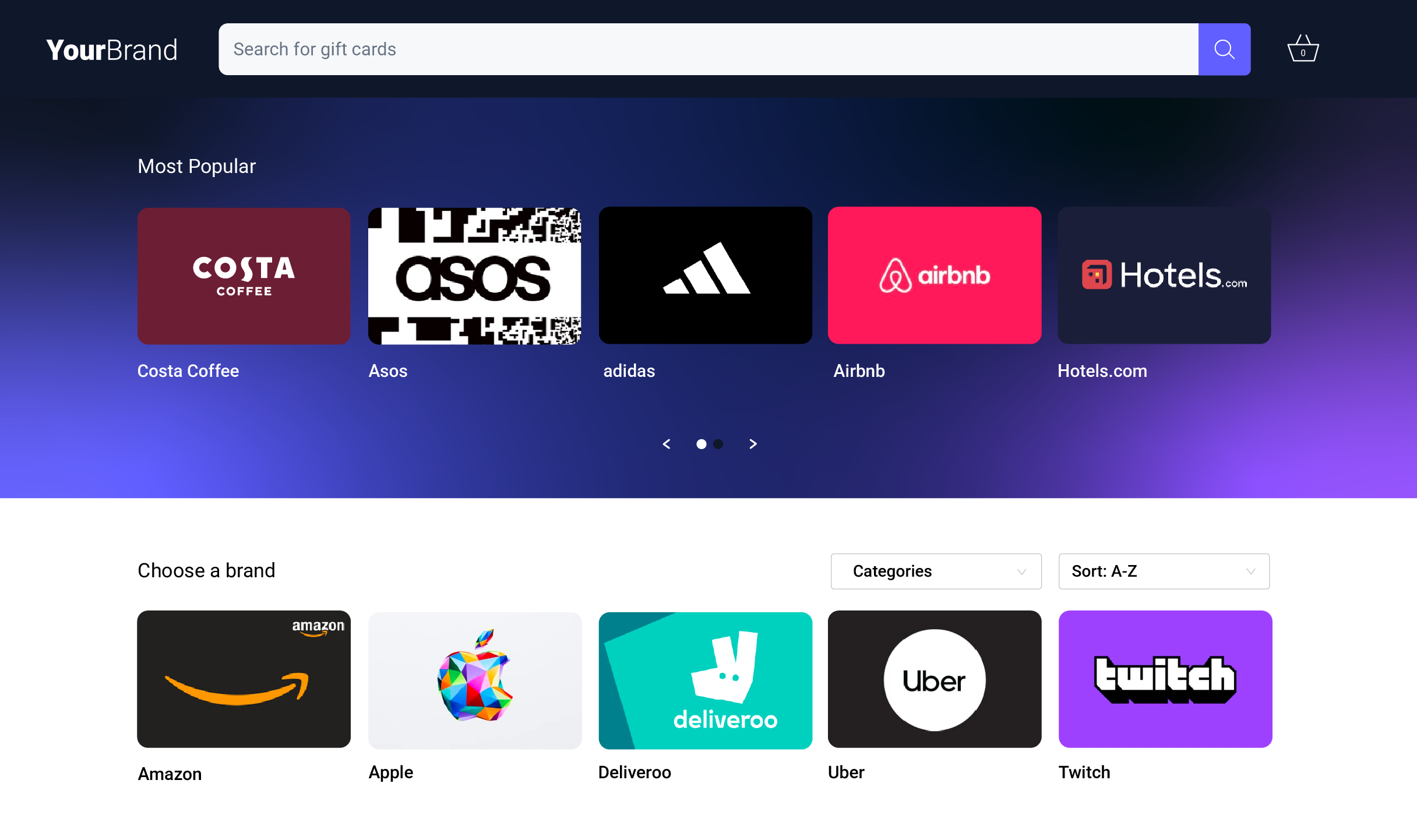
ChoicePlus handles a different decision: which reward should someone receive? A business sends a branded multi-brand reward, and the recipient chooses from a configured catalog, splitting value where supported. PrepaidPass adds prepaid Mastercard and Visa options. The products share a distribution problem, but solve different moments in the customer journey.
The price of making it look easy
A buyer still has to supply money. Tillo’s integration guide requires a funded production account before live transactions, along with testing and certification. The commercial calculation should therefore include money committed to the program as well as engineering, support and any contracted fees. The practical first step is to request a quote for the actual countries, brands and volumes involved.
Discounts create room for several business models. A platform can pass savings to shoppers, retain part of the margin or use it to fund cashback. A retailer gets another distribution channel. Tillo sits between these sides with technology and commercial relationships. Its reported $8.5 billion in gift cards processed measures value moving through the network; it does not measure Tillo’s revenue.
The documentation also punctures the fantasy of perfect uniformity. Some retailers support cancellation or balance checks; others do not. Some orders require asynchronous processing. A large catalog does not mean every brand is approved for every buyer. Teams should test delayed orders and confirm retailer permissions before promising instant, universal redemption.
Tango and Tremendous also offer reward APIs. Tillo’s case rests on the combination of buyer infrastructure, retailer distribution and managed programs. For a buyer, the useful comparison is the usable catalog and complete operating cost. If recipients require unrestricted cash, a closed-loop retailer gift card answers a different need.
Buying the knowledge, too

In March 2024, Tillo acquired Jigsaw Business Solutions in a deal valued at £3.6 million, including an earn-out. Jigsaw managed gift card programs for more than 20 retailers. The purchase added people who knew how to run those programs, alongside the technology that connected them.
Tenzing’s May 2025 investment bought out early investors through a fully secondary transaction. Then, in September 2026, Tillo announced its acquisition of and partnership with Italy’s Amilon. The companies forecast more than £3 billion in combined gift card processing for 2026. That remains a forecast. The direction is clearer: international infrastructure backed by local commercial knowledge.

The people doing that work receive their own version of the rewards proposition. Tillo’s careers materials describe hybrid working, learning budgets, enhanced family leave and charity matching. Its stated values include learning from mistakes and solving challenges together. These are the company’s account of its workplace, rather than an independent verdict on the experience.
The gift you buy yourself
The word “gift” increasingly obscures the use. Tillo’s October 2026 research, conducted by The Harris Poll among 3,081 US and UK adults, found widespread self-purchasing. Eighteen percent in each country said they had bought a gift card specifically to control spending. A retailer balance can be a small household budget.
That same month, GiftWellSoon partnered with Tillo to add practical gift cards to care registries: groceries, meals and transport for people facing difficult circumstances. The transferable idea is modest. Start with what somebody needs to do, then remove the administrative distance. Sometimes the reward is simply getting on with the day.
For another business, copying this approach starts with a map of the handoffs: funding, approval, purchase, delivery and redemption. Find where a person waits or repeats information. Fix that step, measure completion, then widen the offer. Adding more brands will have limited value if the original purchase still feels like an errand.