A parking garage asks a peculiar question of technology. Can it be sophisticated enough to recognize a customer, calculate a price and reconcile a payment, yet simple enough for a tired person to use through a car window? The answer has to arrive before the driver behind them starts honking. TIBA Parking works inside that narrow interval, where software becomes a physical permission to move.
- TIBA connects parking gates, payments and cloud management.
- Its buyers run garages, campuses, hospitals, hotels and airports.
- The useful distinction: upgrade the operation while preserving equipment that still works.
Its category has an appropriately bureaucratic name: Parking Access and Revenue Control Systems, or PARCS. Think of everything between arriving at a garage and leaving it, including the accounting afterward. TIBA supplies hardware and software for that whole sequence. Its customer is usually the owner or operator; the person trying to reach the exit encounters only the visible tip of the system.
01The expensive part is starting over
TIBA traces its beginnings to 1986. Public records identify Isaac Tavori as its founder, and its early expertise included barcode technology. There is a pleasing continuity here. A barcode, a phone credential and a recognized license plate all perform a similar job: they tell the system which rules apply to this particular arrival. The identifier changes. The obligation to get the answer right remains.
The company’s current mission puts investment protection at the center. Working equipment should gain capabilities as the platform develops. That is an attractive proposition in a business where changing software may also involve technicians, lane closures and metal bolted into concrete. A garage operator buys a future maintenance problem along with every new machine. Compatibility can therefore have a value that a screen demonstration barely reveals.
02Baltimore bought a support plan, too
Baltimore makes the economics concrete. Its April 2024 procurement agenda described equipment aged 15 to 20 years, replacement parts disappearing and software support ending that year. The proposed agreement totaled $4,001,022, including $3,413,150 for equipment and installation across 12 garages, a lot and office controls. Those are project figures, not a price list.
The panel compared Precision’s TIBA proposal with Flash, visited operating garages and examined service arrangements. Precision’s included on-site and remote support helped persuade it; the agenda described Flash’s equivalent outsourced component as more expensive. TIBA subsequently reported a 12-garage SPARK and X60 rollout. The initial pressure was obsolescence. The selection also depended on who would answer when something went wrong.
$3.41m equipment + installation · $4.00m total agreement
Rounded for display. Scope includes garages, one lot and office controls.03A ticket is a permission slip
SPARK is the cloud management layer. An operator can inspect facilities, manage accounts, change access permissions and handle validations from a central environment. A merchant can discount a customer’s parking. A monthly parker can have an account rather than a fresh transaction every morning. The platform’s documentation lists more than 150 reports, a reminder that a garage is also an unusually complicated bookkeeping operation.
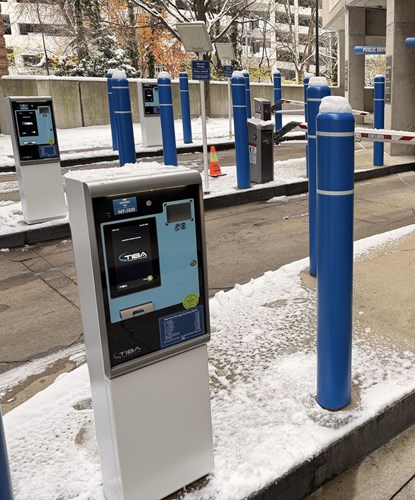
The X60 equipment handles the encounter in the lane. TIBA’s September 2023 ticketless announcement described plate recognition, scan-to-pay and lobby payment by plate number. It also described maintaining the traditional parking journey as a fallback. That qualification matters. A faster normal journey is useful; a recoverable exception is what keeps the queue moving when the normal journey comes apart.
or license plate
and validation
Journey completed.
Partnerships fill in the surrounding jobs. ParkMobile announced a gated-garage payment integration in January 2021, extending its app into facilities using TIBA equipment. Parker Technology’s agreement later that year connected remote audio and video assistance with TIBA’s lane devices. The integration allows actions such as opening a gate or adjusting a ticket. The help button has to reach someone who can actually change the situation.
04The gate that got to stay
At Marconi Garage in downtown Columbus, the idea becomes refreshingly literal. A January 2026 deployment report describes 12 lanes serving a neighborhood of offices, restaurants and Nationwide Arena. The installation paired X60 equipment with SPARK and supported monthly and transient parkers. The team also reused the existing magnetic gates. New management capabilities arrived without every physical component earning a trip to the scrap pile.
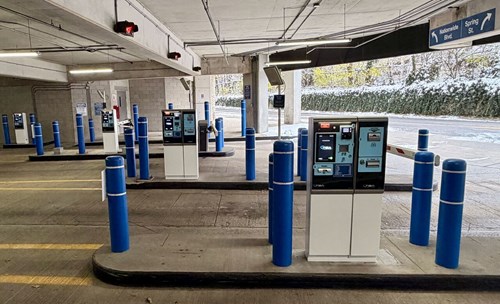
That example gives a buyer a useful question to copy: which parts of my existing installation can remain? The next questions concern credentials, payment integrations and support. Ask for a demonstration with the awkward cases included. A lost ticket, an incorrect validation or a customer needing assistance tells you more about the operating model than a clean demonstration in which every credential works.
05Someone still has to answer
TIBA’s distribution explains part of its position in the market. It sells through direct operations and value-added resellers who install and support systems locally. When FAAC announced its acquisition agreement in December 2020, the stated consideration was $135 million plus acquired net cash. FAAC specifically highlighted TIBA’s indirect sales channel as complementary to its existing, predominantly direct North American model. The service network was part of the attraction.
“Reliable systems and support are essential to successful parking environments.”
Ilan Lev, TIBA CEO · February 2026
That emphasis persists. In February 2026, TIBA expanded Precision Technology Solutions’ regional responsibilities, effective March 2. In August, Richmond’s Expressway Deck became the city’s sixth SPARK deployment, with Entry Guard Systems providing local implementation and ongoing support. These announcements point toward the same commercial logic: central software needs people close to the installation.
For a prospective customer, the buying exercise should follow that same logic. Separate the equipment purchase from installation, software, payment processing and service commitments. Then ask what happens when the next capability arrives: a new credential, a reservation partner or a different payment journey. Which change is configuration, which requires integration work, and which requires a technician? These are ordinary procurement questions, but they expose the distance between a platform that can grow and an installation that merely looks complete on opening day.
The approach suits operators coordinating different parking populations across multiple facilities. Its usefulness depends on the actual site: compatible equipment, configured payment services, dependable support and a workable exception process. Someone needing only a simple unattended surface-lot payment tool may have little use for the wider machinery. For a complex garage, however, keeping existing assets useful can be a practical purchasing criterion. The small victory is easy to recognize: the right driver gets through, and the operator can explain why.
See the platform, the installations and the people behind the help button.