The first Olympic opportunity did not quite work out. In the run-up to Atlanta’s 1996 Games, Lanier Parking founder Michael Robison negotiated hard enough that his company missed the official assignment. But the negotiations introduced him to Tim Walsh, who managed the Games’ parking and later joined Lanier as a partner. A failed deal had produced a relationship worth keeping.
- Lanier runs the people, payments, and equipment around a parking space.
- Its buyers are property owners and public agencies; its everyday users are drivers.
- The useful lesson: examine the collection process before reaching for a price increase.
By Vancouver’s 2010 Winter Games, Lanier was working with Canadian operator Impark on an assignment spanning 25 parking venues. Today the two brands belong to the same Reimagined Parking family. There is something pleasingly circular about that. In parking, apparently, even corporate relationships can come back around.
01 / A business built around the handoffs
Lanier began in Atlanta in 1989. Calling it a parking company is accurate, but leaves out the interesting part. A painted rectangle does little by itself. Someone must decide who can use it, collect the right payment, maintain the equipment, answer questions, and manage the rush when everyone wants to leave.
Lanier takes on those tasks for commercial properties, municipalities, hospitals, hotels, airports, and entertainment venues. Its offering spans management, leasing, consulting, valet, shuttles, and enforcement. The buyer owns or controls the property. The driver encounters the service, often without having chosen the operator. That makes this a business with two audiences whose priorities can diverge.
A hospital illustrates the distinction. An administrator needs spaces available for staff and patients. A patient needs a manageable arrival. Lanier describes adapting valet, signs, infection-control procedures, and vehicle retrieval to healthcare sites. Its valet training includes property-specific situations such as an ambulance arriving. A parking operation has to understand what happens beyond its gate.
02 / The missing ticket was a business problem
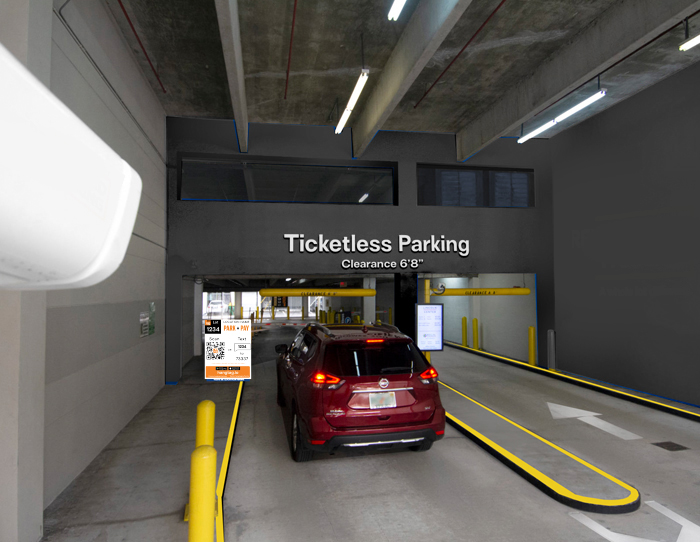
Consider AmericasMart in Atlanta. A case study published on Lanier’s website describes garages where paper tickets caused queues, missing tickets weakened collections, and departures after staffed hours could escape payment. The bottleneck was both physical and financial.
The network installed ticketless access and revenue control, linking vehicle records to payment. Kiosks, online payment, and auto-pay moved transactions away from the exit lane. Managers remained available; cashiers became roaming ambassadors. Rates stayed unchanged. The company reports that revenue during the ten-day market rose 26% compared with previous years. That is an operator-reported result for this property, rather than a forecast for another garage.
Reported revenue during the ten-day market
Indexed comparison. Company case study; previous years = 100.The lesson travels well: before charging more, inspect where the money goes missing. But the result depends on the starting conditions. A garage already collecting every fee has a different problem. Changing the payment method cannot create customers who have no reason to visit.
03 / A price for the work around the space
What does that operating work cost? Contracts provide better answers than a universal price list. In Wrightsville Beach’s 2015 renewal, local reporting put Lanier’s management fee at 3.1% of collected revenue, down from 3.33%. The town and operator had adjusted meters, signs, passes, rates, and space markings. This was an ongoing operating relationship with negotiated economics.
The same report described a proposed shift toward phone payments on additional streets, with projected annual equipment and labor savings of nearly $20,000. That was a projection. It also meant visitors needed an account and a way to pay digitally. A cheaper collection channel changes the work customers must do.
Lanier now invites owners into a call, a customized proposal, and an operational plan. Its business sits between property management and transportation operations. Regional operators and firms such as Ace Parking offer alternatives; owners can also keep the work in-house. Lanier’s pitch is the breadth of the combined service, backed by a larger operating network.
“I am excited to pass the torch to Jerry”Michael Robison, announcing the 2014 leadership handoff
That network grew through changes in ownership. Antarctica Capital invested in 2014, when Jerry Skillett became CEO and Robison retired. In November 2023, the parent announced its Reimagined Parking identity and a Mubadala Capital-led recapitalization. The stated direction emphasized parking service, operations, technology, and employee training.
04 / Software with someone standing nearby
The current toolkit includes hangTag for finding and paying for parking, O-Valet for ticketless vehicle requests and valet management, and access systems using license plate recognition. Remote monitoring adds assistance when equipment misbehaves. These tools deal with different moments in the same visit.
O-Valet also records vehicle inventory, staff interactions, and staffing metrics. That gives managers information about the work behind a retrieval request. Lanier’s commercial services extend to sweeping, line painting, and an in-house sign production facility. The range is revealing: an unclear sign and a failed payment terminal can both interrupt the journey.
Lanier’s stated culture puts service and community involvement at the center. The practical test is whether employees can help when a visitor gets stuck. Automation still needs a handoff to someone with the information and authority to resolve the problem.
05 / The money still needs watching
A May 2026 Harris County audit of its Lanier Parking Meter Services agreement adds a necessary accounting perspective. It identified gaps in county oversight, late deposits, and missing required reports. Of 90 daily cash deposits tested, 38 arrived three or more business days after collection.
The county’s response described expanded revenue reconciliation and variance reporting already introduced in September 2025, plus further controls targeted for November 30, 2026. The point for buyers is concrete: specify reports, check deposits, and document approvals. Hiring an operator leaves an owner with oversight work.
That is what makes Lanier worth studying. The business joins tasks that organizations often treat separately: hospitality, traffic, maintenance, payments, and accounting. The driver judges the visit in minutes. The property owner judges it over months. A well-run garage has to make sense on both clocks.
Keep moving
EXPLORE LANIER & ITS TOOLS