At a coworking building in Almaty, the problem was not a lack of ingenious parking theory. It was a car park that needed to know which cars belonged there, how long they stayed and whether its spaces were being used well. In 2020, Amirkhan Omarov, then general manager of SmArt.Point and a cofounder of what became Parqour, tried license plate recognition instead of buying a conventional stack of parking equipment. The pilot worked. The firm that grew from it now sells a different proposition to property owners: let the plate be the ticket, and let the car park account for itself.
- Parqour connects plate recognition, access, payments, permits and reporting in one operator platform.
- It serves parking owners and operators at commercial, residential, airport and other sites.
- Some customers pay a software subscription; in other deals Parqour funds installation and takes a share of receipts.
- The useful lesson is financial as much as technical: an upgrade becomes easier to sell when it can pay back from measured revenue.
The little gate with a large ledger
A driver approaches a gate. A camera reads the number plate and opens a parking session. At a gated site the barrier lifts; at a gateless one there may be no barrier at all. A first-time driver can scan a QR code to register and pay through a mobile page. A returning driver with a payment method on file may be charged on exit. The system can also recognise a tenant permit, a hotel validation or a reservation made through an outside platform. Parqour says its software integrates with ParkMobile, SpotHero, Honk and PayByPhone.
For the operator, the valuable part happens after the car disappears around the corner. Entries, exits, occupancy, revenue and utilisation become records in one dashboard. A shopping centre can validate a customer's stay; a business centre can manage employee access; a residential site can set permits; an airport can see how its inventory is used. Remote staff can monitor and intervene. The company also describes valet workflows, nested zones and violation detection. It is a parking management company disguised, to the driver, as the absence of a ticket.
The founder went looking for an unglamorous market
Omarov had worked around real estate and corporate technology before choosing parking. In a 2024 interview, he said coworking initially looked promising, but its audience was too narrow to scale as he wanted. Parking offered a larger, slower-moving business. Many sites still depended on attendants, cash collection, ticket machines and equipment tied to a particular vendor. A manager could see cars passing through without getting a clean account of what the asset earned.
The distinction matters. A conventional parking equipment supplier may sell a matched set of barriers, readers and software. Parqour says its platform can work with different hardware, including equipment already in place. It trained its plate recognition on local number formats, a detail that matters greatly when the customer is in Kazakhstan and a global system has seen few Kazakh plates. Omarov told Forbes Kazakhstan that the team had analysed millions of local plates and had collected a large training set at a Dubai facility as it expanded. His stated aim was accuracy in the places where clients actually parked.
“We come to players who want to run a transparent business.”Amirkhan Omarov, translated from Forbes Kazakhstan
That line is franker than the average parking pitch. Better counting is useful to an owner who wants a clearer view of receipts. It is less attractive to anyone who benefits from a murky one. Parqour's customers therefore have to want the accounting as much as they want the convenience.
The price of saying “no upfront cost”
Parqour has described two ways to sell. In a 2023 company presentation, one was a subscription of $250 per camera per month, with the client paying for equipment. The other was a revenue-share arrangement in which Parqour paid the capital cost and earned a portion of parking receipts. Those figures are historical and contract-specific, but the structure explains the company's appeal. The owner can modernise a facility without writing a large initial cheque. Parqour accepts the installation risk in exchange for recurring income.
By 2024, Omarov told Forbes Kazakhstan that many customers chose the second route. In those arrangements, he said, the owner typically returned 10 to 15 percent of takings over several years, and revenue sharing accounted for 60 to 70 percent of Parqour's income at the time. The terms differ from the older presentation's 20 to 30 percent range. That is a useful reminder: “zero upfront” describes the timing of payment, not a free car park.
The model drew Parqour into work that software vendors usually leave to someone else. Omarov said his team sometimes paid for line painting and cleaning as part of a parking deal. It is an awkward sort of moat: a rival can copy a feature more easily than it can finance a site, coordinate local operations and wait for the receipts. It also makes the business capital hungry. The company's 2023 deck listed founder money, debt from friends and outside SAFE financing; a later interview put total founder and investor contributions at roughly $7 million, including money earned during the build-out. Public data providers report a $5 million Series A in June 2023, but the company's own published history offers fewer details on that round.
What broke before the model worked
A good growth story should keep the invoice for its mistakes. Parqour did not become profitable immediately. Omarov told Forbes Kazakhstan it first moved into profit late in 2023, about three and a half years after launch. A substantial engineering team cost money, and not every parking owner wanted more transparent records. He said municipal opportunities were difficult to access. Pandemic closures reduced parking demand at malls and offices even as contactless systems grew more appealing.
Then civil unrest in Kazakhstan damaged payment machines at Almaty's Promenade shopping centre, a customer where Parqour had invested in the installation. The company lost several clients during that period, including Promenade, according to the same interview. When the supplier has funded the equipment, damaged equipment is its problem too. Parqour's apparent response was to keep combining software with the commercial and physical work needed to make a location viable, rather than retreat to a pure subscription pitch.
A route out of Almaty
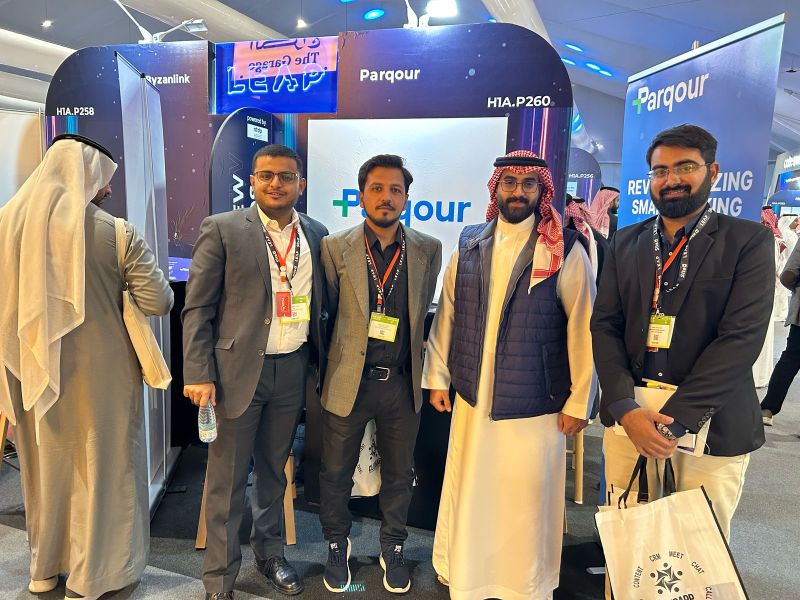
Parqour expanded from Kazakhstan into Central Asia, the Middle East, Europe and the United States. Its company page says it operates in 25 countries and serves more than 300 clients, though published counts vary by date and by what is being counted. A 2024 US residency helped it establish a Silicon Valley team and secure relationships with Parking Nexus and United SF Parking, according to Astana Hub. In 2025, Omarov said the company joined the StartX summer cohort. These are steps into the US market, not proof that every parking site in a partner's portfolio runs Parqour's system.
For a buyer, the practical test is plain. Can the local cameras read local plates? Can the software speak to existing barriers and payment rails? Will drivers understand what to do on a first visit? Can the operator trust the settlement report? And if Parqour pays for installation, will enough cars pass through to make the share worthwhile? A quiet private garage and a busy airport present very different maths. Privacy matters too: Omarov said the cameras were aimed at plates rather than drivers, and cross-border expansion means different rules for storing and using those records.
The idea worth borrowing is smaller than “reinvent parking.” Find a neglected asset with a measurable leak. Make the usage visible. Give the owner a way to pay for the fix from the improvement itself. Parqour's own history adds the final condition: the contract must survive the real world, where a parking machine can break, a shopping centre can close and the person collecting cash may prefer the old arrangement. The gate was the easy part. Making the books add up was the business.