A parking garage can be full of perfectly functioning equipment and still be very bad at letting people leave. The gate opens. The card reader reads. The ticket is valid. Yet a driver searching for a wallet has brought the whole procession to a halt. Anyone behind that driver has suddenly become an unwilling student of operations management.
- The business: software, hardware and services that connect a parking operation.
- The buyers: cities, universities, private operators and other institutions.
- The useful idea: remove work from the place where everybody must wait.
- The catch: technology still needs sensible parking rules and a workable rollout.
T2 Systems lives in this unglamorous, consequential territory. Parking is often treated as something that happens after the important part of a journey. But arrival and departure are the bookends people remember. An excellent lecture, appointment or evening out can acquire a sour aftertaste in a queue of idling cars.
01 / The wallet at the wrong end of the journey
At Texas A&M, the Central Campus Garage had 620 spaces and backups that sometimes reached the fifth floor. Customers preferred paying at the gate, where finding a card or ticket added delay. Staff sometimes raised the gates to clear traffic, sacrificing revenue. The equipment was collecting money in precisely the place where it was least convenient to stop.
The university introduced T2 PARCS Pay-on-Phone in February 2023. Drivers could scan a ticket and pay before departure, then use a receipt’s QR code at the exit. The first 11 months brought more than 48,000 transactions, according to T2’s account of the rollout. The university reported less congestion. It retained its other payment options.
“If you hear nothing, that means it’s working.”Dell Hamilton / Texas A&M
The transferable lesson is pleasingly modest: inspect what happens at the bottleneck. A transaction need not become faster if it can happen somewhere else. The exit lane is a scarce resource; a phone lets payment happen in many places at once.
Conceptual workflow. Payment moves ahead of the shared exit lane; this is not a measured speed comparison.
02 / The permit is only the beginning
T2 sells the machinery of parking administration. Its buyers run institutions and facilities, while their customers are the people trying to park. That distinction explains the product range. The operator must know who may park, where, for how long, at what price, and what should happen when the answer is disputed.
Its permit tools support digital permits tied to license plates, online applications and renewals, eligibility rules, inventory and waitlists. T2 positions Flex for universities and large municipalities with complicated programs. UPsafety serves smaller and midsize operations. A sprawling campus with different calendars and user groups has different administrative needs from a town managing residential passes.
Enforcement then checks the promise the permit makes. T2’s mobile tools support plate lookups, citation issuance, photographs and location records. License-plate recognition connects what cameras see with the permit and payment records. Officers can work offline and sync later. Appeals and supervisory review belong in the same administrative chain. The value is less theatrical than an autonomous car, but rather more useful when somebody insists they paid.
For gated facilities, PARCS means Parking Access and Revenue Control Systems. T2 connects that physical world of lanes and access hardware to Flex. Its Luke pay stations serve paid parking outside the garage workflow; MobilePay offers app-free payments. Citation Services adds people and collection support to the software portfolio. Buyers can assemble a parking operation from several connected parts rather than buy a single consumer app.
03 / A crowded lot can hide empty spaces
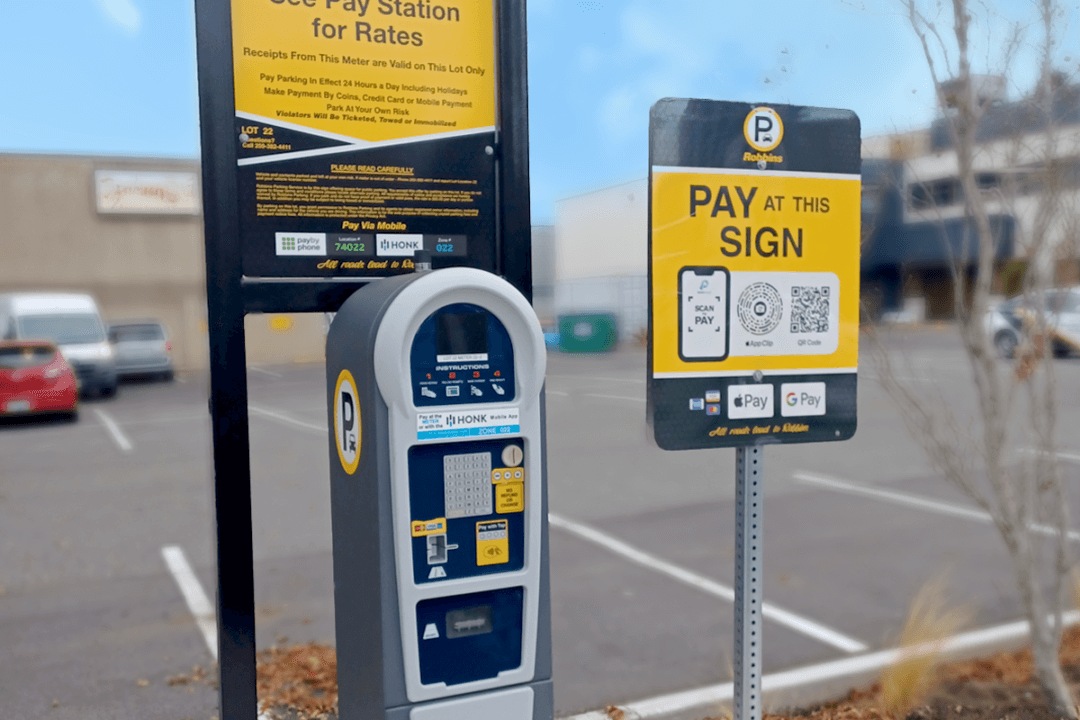
Utah Valley University offers another useful complication. Its older meters were failing, and replacement parts were expensive. But the campus also had a distribution problem: more than 1,000 spaces sat empty while popular lots near classrooms were crowded. Calling this a shortage obscured the distinction between available space and desirable space.
The university introduced T2 Tempo for flexible parking in 15-minute increments and Scan & Pay for citation payments. It placed Tempo spaces in busy locations and limited what could be sold - six of eight stalls in one example - to avoid overselling. The customer story reports more than $100,000 collected through Scan & Pay in its first year. That is collections volume, not proof of $100,000 in additional revenue.
The lesson is to count the right things before buying the next thing. Payment convenience, location and permit duration influence how existing space is used. Software can express those choices. It cannot make every distant stall equally attractive or resolve every accessibility question; UVU still planned refinements to its disability-parking integration.
04 / The expensive part is the handoff
A parking operator can own several good systems and spend the day reconciling their disagreements. A paid session lives in one place. A permit lives in another. A gate has its own account of events. The human at the desk must determine which version deserves to be believed.
Mississippi State’s parking story describes precisely this problem: separate information, manual processes and staff assembling answers from multiple tools. The university made Flex the central system for permits, enforcement, access activity and reporting, with FlexPort providing online transactions and documentation. The change was administrative as well as technological. A connected record reduced the need for employees to act as couriers between databases.
This is T2’s competitive argument. Flash also supplies cloud software and parking hardware, with an emphasis on demand channels that bring drivers to facilities. Passport emphasizes municipal compliance, payments, permits and enforcement. T2’s appeal rests on the breadth of its connected operating tools and its campus and municipal workflows. These are overlapping choices, so a buyer should compare the actual integrations, service arrangements and rules their operation requires.
05 / A business worth $347 million
Mike Simmons co-founded T2 in 1994 and led it through more than two decades of growth. His investor biography says the company reached 325 people and more than $60 million in revenue by its 2016 acquisition by Thoma Bravo. Parking administration had become a substantial software business.
Verra Mobility completed its purchase in December 2021. At the time, it said T2 expected nearly $80 million in annual revenue and approximately $21 million in adjusted EBITDA. Those numbers describe the acquisition period. The transaction bought a functioning business and customer relationships, and T2 became a distinct unit within Verra Mobility. Lin Bo was appointed to lead it in August 2024.
The business model mixes recurring software and services with hardware and support. Specific payment products add transaction fees: the Texas A&M account describes Pay-on-Phone pricing that can be passed to the parker. For a buyer, the useful cost calculation includes implementation, equipment, ongoing service and who pays each transaction fee. A quiet reduction in maintenance or reconciliation work can matter alongside the subscription bill.

06 / The customer who sends log files
Robbins Parking’s contribution is a small antidote to the idea that innovation always begins in a laboratory. General manager Kevin Stacey had spent 20 years as a communications and electronics technician in the Royal Canadian Navy. He and his maintenance staff sent log files and feedback while beta-testing T2’s Pay Station 8 software. Their more than 250 lots supplied a varied collection of operating conditions.
That collaboration makes T2’s customer network more interesting than a marketing phrase. A person who repairs a machine in the field knows things a product meeting may never discover. T2 also runs an advisory board, training and customer events; its online community reports more than 7,500 active individual members. These mechanisms give operational knowledge somewhere to go.
07 / The next lane over
The recent product changes follow the same practical logic. In November 2025, T2 announced PARCS support for ID TECH’s validated point-to-point encrypted payment solution. In April 2026, it announced Apple Pay, Google Pay and Link support for UPsafety. Easier payment and a simpler compliance burden are ordinary ambitions. Ordinary ambitions are often excellent product requirements.
The scope is widening, too. In August 2026, T2 highlighted its part in West Hollywood and LA Metro’s award-winning bus-lane enforcement program. Hayden AI’s cameras detect potential violations; Flex supports the workflow; trained city staff review every case before a citation is issued. LAZ Parking supports operations. The interesting detail is the division of labour: detection, records and human judgment each have a job.
For anyone buying parking technology, the questions are concrete. Where does work pile up? Which systems disagree? What must remain accessible to people who do not use a phone? Which rules need changing before automation will help? T2’s customer stories suggest a useful starting point: watch an ordinary transaction all the way through. The most revealing moment may come when someone is simply trying to leave.
Website ↗ · Products ↗ · Stories & webinars ↗ · News ↗
LinkedIn ↗ · X ↗ · Facebook ↗ · T2-linked video on YouTube ↗