In 2020, Robin Shah received a call from his childhood best friend. His mother had been told she had pancreatic cancer. The next available oncology appointment was four weeks away. Shah, whose father ran a community cancer practice, knew people. Within 48 hours, he recalled in his launch essay, she had seen an oncologist and was ready to begin treatment.
- Cancer support available 24/7, alongside existing doctors.
- Plans, employers and providers fund eligible access.
- The business links coordination with cost and quality.
The revealing detail is the address book. Nothing about the woman’s need had changed. Her access had. Shah had worked at Flatiron Health and helped launch OneOncology. A frightened family had acquired an insider, and suddenly the system moved. What happened to families who never found one?
Thyme Care, founded in 2020 by Shah and oncologist Bobby Green, is an attempt to make that insider available through an organized service. The original failure was access: the distance between being told something terrifying and finding someone who could explain the next step. The company built its proposition around closing that distance.
“What do I do now?”The question Shah kept hearing, May 2021
A care team for the other hours
The service works alongside a person’s existing doctors. Members can reach cancer-trained support around the clock, with help that extends from clinical questions to transportation and financial resources. For someone trying to keep appointments while managing symptoms and household demands, those categories are connected. A treatment plan needs a way to get to treatment.
Thyme Care’s team includes nurses, nurse practitioners, oncology social workers, medical directors and care partners. Each has a different job: explaining symptoms, reviewing complicated cases, helping with practical obstacles or coordinating care. Virtual palliative care adds support for symptoms and quality of life. The treating oncologist remains part of the picture.
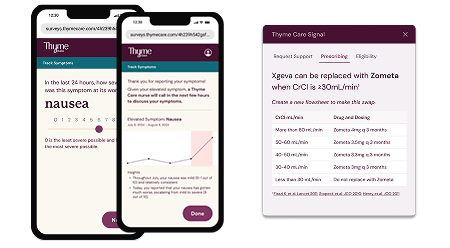
The technology gives these people a shared view of what is happening. Patient-reported symptoms, clinical records and other data can help the team decide who needs attention. The company describes using AI to synthesize information and reduce documentation work. The useful question is whether the next human conversation becomes better informed and arrives sooner.
The customer is also a coalition
Thyme Care serves patients, but its commercial relationships span health plans, employers and providers that carry responsibility for medical spending. Its website lists partners including Humana, Aetna, Clover Health and Blue Cross Blue Shield of Massachusetts. Microsoft’s employee benefits site also describes access to Thyme Care’s cancer navigation program.
Eligible members receive support at no additional cost. That matters to the product: asking someone already confronting medical bills to purchase another subscription would create another decision at an awkward moment. Coverage and eligibility still govern access. A national footprint does not mean every American can enroll.
The company occupies a crowded stretch of healthcare. Reimagine Care also extends oncology support beyond the clinic, while Navigating Cancer provides patient engagement and care management technology. Thyme Care’s distinguishing bet combines a staffed service, integration with oncology practices and financial accountability for a population’s care. Its contracts can involve two-sided risk: better performance can bring rewards, while worse performance can carry financial consequences.
The bill is part of the design
Ordinary fee-for-service medicine pays for activity. Thyme Care’s pitch asks partners to pay attention to the whole bill and the experience behind it. Earlier support may prevent an avoidable hospital visit; coordination can expose waste; oncology partnerships can support treatment decisions that consider value. The economic argument is that useful assistance can pay for itself.
There is evidence to examine, with care. In a 2022 company analysis of a New Jersey Medicare Advantage population, navigated patients had a $429 greater monthly reduction in medical costs than a matched comparison group. Part D drugs were excluded. Inpatient spending accounted for 58% of the reduction. This was a comparison of groups, rather than a randomized experiment.
A separate partnership supplied another test. American Oncology Network reported nearly $6 million in Medicare savings during the first performance period of the Enhancing Oncology Model. Its work with Thyme Care included navigation, pharmacy interventions, performance data and virtual palliative support. Those were results from a combined operating model; the entire savings figure cannot be assigned to a phone call or one vendor.
Greater medical-cost reduction in Thyme Care’s 2022 matched comparison.
New Jersey Medicare Advantage population. Part D excluded. Observational result; not a promised saving.Capital follows the gaps
Building this service has required substantial capital. Thyme Care raised $22 million in its 2021 Series A and $60 million in its 2023 Series B. Its July 2024 financing illustrates why funding labels deserve scrutiny: the announced $95 million comprised $55 million in equity and $40 million in debt. Those are different financial obligations.
In September 2026, it announced more than $125 million in Series E financing led by Morgan Health, at a valuation above $2 billion. The announcement put availability at more than 10.5 million people across all 50 states, with over $7 billion in oncology spending under management. Spending managed is distinct from company revenue; availability is distinct from enrollment.
Brad Diephuis became CEO in September 2026. Shah moved to executive chairman of the newly established parent, Thyme Companies. Its planned businesses include work on biosimilar adoption and clinical trial enrollment. That broadens the original idea: once a business sees where people get stuck, it begins to see adjacent problems worth solving.


An address book you can organize
The practical lesson travels beyond oncology. Find the recurring handoff that forces people to improvise, give someone responsibility for it, and make the information follow them. Then connect payment to the outcome the customer actually wants. Here, that means a care team able to act between appointments, working with the clinicians who already know the patient.
The conditions matter. Virtual support needs reachable members, clinical escalation pathways and cooperation from local providers. Savings comparisons need credible benchmarks and attention to differences between patient groups. A team cannot coordinate information it never receives. Financial accountability also requires enough capital and operational discipline to absorb disappointing results.
For patients and caregivers, the immediate step is more ordinary: check eligibility and ask what help is available before the next crisis. For providers, the question is which tasks consume staff time without improving access. Thyme Care’s founding insight remains useful because it is so recognizable. Sometimes the missing piece of cancer care is a person who knows whom to call.
Keep the conversation going
Explore Thyme Care, its company blog and newsroom. Follow on LinkedIn, X, Instagram or Facebook.
Listen: Robin Shah on Oncology Onward and the leadership team on Raising Health.