A cancer appointment has an ending. Cancer has other ideas. The patient goes home, the clinic moves to the next name on its schedule, and a question arrives that did not occur to anyone in the examination room. A symptom feels different. Dinner tastes wrong. Sleep becomes a negotiation. The distance between a scheduled encounter and an unscheduled need is where OncoHealth has chosen to build part of its business.
- For health plans: oncology treatment review, authorization workflows and cost analytics.
- For eligible patients: Iris offers oncology nursing, mental health, nutrition and practical support.
- The connection: help decide what care should happen, then help people live through it.
The company began in 2009 as Oncology Analytics, founded by hematologist and oncologist Marc Fishman. Its original territory was the complicated junction of clinical evidence and insurance approval. Today, it occupies that junction and another one: the passage from a treatment plan to the ordinary, inconvenient business of being a person receiving treatment.
This makes OncoHealth an interesting hybrid. It sells software and specialist services to organizations responsible for cancer care spending. It also connects eligible patients and caregivers to a virtual care team. The insurer wants appropriate treatment and manageable costs. The patient wants an answer. The business depends on making those interests meet without losing the person in the paperwork.
01 / The regimen crosses the insurance border
Insurance divides care into categories. A cancer treatment plan can travel across them. OncoHealth’s OneUM platform brings drugs covered under medical and pharmacy benefits, radiation therapy procedures and genetic testing into one workflow. Its clinical review considers the whole regimen for safety, efficacy and appropriateness, rather than treating the submission as an isolated administrative item.
For a provider, that means a common submission point and access through a browser or an existing health plan portal using single sign-on. For a plan, it means a way to combine clinical review with visibility into treatment costs. Automation handles parts of case processing; board-certified medical oncologists, hematologists and radiation oncologists provide specialist judgment and peer conversations.
Treatment + evidence
Patterns + spending
Life between visits
The peer conversation deserves attention. A treating oncologist discussing a complex case with another oncology specialist has a different starting point from a generic administrative exchange. They can discuss the evidence, the patient’s circumstances and an alternative regimen. OncoHealth’s proposition rests partly on that shared expertise. A portal may move information quickly; a useful clinical conversation still requires someone qualified to have it.
02 / The appointment ends. Iris stays open.
In March 2022, OncoHealth launched Iris with three health plan collaborators, including Point32Health and HealthPartners. The initial rollout was deliberately limited to subsets of members across five states. The service gave patients and caregivers ways to reach oncology experts through chat, phone or video, using a smartphone or the web.
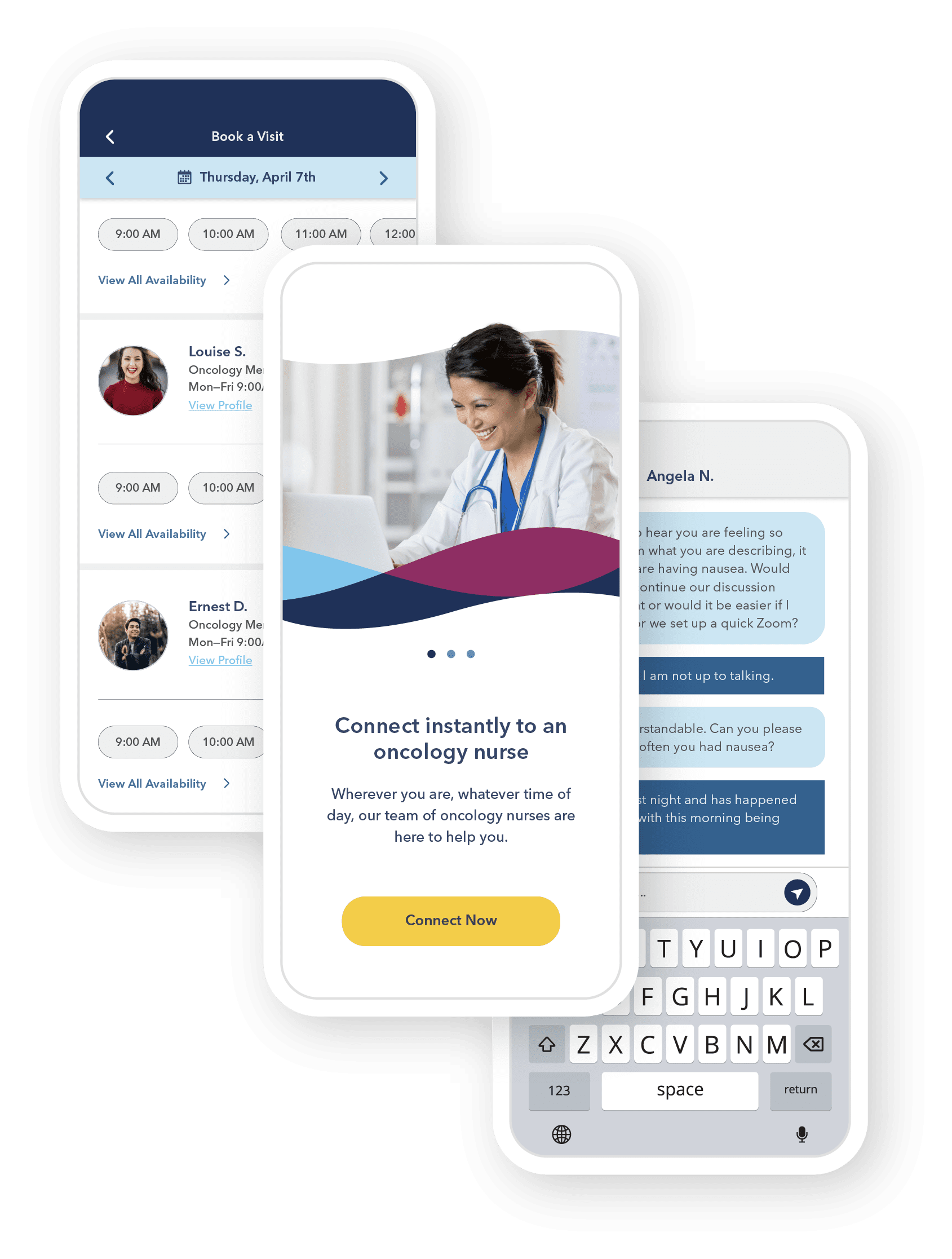
Iris supplies 24/7 access to oncology nursing, alongside mental health therapy, nutrition counseling, resource navigation, educational material and peer support. Round-the-clock nursing does not mean every specialist appointment happens instantly. It means the patient has an entry point when the clinic’s timetable and the patient’s needs stop agreeing.
The treating oncology team continues to lead treatment. Iris describes itself as an extension of that team, covering the moments between visits. Its public site identifies OncoHealth Medical Group, P.A. as the independent medical practice delivering virtual supportive care on the platform, with clinicians licensed across the United States and Puerto Rico.
The distinction matters for anyone considering the service. Iris can help an eligible person discuss side effects, prepare questions, find emotional support or think through eating difficulties. It supplements the clinical relationship responsible for cancer treatment. A virtual conversation cannot perform an examination, deliver radiation or provide hospital care.
03 / The pilot that earned a bigger audience
HealthPartners supplies a useful example of how the idea moved from promise to a broader rollout. In July 2023, a year after piloting Iris, the organization expanded access to 240,000 fully insured commercial members. Its announcement cited positive early member feedback.
“The initial feedback we received from members was positive.”Kevin Ronneberg, HealthPartners · July 2023
During the pilot, 43% engaged with an Iris clinical team member, averaging 2.3 interactions a month, while 68% used a personalized, self-directed curriculum. Those percentages describe different kinds of use and may overlap. They suggest that access to a clinician and access to useful reading serve different needs. Opening a care service does not make everyone consume it in the same way.
The partnerships then broadened. Geisinger Health Plan announced in May 2024 that it would combine fully delegated oncology value management with virtual supportive services for more than 550,000 members. In June 2025, Ovarian Cancer Research Alliance partnered with Iris to extend its Steps counseling program’s reach across all 50 states. Different buyers found uses for different pieces of the same clinical infrastructure.
04 / Seeing the bill before it arrives
Oncology Insights adds another perspective: what the plan can learn from the work already passing through its systems. It combines eligibility, claims and prior authorization data in dashboards organized by drug, diagnosis, provider and line of business. Authorization information lets a plan examine proposed care alongside the record of care already billed.
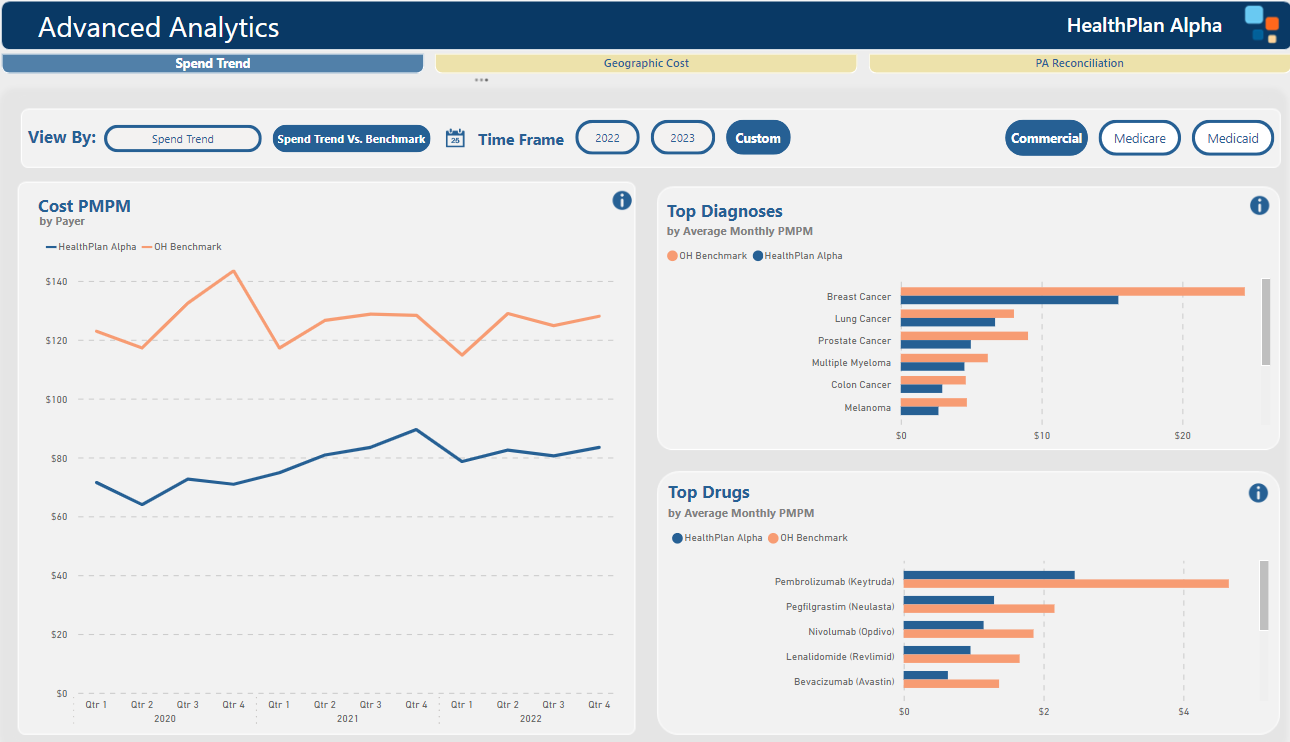
OncoHealth also supplies de-identified comparative benchmarks and an advisory team of clinicians and analysts. The purpose is practical: help plans interpret prescribing patterns, drug trends and coverage choices. Data can make a question visible; expertise helps determine whether the question concerns sensible variation or something worth changing.
Delivered in customer savings, according to OncoHealth’s current website.
Its website also reports 22 health plan partners and more than 15 million members supported. That last figure needs the correct denominator. A covered population includes people who may never need cancer care; it is not a census of patients receiving nursing or therapy. Buyers should examine the service population, engagement and measurement period behind any headline number.
05 / From a review desk to a broader business
The financing history follows the expansion. A $21 million Series B in 2018, led by Oak HC/FT, supported benefits management and data investments. Baird Capital led a $28 million Series C in 2020. The company adopted the OncoHealth name in 2021. In May 2022, Arsenal Capital Partners and McKesson invested, with Arsenal taking majority ownership.
Health plans and employers are the commercial audience. Eligible Iris members receive the service at no charge through participating plans and select groups. That arrangement places distribution inside an existing benefits relationship. For patients, the practical first step is checking eligibility with an insurance card or enrollment code; for organizations, it is choosing the services and population the contract should cover.

Jon Maack succeeded Rick Dean as CEO in February 2025; Dean remained on the board and moved into an advisory role. The company’s published values include patient first, clinical excellence and collaboration. Its continued ASCO analysis and managed-care webinars show another ingredient in the model: staying useful requires keeping clinical knowledge current, even after the software has shipped.
06 / What a buyer should copy
OncoHealth operates in a competitive field. Evolent also offers oncology pathways, authorization, specialist peer review and care navigation. Internal health plan teams and oncology practices supply other alternatives. OncoHealth’s distinctive combination is the connection of an oncology-focused review platform, cost intelligence and its own branded virtual supportive service. The relevant buying question is how that combination fits an existing network and workflow.
HealthPartners’ approach offers a practical lesson: start with a defined population, examine how people actually use the service, then expand. Track clinician contact separately from content consumption. Assess turnaround time and provider experience alongside cost. An attractive dashboard is a poor substitute for a patient getting an answer or a practice getting a timely decision.
The conditions are demanding. Members need access and a reason to engage. Specialists need capacity. Information needs to reach the treating team. Supportive care has to fit the benefit and the clinical relationship. OncoHealth’s proposition becomes persuasive where those connections hold: the treatment is reviewed, the spending becomes intelligible, and someone is available when a patient gets home and thinks of the question.