The most expensive button in modern dating may be the one Three Day Rule asks you to stop pressing. No more browsing faces on a train. No more Tuesday-night archaeology in a stranger's prompt answers. Instead, a matchmaker interviews you, searches a network, approaches candidates, screens them, sets up an introduction and asks what happened afterward. The published starting price for that relief is $6,300. You are not buying more choice. You are paying somebody to edit.
That inversion explains the Los Angeles company's place in the market. Hinge, Bumble and Tinder give singles tools and inventory. Traditional boutiques give a small group of wealthy clients a discreet search. Three Day Rule sits between them: national enough to claim more than 250,000 relationship-ready singles, personal enough to assign a human, and now ambitious enough to offer both a $1 million concierge package and an AI-assisted iPhone app.
It started with office gossip, not code
Talia Goldstein was a television producer who kept setting up colleagues. The parties grew; the side project acquired a name borrowed from the old advice to wait three days before calling; and in 2013 the business appeared on Shark Tank. At the time, co-founder Valerie Brennan pitched an online membership costing $100 a month and asked for $200,000 for 10 percent. The Sharks passed.
The rejection was the first thing that failed - and the broadcast was the first thing that worked. Goldstein has said roughly 10,000 people signed up that night. Attention did what capital did not. The bigger change came afterward: Three Day Rule moved away from being another paid dating website and leaned into the service hiding underneath it. Human matchmaking, not profile access, became the product.
The product is not a date. It is a trusted person willing to say your checklist may be wrong.The core proposition behind Three Day Rule
Match.com led a $1.25 million investment in 2014. A $1.2 million round followed in 2016, including $650,000 from DAN Fund and $550,000 from individuals. Partnerships with Match, OkCupid, JDate, Christian Mingle and The League widened the supply of possible introductions. In November 2024, an undisclosed private investment group acquired the company and installed Adam Cohen-Aslatei - a former Bumble executive and founder of the anti-superficial dating app S'More - as CEO.
What, exactly, does $6,300 buy?
A paying member gets a personal matchmaker and coach. The team digs into goals, values, lifestyle and relationship patterns, then searches its own network and, for some packages, recruits elsewhere. Candidates are screened. Introductions are curated. Coaches can work on photos, presentation and dating habits. After a date, feedback returns to the matchmaker, who adjusts the next search. Higher tiers widen the geography and add recruiting, styling or more intensive support.
The other side of this marketplace is free. Singles can create a profile and become eligible to meet a paying client without buying a package themselves. This is an elegant asymmetry: demand pays for active search; supply contributes availability. It also means a client is not restricted to dating other clients, an important difference from a closed members-only club.
The customers are high-intent singles, often professionals with more money than spare attention. They are not necessarily unable to get dates. Many are exhausted by managing dating as a second job, unsure why the same patterns repeat, or reluctant to expose themselves on mass-market apps. The company sells time, privacy, screening and a polite form of productive disagreement.
Then the matchmaker moved into the phone
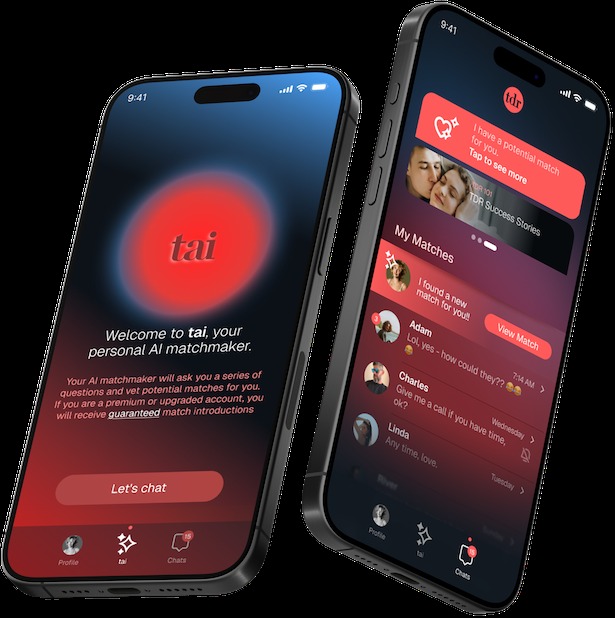
The acquisition changed the ambition. In 2025, Three Day Rule launched Tai, an AI matchmaker and date coach trained around the company's human process. Users speak or type to it, answer unusually detailed questions, receive verified suggestions, get help moving conversations forward and report back after dates. Profiles can also enter the wider database used by human matchmakers. The app offers a free trial and a premium tier promising regular introductions.
This is not a random pivot. A service business accumulates repeated interviews, common objections, successful coaching prompts and structured feedback. Those are exactly the parts software can make cheaper and more consistent. The company says its knowledge base includes insights from more than 20,000 dates. Tai is an attempt to turn that operating history into a lower-priced product.
The first public stress test exposed what failed first. A WIRED reviewer liked the depth and convenience but found repeated AI-generated openers, many matches outside New York and no in-person or virtual date over nearly two months. The app had only a few thousand members at the time. This is the cold-start problem wearing nice clothes: an intelligent interviewer can learn that you want a witty architect in Brooklyn, but it cannot manufacture witty architects in Brooklyn.
There is a second risk. Coaching can help a nervous dater begin. Too much mediation can make two people sound like the same assistant talking to itself. The company built its reputation on human intuition and accountability; an AI product that feels generic could blur the very difference customers pay for.
A marketplace is only as magical as its local supply. Better matching cannot fully compensate for too few suitable people nearby.
The flashy features changed. The job stayed put.
Three Day Rule has always known how to earn a headline. In 2014 it offered a $5,000 service that used facial recognition to find someone resembling a client's ex. In 2025 it announced a $1 million matchmaking experience for three people, complete with an exclusive matchmaker, recruiter and coach. These products are useful publicity. They are not the durable insight.
The durable insight is that people often describe the partner they have repeatedly chosen, not the one with whom they might flourish. A matchmaker can notice the loop, propose someone slightly outside it and take responsibility for the recommendation. Software filters obey stated preferences. A good adviser interprets them.
That is also what readers can copy. Service founders should document the interview their best employee conducts. Turn delivery into a sequence. Ask for structured feedback after every outcome. Let a free network supply the other side of the transaction. Automate scheduling, reminders and status updates before automating the judgment customers came to trust. Three Day Rule itself used workflow automation to reduce matchmakers' administrative load years before Tai arrived.
Worth copying
- Charge for an outcome-oriented service, not raw access.
- Use free participation to deepen supply.
- Make feedback part of delivery, not an afterthought.
- Let experts override rigid customer criteria.
Where it breaks
- The local candidate pool is too thin.
- The customer wants casual volume, not a serious relationship.
- The buyer will not accept coaching or wider criteria.
- Automation impersonates empathy instead of supporting it.
A barbell business with a human middle
Today, Three Day Rule stretches from a consumer app to a seven-figure concierge promise. In between sits the business that survived: premium matchmaking in 15 metro areas, supported by coaches, recruiters, a free network and years of accumulated feedback. Its competitors include Tawkify, It's Just Lunch, Selective Search and local boutiques at the expensive end, plus every dating app and well-meaning friend at the other.
The company will work best for someone who is serious, geographically flexible enough to give the search room, financially comfortable with the fee and open to hearing that attraction may arrive outside a familiar template. It will not work for someone seeking casual dates, total control over browsing, instant results or an abundant hyperlocal pool that does not exist. No matchmaker can waive the laws of geography.
Its most interesting challenge is therefore not whether AI can recommend two compatible profiles. Plenty of software can rank. The question is whether Three Day Rule can make machine assistance feel like less work while preserving the surprise, candor and accountability of a perceptive human. If it can, the app becomes a doorway to matchmaking. If it cannot, the $6,300 service may look less old-fashioned than ever.