The difficult part of joining Thrace was leaving a name behind. Isabelle Beaudoin had spent 20 years putting herself into Communications Isabo. In August 2025, she wrote about retiring that identity with affection and a heavy heart. The work would continue. So would the relationships. But the name on the door would become Thrace, the Quebec creative agency led by her longtime friend Geneviève Côté.
It is an unusually personal introduction to a business that sells other organizations ways to present themselves. Thrace makes logos, websites, brochures and digital campaigns. Its customers include companies, schools and municipalities. The agency understands that an identity has practical jobs to do. Beaudoin’s account supplies the other half of the equation: sometimes the person commissioning the design has quite a lot invested in the old one.
A merger with a personal backstory
Thrace began in Rosemère in 1994. Côté acquired it in 2013, and the agency moved to Sainte-Thérèse in 2017. The merger with Isabo in 2025 added another chapter and a presence in Lavaltrie. Today, the partners divide leadership between Côté’s strategy and growth responsibilities and Beaudoin’s creation and operations role. The arrangement brings the Laurentides and Lanaudière sides of the business under the same name.
Their explanations of the decision are refreshingly specific. Côté recalled meeting Beaudoin more than two decades earlier, with a first business lunch that became the start of a friendship. She had wanted to work together since buying Thrace. By the time of her August 20, 2025 essay, serious discussions had been underway for almost a year. Sharing the burden of entrepreneurship and preparing the company’s future mattered to her.
“J’avais envie de partager cette aventure, de la vivre à deux.”
Geneviève Côté, August 2025
“I wanted to share this adventure, to live it together.” Translation.
Beaudoin described herself as the more conservative partner. Côté had been ready for years; Beaudoin needed longer. After a more difficult period, she wrote, the opportunity to develop, move forward and work with a broader team became clearer. That is the turning point in her account. Her enthusiasm concerned the people and capabilities she could bring to clients, alongside the chance to keep doing the work she enjoyed.

The portfolio has a municipal calendar in it
Agency positioning can float above the actual work. Thrace’s portfolio brings it back to the desk. There is seasonal programming for the City of L’Épiphanie, a logo and standards guide for Lanoraie, a tourism guide for Tourisme Lanaudière, and a visual concept for the annual congress of Quebec’s professional order of agronomists. These are communications with dates, audiences and formats attached. Somebody has to get them finished.
The commercial work is similarly varied: packaging, a brochure and a roll-up display for Lallemand; a microsite for Metro Marché Richelieu; and a website for Externat Sacré-Coeur. Together, the examples suggest a business accustomed to moving between screen and print. They also explain why a client might buy several services from the same agency. A school’s website and an event advertisement are different assignments, but they still represent the same school.
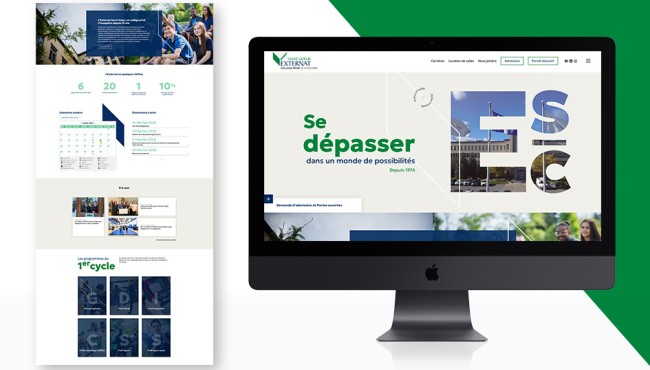
Thrace’s place in the market is a regional, multidisciplinary service business. It offers an outside creative team to organizations that need one, including businesses reinforcing their own marketing staff. That puts it alongside freelancers, specialist studios and other agencies as a buying option. Its case rests on coordination and continuity: people who can carry an existing identity across a series of jobs without requiring the client to explain the organization from scratch each time.
The handover is part of the website
For website customers, the offering extends from audits and project specifications to design and programming performed internally. Possible deliverables include transactional sites, private customer or member areas, custom forms and connections to external systems. Thrace also includes training in its content management system. Clients can update content in the areas planned for that purpose, with the agency available for more complex technical or design changes.
That distinction is useful when buying a website. An editable page and an editable application are different promises. A staff member may need to change a paragraph or add an announcement every week; changing a member workflow is another kind of request. Thrace’s description makes room for both self-service and continued assistance. The practical buying question is which tasks belong in each category, and whether the planned training covers the things staff will actually do.
- 01Define the need
- 02Shape the design
- 03Build the site
- 04Launch + train
- 05Keep supporting
Marketing brings another choice: delegate the work or develop the ability to handle more of it internally. Thrace offers campaign management, search visibility, social content, newsletters and performance analysis, as well as coaching. Its service description includes tailored coaching packages without a long-term contract. That flexibility suits different starting points. One customer may need an agency to run the campaign; another may already have an employee ready to learn.
A budget conversation before the mood board
Thrace’s graphic design terms describe estimates for a defined assignment or work purchased through a bank of hours. Recurring monthly needs are also part of the model. The agency says design production can take two to ten business days depending on complexity, with projects usually including two rounds of revisions. Those details give a buyer something concrete to discuss before approving the work: scope, timing and the amount of back-and-forth included.
The agency acknowledges that its hourly rate is higher than a freelancer’s, then argues that team execution can improve the overall value. Treat that as a proposition to evaluate. A useful comparison asks what the final bill buys, who reviews the work and what happens when it needs another format. For a small, clearly bounded job, a specialist working alone can be a sensible alternative. A recurring mix of print and digital assignments presents a different coordination problem.
Annual reports show how sharply a service can be defined. In its May 2026 article, Thrace describes art direction and layout based on content that the client has already prepared or nearly finalized. Writing and content strategy sit outside that particular offering. The agency prepares the material for print, digital PDF or web delivery. The condition is straightforward: a customer expecting someone to research and write the report needs a different brief.
The brand lives in the small print
Much of Thrace’s recent publishing concerns the unglamorous places where organizations become inconsistent. A June 2026 post looks at email signatures. It recommends a common model for staff and describes the possibility of a signature generator within the private CMS used for client websites. The attraction is easy to understand. When every employee invents a signature, the company acquires a collection of tiny, unofficial design departments.
Another article, published in May, makes the case for checking consistency before replacing a logo. Its argument is that a website, social accounts and sales documents should give a compatible impression. The useful exercise is modest: put the materials next to each other. Do the typefaces, colors and tone look related? For a business with limited resources, fixing those mismatches may be a more focused assignment than commissioning an entirely new identity.
The agency’s writing on color adds a production constraint to that discussion. A palette has to function on screens and in print, while making sense for the audience and positioning. Its design glossary explains terms such as vector graphics, resolution and visual hierarchy. Read together, these pieces reveal a teaching instinct. Better-informed customers can ask more precise questions than whether a design could be made a little more exciting.
The subjects continue beyond appearances. An August 28, 2026 article covers fraudulent messages arriving through email and website forms. That sits comfortably beside signatures and report layouts in the agency’s editorial output: the communications machinery a business uses every day. The pattern is less about a single showpiece campaign than the accumulation of things an organization needs to keep intelligible, recognizable and usable.
What another business can borrow
For prospective customers, the transferable lesson is to bring the working context into the brief. Identify the audience, the formats, the deadline and the person who will maintain the result. Bring the current materials, too. A brochure that looks fine alone may make the problem obvious when placed next to the website. This is an editorial inference from Thrace’s service descriptions and advice: the connections between assignments deserve attention before production starts.
For other agency owners, the merger offers a different observation. The partners’ accounts describe a relationship tested over years, with different appetites for the decision and explicit reasons to share leadership. Friendship made the conversation possible; their professional responsibilities give the partnership a working shape. The story is most useful to readers willing to examine those conditions, rather than treating a merger as an automatic answer to the pressures of running a small business.
Thrace explains the H in its name as a reference to the human element in creation. It is a neat piece of agency language. The merger gives it a more concrete expression: two people deciding how to keep serving clients, support their colleagues and make room for another stage of their careers. For a company paid to help others communicate who they are, that is a credible place to begin its own next chapter.
Meet the work. Follow the people.
Explore Thrace’s website, its client portfolio and latest writing. Read the merger reflections from Isabelle Beaudoin and Geneviève Côté.