The backers’ question was reasonable. Why would a company let somebody else into its laboratory business? In 1991, Thomas E. D’Ambra was helping start Albany Molecular Research, an enterprise built around doing chemistry for other companies. Prospective backers worried that customers would keep their research and intellectual property to themselves. A chemist could demonstrate a reaction. Demonstrating that strangers would trust him with their work required a rather different experiment.
D’Ambra and his co-founder, Chester Opalka, went ahead. The company they established became AMRI and, much later, Curia. Its history contains public markets, overseas laboratories, acquisitions and uncomfortable earnings calls. Alongside that commercial story runs another: a chemist helping pay for the education and working space of other chemists. The two threads make his career worth examining together. Both concern what becomes possible when expertise has somewhere to work.
The experiment before the company
His credentials came first. D’Ambra studied chemistry at the College of the Holy Cross and earned his doctorate in organic chemistry at MIT in 1982. He then spent seven years at Sterling Winthrop, working as a research chemist and rising to group leader. Before he had a company to run, he had the daily work of a scientist to do. The boardroom arrived after the bench.
Coromed was the next step. From 1989 to 1991, he was its co-founder and vice president of chemistry. That gave him experience inside a contract research business before the launch of AMRI. The progression matters: this was a scientist moving through an established employer and an earlier enterprise before setting out again. The tidy founding date conceals a much longer apprenticeship in how scientific work gets organized.
The local circumstances were changing, too. Sterling had announced that it would close its Rensselaer research laboratory. D’Ambra and Opalka passed through Coromed before establishing their own business. There is a practical, regional history here: people trained inside a large organization finding another way to put their skills to work. An employer’s retreat became part of a new company’s origin.
“We built a new business paradigm in outsourcing.”
Thomas E. D’Ambra, 2003
A business with several forwarding addresses
AMRI began with custom synthesis services and laboratory space provided by Siena College. It subsequently used space at Wright Malta and, in early 1992, consolidated and expanded at RPI’s Incubator Annex in Watervliet. These addresses offer a useful correction to the polished corporate timeline. Before there was an international network, there were successive places to fit the work.
By 1997, the company was using laboratory space at the University at Albany’s East Campus, formerly the Sterling Winthrop Research Institute. The geography almost supplies its own plot: a new company growing into a setting associated with the earlier employer. Universities appear throughout this period as part of the working landscape, providing space and proximity as the enterprise developed.
The commercial proposition depended on collaboration. By 2003, AMRI had relationships with more than 160 companies worldwide. D’Ambra described using resources from outsourcing partnerships to support further technology investment. Fees for today’s work could help make tomorrow’s work possible. That connected the service business to a longer horizon, while leaving the immediate obligation very plain: customers still needed their projects done.
- 1982MIT doctorate; joins Sterling Winthrop
- 1989Co-founds Coromed
- 1991Co-founds Albany Molecular Research
- 1999AMRI begins trading on NASDAQ
- 2013Ends his tenure as CEO
- 2021The company adopts the Curia name
When another founder takes notes
One measure of a company is whether other people want to build something like it. Greg Reid later recalled studying AMRI when he and other former Bristol-Myers Squibb researchers launched American Advanced Organics in Syracuse in 1998. AMRI offered them a picture of what their own contract research and custom synthesis business might become over five or ten years.
The relationship developed faster than that. In 2000, AMRI acquired American Advanced Organics to strengthen its chemical development services. Reid went on to work within the larger business. A company that had served as an example became an employer and an organizational home. Influence, in this case, had a transaction date.
D’Ambra’s work also retained a laboratory dimension. Institutional biographies credit him with more than 30 U.S. patents and numerous publications. These sit alongside the executive titles rather comfortably. He had participated in creating the technical work being sold, as well as in building the organization that sold it. Customers were dealing with a business whose founder understood the substance of the assignment.
The awkward part of expansion
The record becomes less comfortable in 2010. AMRI bought Excelsyn in Wales and Hyaluron in Massachusetts as it broadened its service offering. The latter acquisition encountered an FDA warning letter; a separate raw-materials contract dispute produced an unfavorable arbitration ruling. At the same time, work was shifting geographically, with overseas growth accompanying pressure on domestic business.
These were consequential complications for the ambition to offer a wider range of services. Putting more capabilities inside one company could make life easier for a customer, while creating more operations for management to coordinate. The business had established research and small-scale manufacturing operations in Singapore and India. Its expanding map brought different costs, competitors and operating demands.
The figures around D’Ambra’s departure give the story scale without making it look frictionless. AMRI reported $226.7 million in revenue for 2012 and $246.6 million for 2013. Contract revenue in 2013 was $210 million, with $36.6 million in royalty revenue. Those were distinct streams of income, an important distinction for a company working to strengthen its contract business.
within total revenue of $246.6 million
D’Ambra retired as CEO on December 31, 2013. William Marth succeeded him. D’Ambra resumed the chairmanship in January 2014 and remained chairman until 2017. The separation of dates is useful. He stopped running the company day to day before his board involvement ended, and both changes preceded its adoption of the Curia name in July 2021.
Money returns to the laboratory
Higher education gives this story another set of institutions and another kind of investment. In 2004, the University at Albany named D’Ambra a Citizen of the University. He was a supporter without being an alumnus. He and his wife, Connie, had helped open the university’s fundraising campaign with a million-dollar gift. His involvement also included committee work connected with the university’s research ambitions.
By 2014, the couple’s documented giving included a $1 million matching grant supporting UAlbany’s research building, $3 million to endow an organic chemistry chair at RPI, and $1.3 million for the Thomas E. D’Ambra Endowed Professorship in Chemistry at Holy Cross. Different institutions received different forms of support. Together, the gifts put resources into buildings, faculty positions and the continuity of scientific work.
Documented university gifts with Connie D’Ambra, reported in 2014. UAlbany’s gift was a matching grant. Bar lengths compare dollar amounts.
At Holy Cross, Joshua Farrell became the first holder of the named professorship. His work included an undergraduate summer research program. The college’s accounts of summer research show students working alongside him, including chemistry major Gil Gomez. A faculty title can look ceremonial from a distance. Follow it into the calendar and there are students spending their summer in a laboratory, then presenting what they have learned.
The RPI connection acquired a further twist in January 2022. Christopher Cioffi became the inaugural Thomas and Constance D’Ambra Professor of Medicinal Organic Chemistry after a career that included sixteen years at AMRI and Curia. The endowed position helped him equip his laboratory and recruit student researchers. The company and campus stories meet in one working scientist’s career, with another generation joining him at the bench.
Even the horses had science names
There is a lighter way into the family history. When his daughter Agatha was young, she and D’Ambra went trail riding in the Catskills. She later developed a competitive equestrian career and her own training operation. The family’s horses included Scientist and Scienziato, the Italian word for scientist. Apparently, leaving the laboratory did not require leaving the vocabulary behind.
In a 2003 interview, D’Ambra spoke about wanting his children to achieve what they were dreaming of. Ten years later, Agatha was preparing for a million-dollar show-jumping event. Her ambitions belonged to her, and her father’s support formed part of their background. It is a useful family detail in a career otherwise described through company names, patents and financial statements.
Another organization, another beginning
D’Ambra’s professional activity continued beyond AMRI. In 2020, he joined Pharmapotheca A to help lead an expansion through planning, fundraising and execution. Its public biography lists him as chief executive and a board member, alongside a board affiliation with Adora Life Sciences. The assignment returned him to familiar organizational problems: how to assemble resources and turn a proposed expansion into actual work.
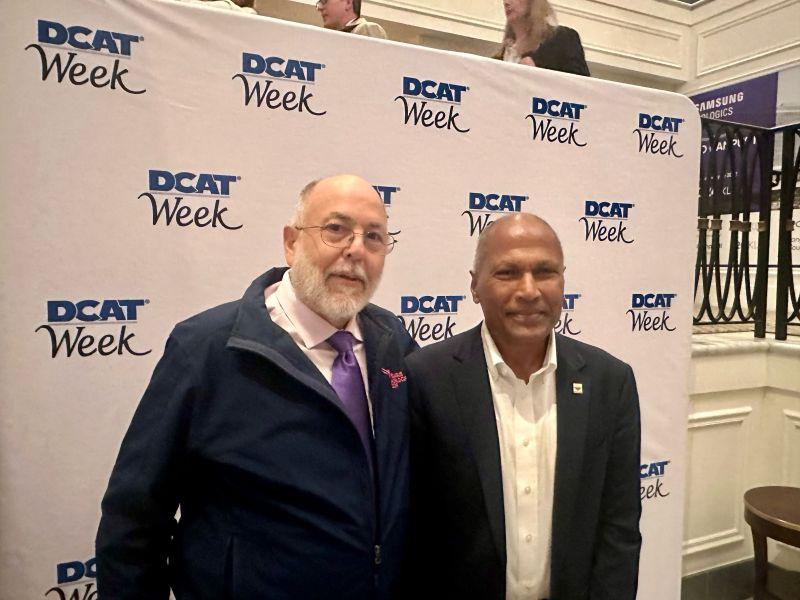
A 2024 photograph places him beside fellow executive Bhaskar Venepalli at DCAT Week in New York. The setting is recognizably commercial, a gathering of people whose work depends on relationships across company boundaries. More than three decades after AMRI’s founding, that remains a fitting place to encounter him.
The connective tissue of this career is visible in its settings: a research group, an incubator, an acquired company, an endowed laboratory. Each holds people doing work that depends on somebody else committing space, money or confidence. D’Ambra has spent much of his career helping arrange those commitments. Those early backers’ question was fair. The years supplied an answer.
Follow the chemistry
Explore Curia’s company history, D’Ambra’s professional biography and his LinkedIn profile.
Further reading: UAlbany’s commencement announcement, the RPI professorship, AMRI’s 2010 expansion, other founders’ view of AMRI and the family’s equestrian chapter.