Lenovo could make a laptop people admired. The harder question was what they thought of the company behind it. In RepTrak’s published account, product quality was a strength, while citizenship was the lowest scoring reputation driver. A customer could appreciate the machine on the desk and remain unconvinced about the institution that put it there.
That gap is where The RepTrak Company earns its living. It measures corporate reputation, compares perceptions across audiences and markets, and helps executives choose a response. The proposition has an appealing sting: being good at the thing you sell does not settle every other question people have about you.
- Surveys reveal what stakeholders think, feel and intend to do.
- Compass pairs reputation data with expert advice.
- The useful output is a priority for action, beyond a score.
A laptop is easier to judge than a company
For Lenovo, the response was the September 2019 “Smarter Technology for All” campaign. RepTrak’s case describes a common global theme with different local emphases: technology leadership in China, positive social impact in the United States. The company reported a one-point increase in its global Reputation Score and three-point improvements in perceptions of innovation, citizenship and governance.
Those are vendor-reported results, not a controlled experiment. Still, the management lesson is clear enough. A global message needs room for local expectations. Repeating the same words everywhere is easier to administer. Whether those words answer the same question everywhere is another matter.
Three verbs behind the number
RepTrak organizes its model around think, feel and do. Think covers seven drivers: products and services, innovation, workplace, conduct, citizenship, leadership and performance. Feel captures emotional regard, expressed through a Reputation Score from zero to 100. Do measures stated willingness to support a company, including buying, recommending, working for it or investing.
The distinction matters. Someone can admire an employer without wanting its products. Someone can buy a cheap product without trusting its maker. Combining those responses too early produces a pleasing average and a poor diagnosis. RepTrak’s framework gives teams a way to ask which relationship needs attention, and which belief might explain it.
Its annual Global RepTrak 100 is the public window into that machinery. The 2026 ranking draws on informed members of the public across 14 major economies. LEGO came first again. A ranking offers a conversation starter; the underlying questions offer a working agenda.
The business hiding behind the league table
RepTrak sits between market research, enterprise software and corporate advisory. Its customers include boards and communications, marketing, sustainability, HR, risk and legal teams. They subscribe to a continuing intelligence program. The company reports more than one million company ratings annually, with executive use in over 60 countries.
Compass, officially launched in December 2025, puts that proposition into a platform: dashboards, comparisons across markets, reporting and expert guidance. Brand Intelligence examines the relationship between brand and reputation. ESG Intelligence measures stakeholder perceptions of environmental, social and governance performance. The latter answers a perception question; it does not establish how much pollution a plant emitted.
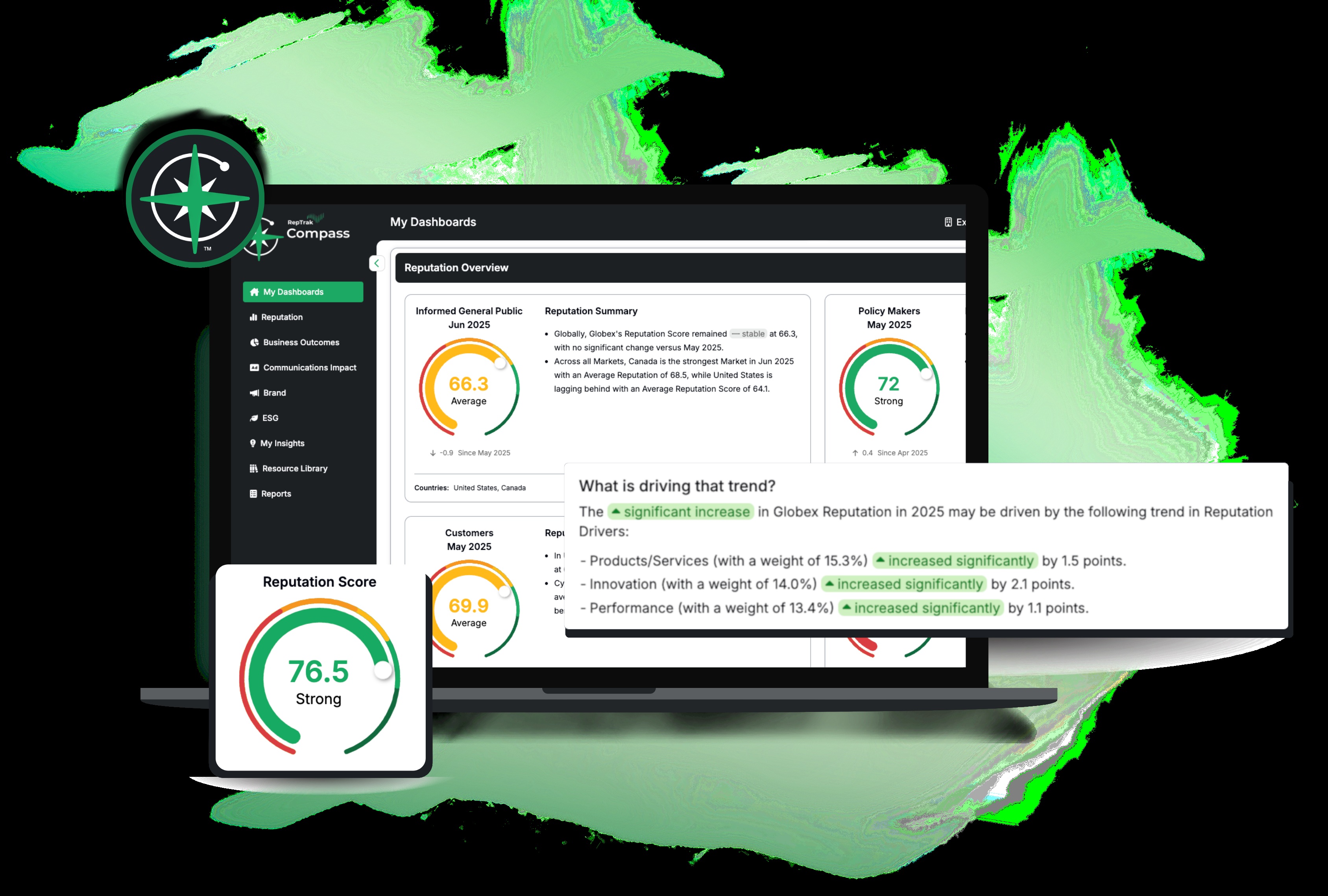
Compared with monitoring media mentions or online conversation, this approach adds structured stakeholder research. You can hear the loudest complaint on the internet without learning how widespread the belief is. A survey lets you ask a defined audience. Its usefulness still depends on whom you ask, when you ask and whether the questions remain comparable.
The organization has changed its own description along the way. Reputation Institute became The RepTrak Company in 2020, announcing a shift toward making measurement actionable. Today its published values include rigor and honesty, and its staff working groups cover sustainability, inclusion and culture. In 2024, it placed 90th on the Global Most Loved Workplaces list. For a company studying the distance between corporate claims and employee experience, listening to its own workforce is an obvious place to practice.
What the money actually bought
The funding numbers require some care. In July 2021, Horizon Technology Finance announced a $10 million venture loan to RepTrak, split equally between Horizon and a privately managed investment vehicle. That was borrowing. In November 2024, Periscope Equity announced a majority recapitalization, naming AI, data visualization and broader offerings among its priorities.
For buyers, the economics begin with a different calculation: will the research change a decision large enough to justify the program? A multinational deciding how to communicate in several markets has more opportunities to use comparable data than a tiny business seeking a few more reviews. The product makes most sense when someone owns the decisions that follow the findings.

Consider the purchasing decision from a communications director’s chair. A falling score creates several possible jobs: investigate an operational problem, explain an overlooked improvement, or revisit a claim the audience rejects. Each job has a different owner and a different cost. Buying measurement before agreeing who can authorize those responses risks creating a report that travels around the organization without changing it. A sensible brief therefore starts with the decisions the team expects to make, the audiences those decisions affect and the evidence that would persuade colleagues to act. That is a more demanding purchase than access to another chart.
The audience now includes a machine
RepTrak’s Dynata partnership joins its measurement framework with survey-data capabilities. Their announced 2025 study covered 10 countries and 13 industries. A separate partnership with Qnary, announced in 2022, connected reputation intelligence to executive communications. Both arrangements put other specialists around the measurement work.
The newer AI as a Stakeholder offering examines how AI platforms describe a company, the narratives they repeat and how those portrayals compare across competitors and markets. It is a recognizable extension of RepTrak’s original question: what picture of the business reaches someone before the business gets to speak?
“Reputation is not a soft metric.”
Chip Garate, Chief Product and Technology Officer, at Compass’s launch
A score needs someone willing to act
The discipline readers can copy is straightforward. Separate familiarity from approval. Break approval into specific beliefs. Compare audiences before choosing a message. Then track whether the intended belief changes. RepTrak sells the research and interpretation needed to make that routine possible at corporate scale.
The limit is equally practical. Research cannot repair a defective product, reverse a broken promise or turn an unpopular decision into a popular one by describing it differently. And willingness to buy remains an intention, not a receipt. The dashboard becomes useful when its owner can change something beyond the dashboard. Otherwise, it is an unusually precise way to watch people remain unconvinced.