In 1898, the Seiberling brothers started a rubber company that made bicycle tires, carriage tires and horseshoe pads. Frank and Charles gave their Akron venture the name of a man who had already died: Charles Goodyear, the pioneer of vulcanization.
More than a century later, Goodyear faces a strangely familiar question. Which parts of transportation deserve its money? The company still sells the round, black objects that connect vehicles to roads. But beneath that reassuringly familiar product is a business trying to choose between volume and value, cheap tires and specialized engineering, sprawling operations and a smaller set of commitments.
- Goodyear sells tires to drivers, vehicle manufacturers and fleets, plus installation and maintenance services.
- Its turnaround sold businesses and cut costs; weak demand continues to test the results.
- The useful lesson: measure the value of a sale, then count the cost of walking away.
A tire has two first customers
Consider two purchases. An automaker chooses tires for a new vehicle. Years later, a driver needs replacements. Both purchases produce tire revenue, but they happen in different markets, with different gatekeepers. Goodyear serves both. In 2025, it sold 45.6 million original-equipment tires and 113.1 million replacement tires. Roughly seven of every ten tires sold went into the replacement market.
That distinction explains why the company extends beyond factories. Drivers can buy online, arrange installation and visit Goodyear Auto Service or Just Tires for maintenance. Commercial customers can buy tires, retreading and fleet support. Aircraft operators and racing teams bring another set of requirements. Goodyear earns money from manufactured products and the services surrounding their working lives.
The cheapest tire is a crowded place
Goodyear competes with Michelin and Bridgestone, alongside Continental, Pirelli, Hankook and others. Its argument combines brand recognition, distribution, materials research and applications expertise. Those assets matter when a customer needs wet-weather grip or reliable fleet operations. They offer less protection when the purchase reduces to the lowest price on the shelf.
The pressure became visible in 2024. Goodyear recorded a $125 million intangible-asset impairment that included a significant reduction in the carrying value of its Mastercraft and Roadmaster brands. It pointed to increased competition at entry-level prices and its own profitability plans. A recognizable name could still attract customers without supporting the economics management wanted.
A recognizable name can still attract customers without supporting the economics management wants.THE ECONOMICS OF A FAMOUS NAME
This was one concrete warning sign, rather than a tidy origin story for every subsequent decision. Goodyear had already announced its Forward transformation in November 2023, following a board-led review. That review examined the portfolio, costs and profitability. The resulting plan put businesses up for sale and called for fewer product variations and better returns from customers and channels.
Subtraction comes with a bill
Mark Stewart, who arrived from Stellantis as chief executive in January 2024, inherited that assignment. His background included automotive manufacturing and Amazon fulfillment. The challenge suited an operator: decide what to keep making, where to make it and how to move it. They become harder when attached to plants and paychecks.
In 2025, Goodyear completed sales of its off-the-road tire business, Dunlop brand rights in specified markets and polymer chemicals business. The OTR sale to Yokohama alone carried approximately $905 million in gross cash consideration. Readers using an old product list could easily mistake yesterday’s Goodyear for today’s.
The original Forward plan anticipated approximately $1.1 billion for restructuring. The company later reported reaching $1.5 billion in annualized benefits at the end of 2025. Annualized benefits describe a pace of improvement; they are not cash sitting in a bank account. Nor do they remove the expense of changing the business.
Restructuring anticipated in the original 2023 Forward plan.
Annualized benefits reported at year-end 2025.
Different measures, different periods. These numbers are not a return-on-investment calculation.A further example arrived in July 2026: the approved Fayetteville factory closure plan involved approximately 1,750 job reductions. Estimated pretax charges were $535 million to $565 million, including $190 million to $210 million in cash charges. The projected annual operating-income improvement of approximately $270 million from 2028 remained a forecast. The people affected face the decision before shareholders can judge its full payoff.
The engineering is in the puddle
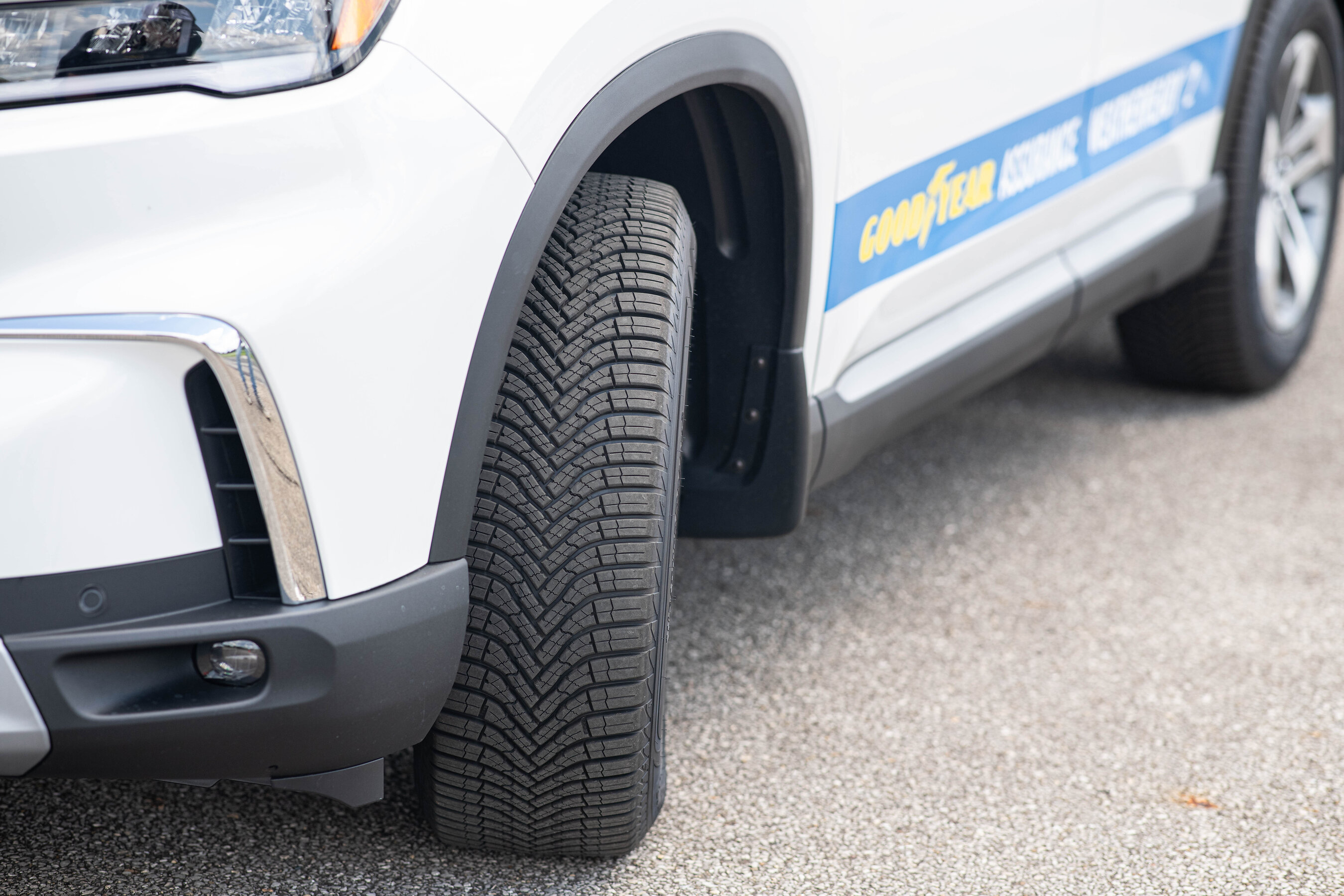
To understand what Goodyear wants customers to pay for, look at the Assurance WeatherReady 2. Introduced in 2024, it arrived in 58 sizes with a 60,000-mile limited tread-life warranty. Its grooves move water and slush away from the tire. A built-in tread-wear gauge makes a small maintenance task easier to understand. The product turns a broad promise about confidence into features a driver can inspect.
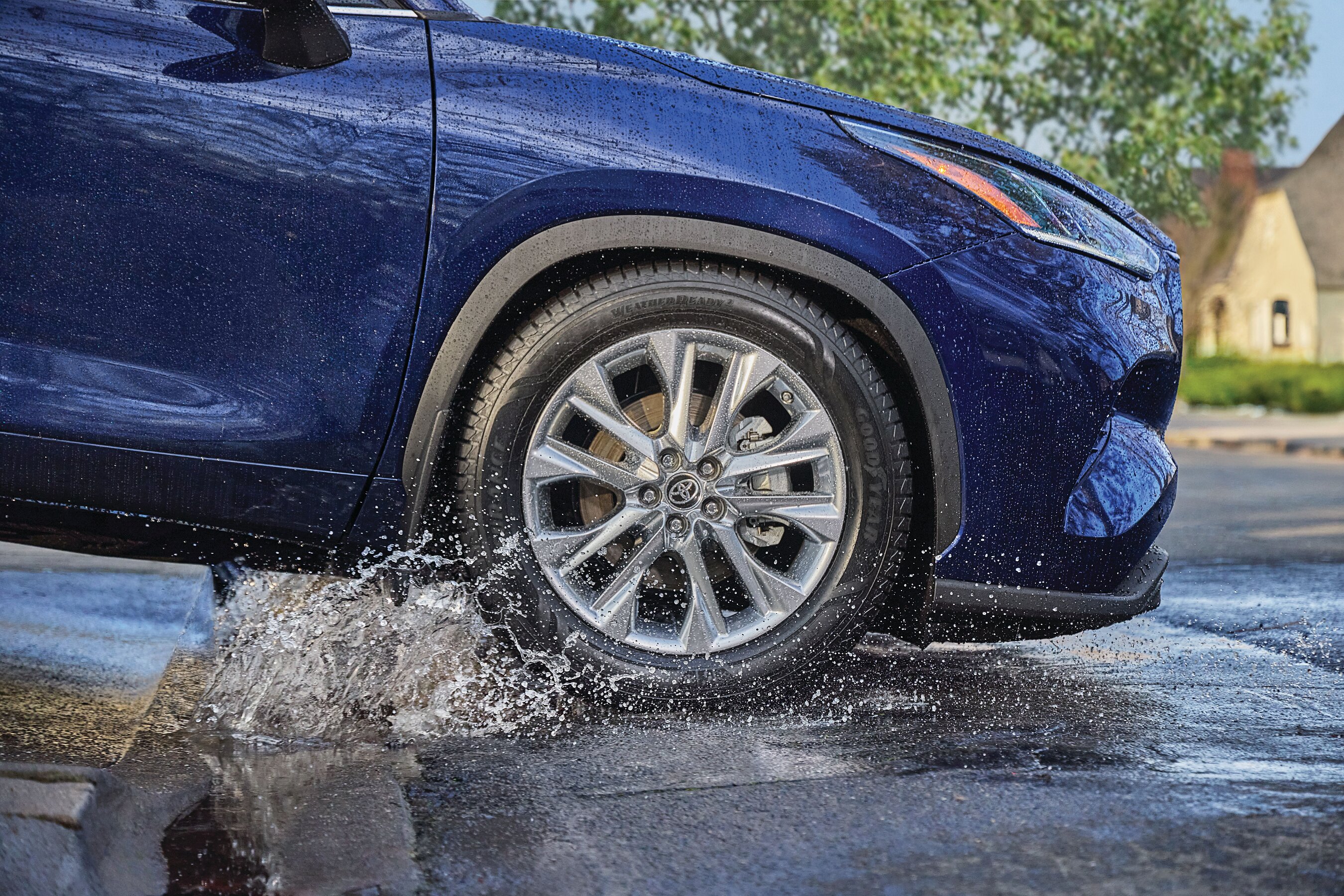
For a driver, the useful next step is practical: find the correct vehicle fitment, compare suitable products and arrange installation. A tire’s price varies with size, specification and seller; installation and other charges affect the final bill. A warranty has conditions. Choosing by brand alone skips the question the engineering is supposed to answer: suitable for which vehicle, road and weather?
Rubber that reports back
Goodyear’s work with autonomous-trucking company Gatik suggests another direction. In January 2024, the partners described integrating SightLine tire intelligence into Gatik’s driving system. Information about tire load, stiffness and road conditions feeds vehicle control. The tire becomes a measuring instrument as well as a replaceable part. Its value can extend to the decisions a vehicle makes.
Materials research brings a different constraint. In 2023, Goodyear demonstrated a tire containing 90% sustainable materials under its definition, including soybean oil and rice-husk-derived silica. It passed applicable regulatory testing. Yet the announcement explicitly identified supplier scale as a hurdle to high-volume production. A successful demonstration establishes possibility. Purchasing departments and factories still have to establish repeatability.
The road still gets a vote
The turnaround remains exposed to the market. In the second quarter of 2026, Goodyear reported $4.3 billion in sales and a $204 million net loss. Lower volume, tariffs, other costs and inflation weighed on performance despite transformation benefits. Selling fewer low-return tires can be deliberate; losing enough demand to weaken factory economics is a different problem.
The lesson a reader can copy is a discipline: examine which products and customers justify their complexity, and price the exit before celebrating the savings. It works only if the remaining business can earn enough to support its costs. At Goodyear, the answer will emerge in orders, production and margins. The name on the sidewall gives it a hearing. Every replacement purchase asks it to make the case again.