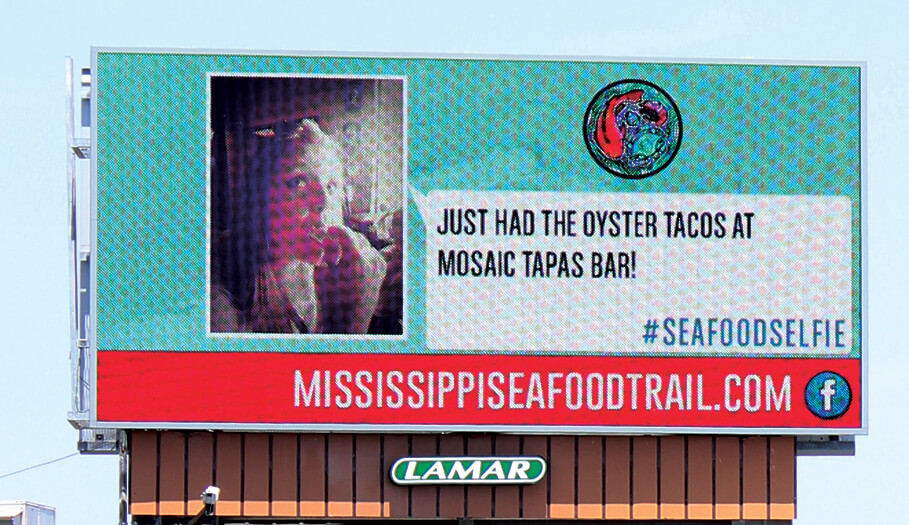
On the Mississippi Seafood Trail, lunch could climb onto a billboard. A diner photographed a plate of local oysters or shrimp, posted it with #seafoodselfie, and the image could appear on a digital board near the restaurant. The billboard was not merely decorating the highway. It was pointing back to lunch.
That neat little loop - customer to phone, phone to billboard, billboard to customer - says more about The Focus Group than its long menu of services. The Biloxi firm does research, branding, advertising, websites, social media, content, public relations, events and media buying. Many agencies can recite that list. The more interesting question is whether all those people are solving the same problem.
Here, the problem was painfully concrete. After the BP oil spill, Mississippi's seafood industry needed confidence and restaurant sales. The agency and the Mississippi Hospitality & Restaurant Association launched the trail in 2013, presented Gulf seafood as its own regional category and gave diners an interactive way to choose a species and find a participating restaurant. Photography made the food desirable. Custom illustrations made it local. Social posts became outdoor media. A toolbox of brochures, table tents, window clings, gift cards and shirts let restaurants carry the idea themselves.
A regional accent is a form of data
The Focus Group's public portfolio has the peculiar coherence of a place. There is shrimp, naturally, but also the Port of Gulfport, Gulfport-Biloxi International Airport, The Peoples Bank, tourism offices, cities, wildlife, mental-health programs and organizations clustered around Stennis Space Center. These clients do not buy the same deliverable. They do share an audience that can detect an outsider's approximation of the Gulf Coast.
Allison Buchanan has led the agency since 2011. She arrived after running her own communications business and working in corporate marketing, and described The Focus Group at the time as a small startup that needed a leader. Her unusual advantage was range: journalism, art, product management, copy, research and community work. The agency's current structure reflects that appetite. An account strategist can pull in a content producer, art director, digital specialist and media buyer, rather than pass a brief down a departmental conveyor belt.
“Creativity is an economic multiplier.”Allison Buchanan, CEO
The line sounds like a slogan until the seafood trail supplies the arithmetic. The campaign reported more than 20,000 Facebook likes in its first three months. USA Today put the trail among the country's leading food trails, and readers voted it No. 2. The concept was adopted into statewide tourism marketing. One piece of creative work moved across restaurants, tourism, social media and roadside inventory. That is the multiplier Buchanan means.
The commodity needed a biography
Wild American Shrimp presented a harder version of the same assignment. Shrimp looks like shrimp in a freezer case. The agency's response was to replace sameness with provenance: the people who catch and process it, the coastal inheritance around it, chefs who cook it and reasons to ask for American shrimp by name. An interactive site carried processor stories, recipes, videos and a “shrimp academy.” Social programs, trade materials, television and search all pushed the same distinction.
The reported results were substantial: the Facebook audience grew from zero to more than 140,000, engagement topped 10 percent against a stated industry benchmark of 1 to 2 percent, and post reach hit 1.3 million. The website consistently ranked first in Google search for the category. These are the agency's own case-study numbers, but they are precise enough to show what it regards as proof. The work is judged by discoverability and response, not only appearance.
The same habit appears in a campaign for Gulfport-Biloxi International Airport. Research found that local passengers liked the airport's easy parking, short waits and friendly staff, yet some still drove to larger airports. The agency did not invent a grand cosmopolitan fantasy. It advertised the annoyance of traveling farther to travel. Billboards appeared along the road to the biggest competing airport, reframing extra driving, parking and security time as part of the ticket price.
What the work costs - when the paperwork is public
Private agencies rarely publish a rate card, and The Focus Group does not. Government files provide two useful glimpses. Mississippi paid the firm $22,500 to develop a digital media and content strategy for 2020 census outreach; the state's wider outreach appropriation was about $400,000. In 2026, the firm won a five-year Mississippi Department of Education media contract for the Summer Food Service Program with a ceiling of $240,000, or $48,000 a year.
Those numbers are examples, not a price menu. They do show the range of what “marketing” can mean: a strategy document at one end; creative assets, social management, radio, digital, outdoor buying and performance reports over five years at the other. The buyer is paying for coordination as much as production.
The census assignment also reveals what failed first: normal life. The pandemic disrupted in-person outreach just as Mississippi tried to reach residents historically missed by the count. During the contract, the agency produced Spanish and Vietnamese advertising and emphasized community leaders in hard-to-count areas. Before the disruption, officials said Mississippi was outperforming prior response rates. The lesson is modest but useful. A media plan is not a machine you switch on; it is a hypothesis exposed to weather, politics, public health and human attention.
The change behind the awards
In 2020, The Focus Group reorganized around multidisciplinary teams to become more flexible. The decision is easy to romanticize because work from that year later won 47 Gulf Coast Addys - 12 gold, 31 silver and several top honors. But awards are a trailing indicator. The important change was operational: strategy, writing, design, digital, social and media could respond together when a campaign moved under their feet.
The year's work makes the point. A Mississippi census campaign included a Morgan Freeman television spot. Biloxi Shrimp Co. launched an e-commerce brand capable of shipping Gulf shrimp nationwide. A mental-health effort built a service-finding campaign during the pandemic. The agency also made an unsolicited Gulf Coast resilience film from footage it already had and worked with Lamar to place the message on donated billboards. Different audiences, same compact machinery.
The part worth copying
A reader can copy that sequence without hiring an agency. Do the research before choosing a channel. Define the desired action in ordinary language. Put everyone making the work around one brief. Measure something closer to the business than applause. Then alter the mix while the campaign is alive.
It will not travel intact everywhere. The method depends on access to customers, permission to adapt, a budget large enough to test channels and a product with a defensible truth. “Local” is not automatically persuasive, and integration becomes expensive clutter when nobody owns the outcome. The Focus Group's better campaigns work because place is evidence: shorter airport lines, Gulf-caught shrimp, a restaurant down the road. Without that truth, a regional accent is merely decoration.
A small agency in the middle of the map
The Focus Group sits between several alternatives. A client could hire a national shop with larger specialist benches, assemble separate web, PR and production vendors, or build an internal team. The Biloxi agency's proposition is coordination plus context. It knows the institutions and anxieties of its home market, yet its national association and e-commerce work extends beyond Mississippi.
Its limits are visible, too. Some portfolio pages preserve launch language long after results should have arrived. Public case studies naturally emphasize victories. And a broad services list places a heavy burden on a team of roughly two dozen people. The answer is not scale for its own sake. It is the discipline to decide which problem deserves the whole team.
Return to the seafood selfie. It is playful, but it is not frivolous. One diner supplies the picture. A platform supplies distribution. A billboard supplies public proof. Geography supplies relevance. The restaurant gets a customer. The coast gets a story about itself, told by someone who has just eaten lunch. The agency's best work begins there - not with the ad, but with the circuit it completes.