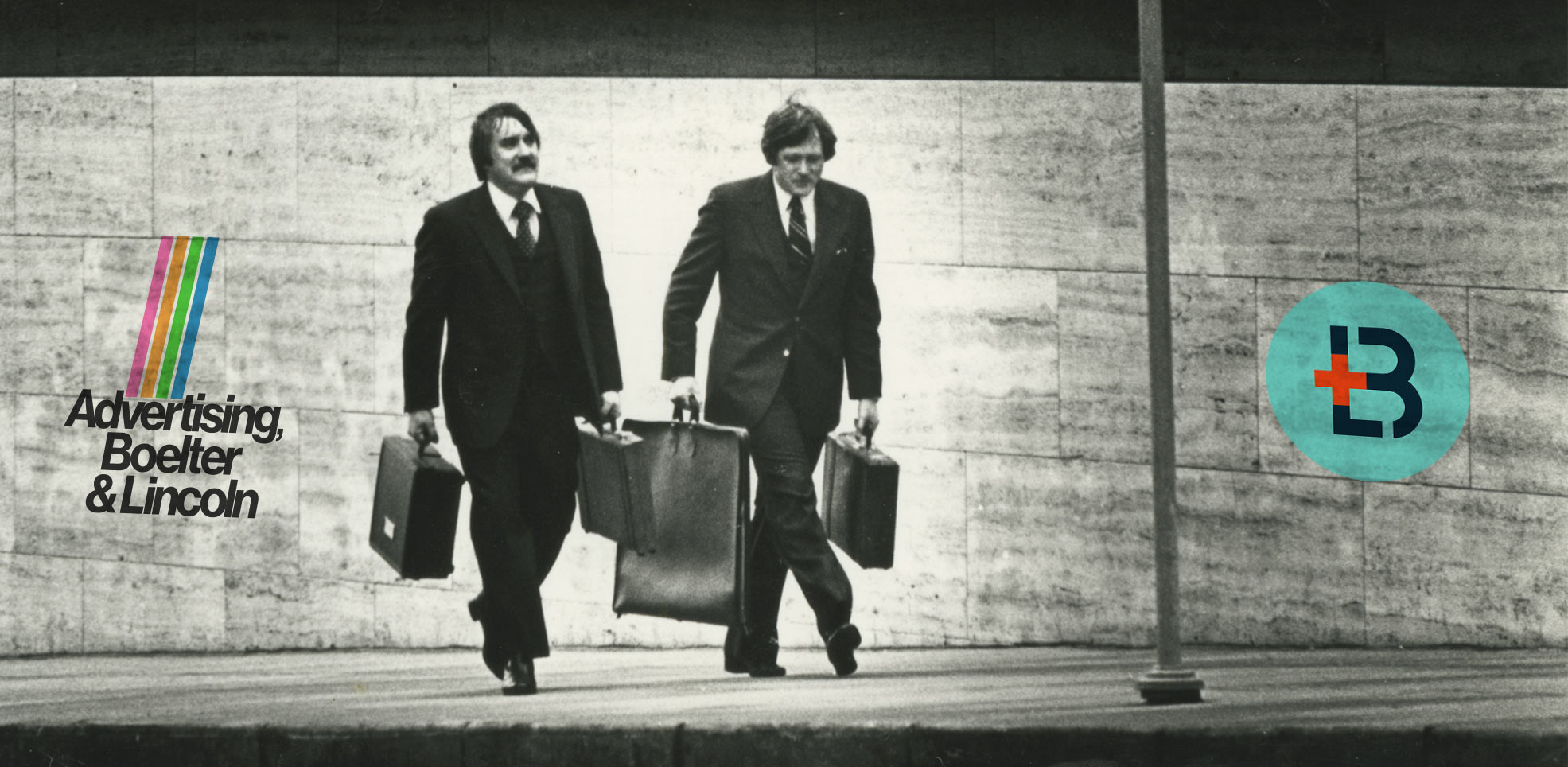
On April 1, 1975, Bob Boelter and John Lincoln opened an advertising agency in Milwaukee. This was a moment when a media buyer could survey the television landscape without scrolling. There were three networks. A calculator counted as technology. Plans, budgets and conference reports went into three-ring binders. The ashtray sat on the desk; the Scotch waited in the cabinet. Boelter + Lincoln remembers all of this because, unlike most things built for that media world, it is still here.
The obvious lesson would be longevity. That is also the boring one. The useful lesson is that the firm survived by refusing to confuse its tools with its job. Today its media buyers size up more than 1,000 television options across broadcast, cable and streaming. Its 34-person team builds websites, studies search behavior, manages influencers, makes podcasts and runs social feeds. Yet the agency's own description of its purpose remains almost suspiciously plain: help the client's business.
“Our foremost goal then and now was to help the client's business.”Boelter + Lincoln, at 50
The deliverable is not the problem
Full-service agencies are easy to describe and hard to distinguish. Everyone has strategy, creative, media and digital written somewhere on the door. Boelter + Lincoln offers the entire familiar shelf: brand workshops, market research, package design, broadcast ads, public relations, crisis communications, social listening, influencer work, UX, websites, SEO, photography, video and media buying. The business model is the traditional one: clients pay for expertise, production, ongoing management and media work. The agency does not publish a rate card, and no reliable public project costs are available.
What separates the practice is not a magical new service. It is the order of operations. The agency's proprietary BRAND+ process treats identity as infrastructure, not decoration. Primary and secondary research come before the channel plan. A single core user comes before a dozen audience personas. The principle sounds modest until you see how often marketing teams reverse it: buy software, fill channels, then go looking for something worth saying.
Research the audience, the market and the friction that is stopping action.
Use BRAND+ to establish positioning, language and the core person being addressed.
Turn the strategy into design, content, PR, digital products and paid media.
Track downloads, traffic, applications, sales, attendance and the behavior that matters.
This is particularly suited to clients whose problem moves between the physical and digital worlds: a tourism destination that needs actual visitors, a transit system that needs riders and operators, a snack brand that must charm a shopper and a retail buyer, or a manufacturer that needs authority in a trade publication. That mix explains the agency's visible concentrations in tourism, transportation, food and beverage and financial services. It is consumer persuasion with operational consequences.
The bus was not a bus problem
Consider Milwaukee County Transit System. In a city where parking can be manageable and the bus carried a negative perception, the assignment was not merely “make an ad.” The useful question was how the bus could fit a person's life. Boelter + Lincoln helped promote a redesigned site, Trip Planner, Bus Tracker and Ride MCTS app with digital ticketing. The work connected the message to a product that made riding easier.
Then another problem arrived: hiring. Transit systems across the country were short of operators, and the pandemic made recruitment harder. The first thing that failed was not a particular advertisement so much as an assumption - that people outside transportation could picture themselves inside it. MCTS's HR team shared what candidates were saying during screening and hiring. That direct feedback changed the campaign.
The resulting two-part approach first showed long-term careers through employees who had started in entry-level roles. It then widened the lens to the “dream jobs” available across operations, maintenance and administration. In 2023, MCTS hired more new operators than in any previous year. Half of the top 10 ways applicants said they discovered openings were connected to paid advertising tactics, and operator applications rose 10 percent. The lesson is portable: when recruitment marketing stalls, move closer to the people who conduct the interviews. Their notes may be better creative research than another trend report.
A package can be a business argument
For Gorilly Goods, the friction sat on the shelf. The organic snack company's packaging did not fully express its personality or its health-conscious customer. After a branding process, Boelter + Lincoln created a platform spanning logo, color, package, collateral and trade-show material. Those last items matter. A consumer package has to speak across the aisle; a young food company also has to persuade the retail buyer who controls whether it reaches the aisle at all.
The redesigned brand accompanied Canadian distribution and survived the company's acquisition by a larger organic-snack producer. Correlation should not be dressed as sole causation, but durability after an acquisition is a serious compliment to the underlying brand system. The agency reports that the major elements stayed intact.
The same integrated logic appears in work for Saz's Hospitality Group. Its restaurants, catering, festivals, venues and sauces had multiplied into a family of businesses. Boelter + Lincoln unified them and rebuilt the website around the same organizing idea. The agency reports pageviews and unique pageviews rose 250 percent, bounce rate fell 42 percent and organic search increased 220 percent.
“TB” is the Tommy Bartlett Show, the Wisconsin Dells water-ski attraction that was a Boelter + Lincoln client for more than 30 years. For a seasonal business with limited budgets, the agency blended traditional media, paid social and interactive banners, reporting a doubling of ticket conversions and more than 200 percent social-community growth in the first two years of management. A 30-year account is more than a testimonial. It suggests a firm willing to revise the plan without staging a reinvention every quarter.
Old enough to know what not to change
Advertising culture likes novelty because novelty is easy to present. Boelter + Lincoln's stranger advantage is continuity. The company says staff tenure is nearly twice the industry standard. It credits work-life balance, fresh coffee, a Historic Third Ward office and the fact that no two days look the same. A client experiences the practical side of that statistic: fewer introductions, less institutional memory lost between campaigns, and colleagues who remember why a decision was made.
Bob Boelter and John Lincoln open the agency on April 1.
The firm signs for its current home on East Chicago Street in the Third Ward.
MCTS work earns regional PR honors for public affairs, video and events.
Boelter + Lincoln marks 50 years with 34 employees.
The agency keeps publishing on AI, PR, brands, podcasts and event marketing.
That stability does not make the agency right for every brief. Its public evidence is strongest where sustained regional knowledge, integrated execution and access to client data matter. A startup seeking a one-week logo sprint may find the research-first process heavy. A global account demanding offices on four continents may prefer a holding-company network. And measurement only works when the client can share operational numbers. The MCTS recruiting story depended on HR feedback. Remove that access and you remove the hinge of the idea.
What can another company copy without hiring the agency? Start with the obstacle, not the output. Choose the core audience before the platform. Ask frontline staff what prospects misunderstand. Make creative and utility reinforce one another. Measure behavior closer to the business - applications, downloads, tickets, visits - instead of stopping at impressions. Then keep the parts that work long enough to learn something.
The clever move was never surviving the old media world. It was declining to mourn it.
The ashtrays disappeared. So did the Scotch, at least from the cabinet. The binders became files, three networks became a thousand options, and news deadlines became a permanent condition. Boelter + Lincoln changed its inventory of skills each time. What it kept was a practical belief that creative work ought to end somewhere beyond the creative department. In an industry famous for selling attention, that may be the most durable pitch: do something with it.
Continue exploring