The awkward thing about selling software is that the customer must buy it before it exists. For a young development company, the problem is worse: the evidence that would win the next job belongs to projects it has not yet won. TechJini ran into precisely this little trap. Its answer was unusually literal. Build a proof of concept. Give the prospective customer something that works.
- Custom mobile and web engineering, with design and maintenance attached.
- A concrete calling card: Pepperfry’s image-heavy shopping app on poor networks.
- Datamatics acquired control in 2017, completed ownership in 2019 and absorbed the business in 2020.
The portfolio problem
Founded in 2005 by Shyamal Mehta and Amit Rana, TechJini sold technical judgment along with development work. In a 2016 interview, Rana recalled the difficulty of approaching customers without a portfolio. The team responded with demonstrations and consultation. A proposal asks a buyer to imagine competence. A prototype allows the buyer to inspect it.
This was also a business with ordinary financial pressures. Rana identified cash flow and money management as important service-industry challenges. He described TechJini then as debt-free and profitable since its beginning. That was the founder’s account, but it helps explain the sales approach: each engagement had to support an operating business.
A sofa on a slow connection
Consider Pepperfry, the online furniture retailer. Google’s January 2017 developer spotlight described a company that came to TechJini without a mobile presence. Furniture shopping depends on pictures. The shopper needs to see the chair, the finish, the proportions. Yet those pictures must travel through whatever connection the shopper happens to have. A beautiful screen is a rather limited achievement if it never finishes loading.
Google’s India blog later described the resulting performance challenge. TechJini worked with Google developer advocates and support engineers to address roadblocks in the visually heavy app. Mehta put the constraint plainly: the experience had to work “even in poor network conditions.” The useful design brief included the network.
shopping
experience
That is where the Google agency relationship becomes interesting. Certification brought workshops, early technology access, direct support and UX reviews. These were practical resources for an agency carrying responsibility for somebody else’s product. The Pepperfry example makes the relationship easier to understand than a badge on a website ever could.
In March 2018, Datamatics announced a third consecutive year of Google agency certification and said TechJini had delivered more than 200 mobile apps and products. That breadth matters because a development agency learns across assignments. Each new customer brings different constraints, existing systems and expectations about what counts as finished.
The designer moves in
TechJini had already made a structural bet on this connection between appearance and function. In September 2014, it announced a merger with CodeConclave, a two-year-old mobile design and strategy company. CodeConclave founder Siddhartha Banerjee became Creative Director and took charge of the UI/UX studio.
The decision put design leadership inside the engineering operation. For a customer, the attraction is straightforward: fewer handoffs between the people deciding how an app behaves and the people making it behave. That is an interpretation of the arrangement, rather than a measured claim about every project. Still, it gives substance to TechJini’s positioning as a product engineering business.
The useful design brief included the network.THE PEPPERFRY LESSON
Its engineering interests also escaped the client brief. In February 2014, a TechJini team won the Hack-a-Fin competition in Bengaluru with Thirukkural, a voice-driven finance prototype. A person could ask about spending on a card and receive an answer. The project was a hackathon entry; treating it as a commercial banking product would stretch the evidence. As a small example of curiosity translated into working software, it fits.
The price of another pair of hands
What could a buyer actually purchase? TechJini offered custom web and mobile development, technical planning and maintenance. Its LinkedIn description emphasized iterative work and changing requirements. This put it in the market for outsourced product teams, serving startups and enterprises rather than selling one standardized application.
Its market included fellow Google-listed agencies such as Mutual Mobile, Cognitive Clouds and GoodWorkLabs. The sensible comparison for a buyer was the fit between a team’s experience and the assignment: the operating system, the interface, the existing infrastructure and the work needed after launch.
One pizza-ordering client interviewed by Clutch reported spending $20,000-$25,000, with $30,000 expected overall. The arrangement used a dedicated developer on a monthly fee. An Android app replaced a website wrapper; ordering and payment connected to an existing backend.
A project example, not a current quote.
The same customer praised the developer’s clarifying questions and described a missed New Year launch. Time zones and working approaches slowed delivery, while the customer’s own design constraints also blocked progress. This is useful purchasing evidence: a satisfactory product and a disappointing schedule can coexist.
My reading of that account is that buyers should budget for their own participation, too. Someone must settle design questions, prepare dependencies and make decisions during shared working hours. A monthly developer arrangement becomes less attractive when the customer cannot do those things, or when a fixed seasonal deadline leaves little room for iteration.
Why a mobile boutique joined Datamatics
By July 2017, Datamatics described TechJini as a 250-person business serving more than 35 companies. Its customers spanned media, engineering, manufacturing and startups. Datamatics wanted to strengthen enterprise mobility. TechJini’s founders pointed to the larger company’s resources and access to customers in the United States and Europe.
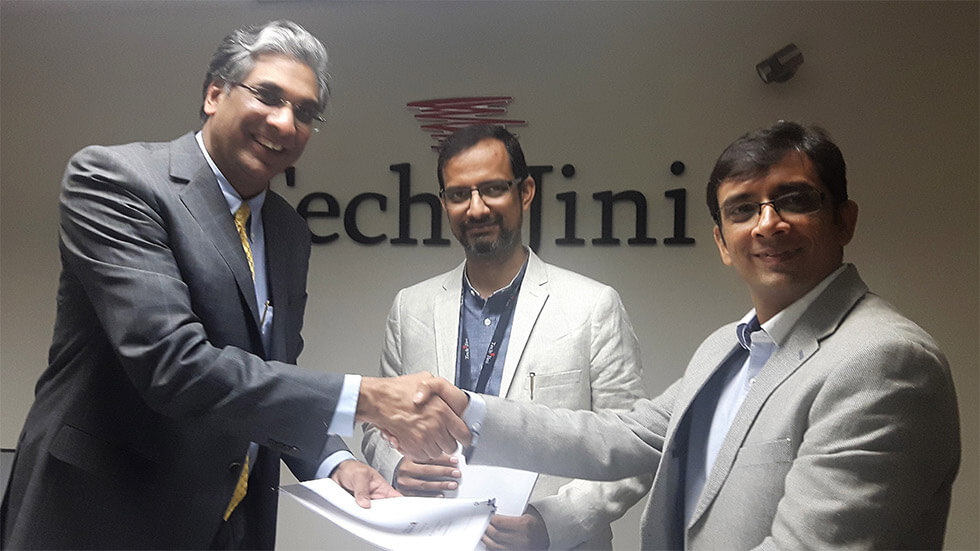
The change unfolded in stages. Control arrived in 2017. Datamatics bought the remaining 18.91% in May 2019 for ₹104 million. The business, renamed Datamatics Digital, subsequently merged into Datamatics Global Services, effective December 7, 2020.
The financial record supplies a final perspective. Datamatics’ May 2019 presentation reported TechJini revenue of ₹392.6 million in FY2018 and ₹598.6 million in FY2019. Those are historical numbers for a business being integrated, not a present-day standalone forecast.
For anyone choosing an outside engineering team, the prototype can be a useful first conversation. It makes assumptions visible early. Ask what it demonstrates, which dependencies it leaves untouched and who will make the decisions when the demonstration becomes a maintained product used by actual customers.
The lesson worth borrowing is modest enough to use tomorrow: identify the part of a customer’s problem that a sales presentation cannot settle, then demonstrate it. TechJini used prototypes to establish credibility, design expertise to broaden its offering and a larger owner to expand its reach. Start with the uncertainty. Build something that makes it smaller.