The cocktail receives all the theatre: the cold glass, the twist of citrus, the little ceremony at the bar. Its purchase order receives none. Yet before a bottle reaches a back bar, somebody has searched catalogs, checked prices, chased representatives and placed orders across a small parliament of distributors. Taylor Katzman built his company in that neglected interval, well before the first pour and long after anybody thought the paperwork charming.
His education in the problem was personal. After college and an early stretch helping a technology startup grow its sales operation, Katzman moved to Chicago. His wife and father-in-law were starting Rhine Hall Distillery, a fruit brandy producer. The family learned the three-tier alcohol system from inside it: suppliers sell through distributors, distributors serve licensed retailers, and every market comes with its own relationships and rules.
The lesson was not merely that alcohol is regulated. It was that a vast trade could still conduct ordinary business through a disorderly mixture of pen, paper, calls, email and text messages. A beverage manager might deal with eight to fifteen distributors in a week. Each carried different products; each had its own representative; each conversation could become its own tiny filing cabinet.
“This enormous, and complex, industry is operating through pen-and-paper.”Taylor Katzman, on seeing the opening
Learning the route before redrawing the map
Katzman did not go directly from the distillery to Provi. He joined Drizly early and worked on the consumer alcohol-delivery company’s Midwest expansion. That job supplied a second apprenticeship: how to take a technology concept into new cities, how local alcohol commerce differs from one market to another, and how much of the work lives beyond the screen.
By 2016, he had enough views of the machinery to found the business that became Provi. It was first called Tiz, a name with the faint air of a placeholder that has escaped into public. The company changed it in 2017. Katzman explained that Provi came from “provision,” a word for supplying food, drink or equipment for a journey. A practical name suited a company devoted to a practical nuisance.
One order, three interested parties
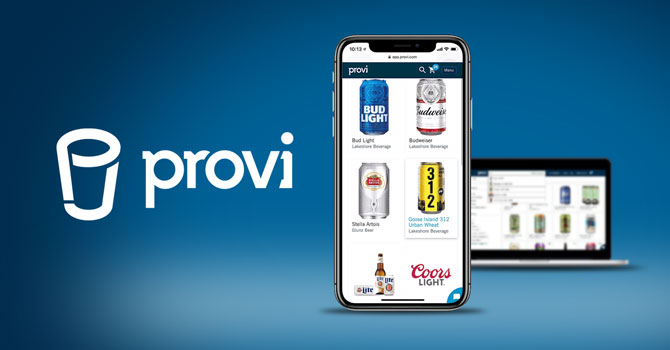
The product gathered distributor catalogs into one marketplace. A retailer could search across them, put products into one cart and have the order communicated to the proper sales representatives. Provi preserved the distributor relationship instead of trying to leap over it. That detail is the quiet hinge of the business. In a regulated market, an elegant screen is useful only if the order travels along a lawful, workable route.
For sales representatives, Katzman framed the pitch in terms of reclaimed attention. Reps could be responsible for scores or even hundreds of accounts. Clerical order entry competed with the human work of selling and advising customers. “They’re the best sales people,” he said in an early interview. “They should go out and sell.” Software, in this telling, was less a robot bartender than an unusually tireless assistant with excellent handwriting.
The unglamorous middle begins to scale
In 2018, Provi announced a $3.5 million financing that brought its disclosed total at the time to $5 million. The company was operating in Chicago and Denver and preparing to enter Atlanta. Katzman told Brewbound that hundreds of people were using the platform and that tens of millions of dollars in sales were already moving through it. He also described the larger canvas: a $240 billion industry still heavily reliant on SMS and paper invoices.
Three years later, financing arrived at a different scale. Provi raised $25 million in a Series B and then $75 million in a Series C led by D1 Capital Partners, with participation from Bessemer Venture Partners and others. The latter round valued the company at $750 million. Katzman said revenue had tripled over the preceding year and described continued investment in both sides of the marketplace: the retailers who order and the distributors who supply them.
Capital made expansion possible, but scale in this business required more than recruiting users one bar at a time. Provi had to become useful to the institutions around those buyers. In 2022 it joined forces with SevenFifty, whose tools and detailed product database had been built for distributors and their sales teams. The combination broadened Provi’s place in the trade, from a convenient ordering layer toward a shared operating surface for retailers, distributors and suppliers.
It also made Katzman’s job increasingly diplomatic. Every tier wants something different. Retailers value speed, visibility and saved order history. Distributors care about trusted account relationships, fulfillment and systems that already run their business. Suppliers care about discovery and trade marketing. A marketplace between them must create convenience without flattening those differences into a slogan.
A platform learns the local rules
The later milestones show that institution-building work. In 2025, Provi and Republic National Distributing Company resolved litigation and announced a national integration agreement intended to let licensed retailers access RNDC’s portfolio through Provi while keeping existing relationships and workflows intact. The same year, Provi became the first B2B platform announced as an integrator with Ohio Liquor’s Wholesale Cloud.
Ohio offers a particularly revealing test. High-proof spirits move through a state-controlled system. The integration lets on-premise permit holders use Provi for those orders alongside beer and wine, while the requests route into Ohio’s wholesale portal and onward to contract liquor agencies. This is digitization with its sleeves rolled up: inventory data, permissions, routing and the local nouns all have to be correct.
Katzman joins Drizly and helps expand its Midwest presence.
He founds the Chicago company that becomes Provi.
A $75 million Series C values Provi at $750 million.
Provi and SevenFifty join forces.
Provi reports more than $5 billion in cumulative platform GMV.
Enterprise Plus launches for regional and national restaurant groups.
By November 2025, Provi said more than $5 billion in gross merchandise volume had flowed through its platform. The figure is cumulative transaction volume, not company revenue, but it is a substantial measure of activity running through a tool that began with a fragmented weekly errand. Katzman called it a turning point in how the industry operates. More precisely, it marked how far a once-invisible workflow had moved into view.
The number also says something about where business software earns its place. A retailer does not need a lecture on digital transformation while checking stock before service. The retailer needs to know what is available, what it costs, who carries it and whether last week’s order can be found again. Each answer is small. Put together, they can return hours to a team every month. Provi’s early promise was measured in precisely that currency: fewer repeated messages, fewer scattered records and less time spent rebuilding the same order from memory. Grand strategies are frequently smuggled into companies inside very modest conveniences.
In February 2026, the company pushed further into multi-location operations with Enterprise Plus. The subscription tier was designed for national and regional restaurant groups that need local flexibility alongside corporate purchasing standards and visibility. Katzman described those needs as paired rather than opposed. The sentence captures his company’s wider method: find two interests that look inconvenient together, then build the connective tissue.
The temperament of a connector
Public recommendations from former colleagues repeatedly describe Katzman in social terms: energetic, enthusiastic, attentive to customers and quick to read a room. Those qualities make sense beside his career. Marketplace founders do not merely ship features. They persuade groups with old habits and unequal power that sharing a new piece of infrastructure will serve each of them.
His public language tends to distribute credit across the network. When Provi announced the $5 billion figure, Katzman thanked retailers, distributors, suppliers and control states. The roll call could sound ceremonial, but it also names the practical coalition required for the number to exist. A cart on its own moves nothing. The network does.
There is a tidy irony in the arc. Katzman found his opportunity inside a family distillery, among fruit brandy and the stubborn paperwork of wholesale trade. A decade later, his company’s challenge remains recognizably the same, only wider: help the people who make, move and buy beverages coordinate without asking them to abandon the system in which they work.
The visible product is software. The less visible product is agreement: that a buyer should be able to search everything in one place, that a representative’s time is better spent with customers, that a distributor can offer digital convenience without surrendering its relationship, and that an old trade can modernize one ordinary task at a time. The drink still gets the garnish. Katzman has made a career from noticing everything that had to happen first.