The introduction came through a brother. In Los Angeles, after the 2014 World Cup, Tashi Nakanishi met Keisuke Honda, the Japanese footballer whose career had taken him to AC Milan. Nakanishi brought a background in investments. Honda brought a growing interest in what he could build beyond football. Their eventual partnership began with something less photogenic than a launch announcement: conversations.
They talked over the next two years. That interval matters. Put the founding date on a timeline and the relationship can look instantaneous, as though an investor and an athlete simply discovered a shared business opportunity between appointments. The actual sequence gives the partnership room to breathe. They spent time understanding each other before putting a fund around the idea.
“With Keisuke, I thought we could do bigger things than doing it myself,” Nakanishi said. It is a modestly phrased explanation for a career that would later involve Will Smith, Kevin Hart, Steve Aoki, Simu Liu and Giannis Antetokounmpo. At the beginning, the question was whether two people could do useful work together.
An introduction with a two-year runway
KSK Angel Fund followed in 2016. The early investment record included Makuake at seed stage and Kyash at Series A. Those names locate the partnership in the ordinary business of finding companies and backing them early, when an investment still requires a considerable amount of belief in work yet to be done.
For Nakanishi, working with Honda also extended into operations. He advised Honda Estilo from 2014 and took responsibility for the day-to-day work and project management of Honda Estilo USA. There were soccer schools as well as startups in this relationship. The vocabulary of dreams had an administrative side: a program needs someone to organize it.
That combination would recur. Nakanishi’s career repeatedly places him beside people whose public achievements are easy to recognize, then inside the organizations built around their next ambitions. An athlete can decide to invest. Turning that decision into a working organization requires another set of skills, and a calendar with rather fewer match days.
Los Angeles
Angel Fund
VC
essays
Before the fund, the goalmouth
Nakanishi had a football history of his own. At St. Francis, he was named a first-team goalkeeper in the Division II All-CIF Southern Section selections for the 2003-2004 season. Later, he played for Cal State San Marcos. The 2007 roster puts him in goal, wearing number 31, with Cal State Northridge listed as his previous school.
One college game supplies a small, vivid episode. Against Cal Poly Pomona in 2008, the teams remained scoreless. Nakanishi had gone through the first 100 minutes without needing to make a save. In the closing minutes, he pushed a shot over the crossbar, then stopped a header from the corner that followed. The draw survived.
“Tashi was the player of the game,” coach Ron Pulvers said afterward. It is an agreeable early entry in a professional biography: an afternoon when the important work arrived late, and all at once. There is no need to turn it into a theory of investing. Goalkeeping is sufficiently interesting on its own.
His university career records list nine shutouts across 2007 and 2008. His education also took him well beyond the field: a B.S. in political science at Cal State San Marcos, attended on a full athletic scholarship, and a Master of Law from ISDE in Madrid. Politics, law, sport and finance make an untidy set of headings for a résumé. They make a better story.
Career shutouts at Cal State San Marcos, 2007-2008.
Before the better-known venture partnerships, he held vice president roles at Christina Development, a real estate fund; Logica Advisers, a quantitative fund; and Shinnecock Partners, a fund of funds. He also earned the Chartered Alternative Investment Analyst designation. His later work with recognizable public figures came after experience in several corners of alternative investing.
A bridge with a Hollywood address
Dreamers VC, co-founded in 2018 alongside Honda and Will Smith, enlarged the circle. Nakanishi served as managing partner. The fund connected established Japanese corporate investors with early-stage companies in the United States, investing alongside lead investors. Its proposition depended on bringing people into a market where local relationships carry weight.
The bridge image is useful because it describes a job. Capital on one side does not automatically become a relationship on the other. An institution needs people who can understand both parties, arrange the crossing and remain involved afterward. Nakanishi’s work occupied that middle ground between Japanese investment interest and American startup opportunities.
By July 2022, he was discussing Dreamers and his partnership with Honda on Coasthawk Talk with Nick Swinmurn. The subject had become substantial enough for a conversation of its own: how the relationship began, what working with Honda and Smith involved, and what the fund intended to accomplish. There was now an organization behind the introduction.
There is also a useful distinction between founding a fund and founding every company in its portfolio. The record here is Nakanishi’s work as an investor and operator. His achievement lies in helping build the investment organizations through which other founders receive capital and support. That is a consequential role without borrowing anyone else’s biography.
The room gets bigger
At X&, the partnership model became a broader business. The names around it span several kinds of public life: Honda in football, Antetokounmpo in basketball, Aoki in music, Hart and Liu in entertainment. Their associated funds include X&KSK, BYL Ventures, Aoki Labs, HartBeat Ventures and Markham Valley Ventures.
Each has its own identity. The common organizational question is how to support the investing work around a person of influence. A recognizable partner brings relationships and an audience. The platform has to provide the processes that allow a fund to function over time. A launch can happen on one day; administration has an unfortunate habit of returning tomorrow.
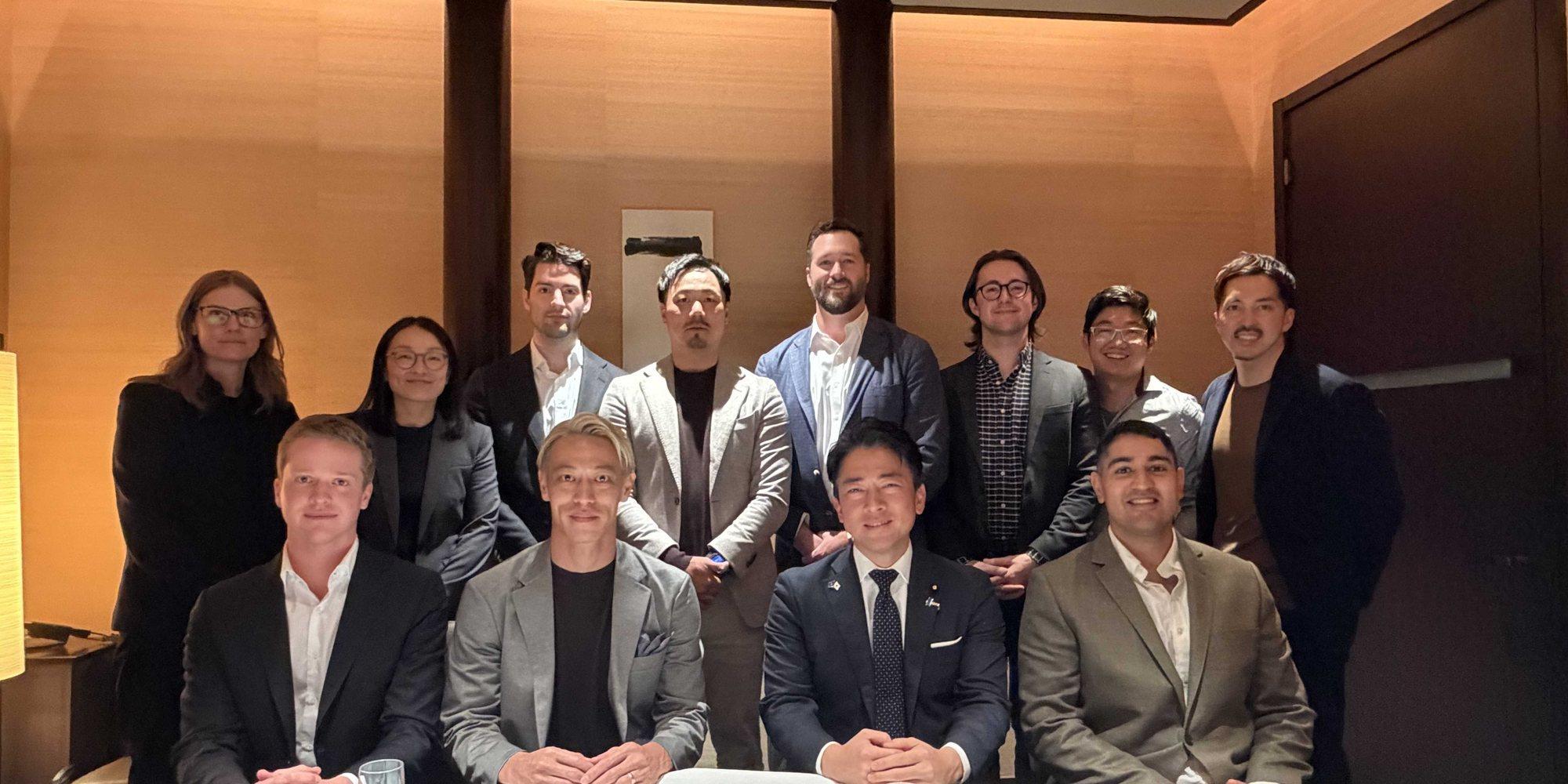
The company’s hiring also points toward work beyond introductions. In July 2025, Nakanishi announced Taido Lantz Nakajima’s arrival as chief design officer, joining the executive team for the venture business and an incubation effort. Design had a place in the organization alongside investing. The firm was assembling people to build, as well as people to choose what to back.
That is where the familiar names stop being a sufficient explanation. They help a reader recognize the network. They do not explain how its members share information, evaluate an opportunity, or maintain the relationships around a fund. To follow Nakanishi’s work further, it is necessary to descend from the guest list into the machinery.
Someone still has to write the report
In October 2025, Nakanishi published his argument for Sanbo. He expected AI agents to take on many recurring financial tasks and set out an ambition for a trusted operating system. In his formulation, useful automation would need reliable data, standards for the agents and a marketplace where firms could choose what to use.
“Accuracy and speed are timeless,” he wrote. The phrase gives his software ambitions a relatively practical anchor. A faster process has little value if its output cannot be relied upon. A financial institution has to know what its records mean before it asks software to act on them.
“Accuracy and speed are timeless.”
Tashi Nakanishi, October 2025
His November essay carried the idea into an agent marketplace. He distinguished the infrastructure behind trading from the workflows that run an investment firm: portfolio reconciliation, investor relationships and audits. The latter, he argued, needed a more consistent operating layer. This was a proposal about how firms should work, with ambitions extending beyond a single clever application.
The distinction matters because those tasks recur whether or not a partner is famous. An investor report must make sense to its recipient. A reconciliation has to reconcile. Neither job is improved merely by placing a well-known name at the top of the document. Software earns its place by making the recurring work dependable.
capitalBusiness
management
Two operating divisions, running on the firm’s own software.
Four cities, one working relationship
By its 2026 presentation, X& Financial describes three divisions: venture capital, business management and Sanbo. It names Nakanishi as CEO and Sanbo build lead. The software is described as an internal system used across the firm, rather than an external product for sale. That gives his current role a concrete combination of responsibilities: leading the business and helping build its operating foundation.
The geographic picture is similarly specific. The company lists Los Angeles, San Francisco, Tokyo and Belgrade. Nakanishi is based in Los Angeles. Those locations recur around his public work, which moves between investment organizations, technology teams and conversations about Japan’s startup economy.
At CREATE in Tokyo, he moderated a session with Alexis Ohanian and another with Simu Liu and video creator Hajime Syacho. In February 2025, he joined Honda for a fireside chat in Belgrade. In May, he was listed among the speakers for a Japan-focused investor discussion at the Milken Institute’s Global Conference. These appearances put him in several different conversations rather than a single professional lane.
That range is the interesting part of his career. The college goalkeeper became an alternative-investment professional, then a partner in venture funds, then the CEO of a business with financial software at its center. The roles changed. The work kept requiring people to coordinate around an undertaking that would last longer than its announcement.
The 2014 introduction offers a fitting place to leave the story. Two people took time to decide what they could build together. A decade later, the list of partners and responsibilities is much longer. Nakanishi’s business now has more rooms to connect, more records to keep and more conversations that must become useful work. The meeting was the easy part to remember. What followed is the career.