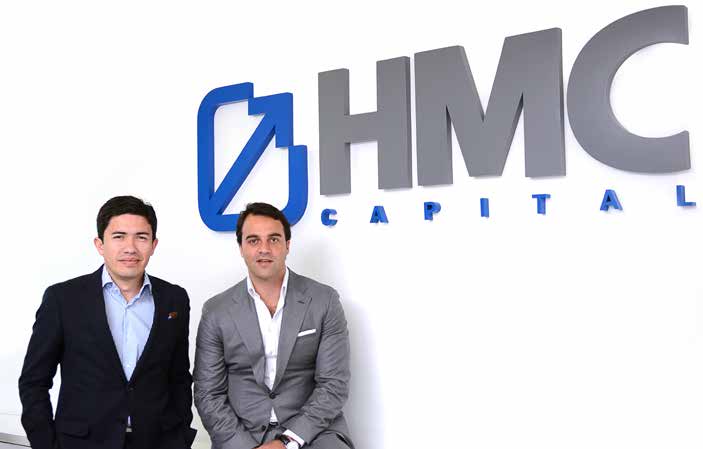
In February 2010, Felipe Held was running the Santiago office of a financial boutique that had barely begun its life. His co-founder, Ricardo Morales, was in Buenos Aires. Their next destinations were Colombia and Brazil. But the most revealing detail was the invitation: HMC wanted family offices to reach the managers, opportunities and costs available to institutional investors. Even then, Held's business revolved around a question that sounds deceptively simple. Who gets to enter?
The firm had been founded in 2009, after the two executives left LarrainVial to work independently. Its first regional mandate came from Beacon Capital Partners, for a global real estate private equity fund to be distributed in Colombia, Peru and Chile. The product was international. The work of finding its investors was intensely regional. Held's opening proposition joined the two: take investments that travelled poorly across borders and build a business around helping them travel.1
A trader learns the other side of the table
Held had started at LarrainVial as a trader, before moving into international distribution several years later. He eventually headed distribution of derivatives and alternative investments to institutional and wealthy clients across Latin America. His work included building a platform with international banks for structured products, options and swaps. He also led international sales and trading for Latin American pension funds through an agreement with Goldman Sachs.
Morales brought an overlapping background. At LarrainVial, the two worked together on the equity derivatives business. Their eventual partnership therefore grew out of experience already shared, rather than an introduction followed by a hopeful business card exchange. They knew the institutional audience and the international suppliers. HMC would place that familiarity inside a company of their own.
There is a useful distinction here between understanding a financial instrument and getting it into somebody's portfolio. Held's career crossed both activities. A trader deals with the instrument; a distributor must also deal with the institutions around it. That combination gives his later expansion a more practical starting point than the usual founder mythology.2
The passport came before the scale
The early Colombian arrangement shows how the business actually travelled. In April 2010, HMC entered through a joint venture with local brokerage Ultrabursátiles. The Colombian partner would lead the commercial work and provide market information; HMC would contribute its regional institutional expertise. Held described meetings planned with Colombian pension funds to distribute a global private equity and real estate fund. Brazil was next on the list, with local partners being explored.
That division of labour matters. An international investment opportunity arrives with its own vocabulary and requirements. A local institution has another set. HMC's arrangement put people on both sides of the conversation. The founders were building a network of working relationships, country by country, rather than assuming a single presentation would serve an entire continent. Expansion meant knowing whom to sit down with, and what each party could bring to the table.3
- 2009Held and Morales found HMC in Chile
- 2015Latin American credit platform
- 2017US investment platform: New York and Silicon Valley
- 2022Gama Investimentos acquisition
- 2023London office
- 2025Argentina office
Over the following years, the firm added its own investment capabilities. A real estate platform and the first proprietary funds arrived in 2011. Credit followed in 2015. The US investment platform launched in 2017, and a platform for direct investments and co-investments followed in 2018. By 2021, HMC had launched an early stage venture platform in the United States. The sequence broadened the founder's job: connecting clients to managers was becoming part of a larger undertaking that also created investment products.4
The bridge starts carrying traffic both ways
A Peruvian debt fund gives that change a concrete shape. In February 2015, HMC Capital Perú launched a US$60.4 million fund for debt instruments issued by medium sized companies. Held said institutional investors in Peru had supported it. The focus included bond issuance through the country's Mercado Alternativo de Valores, a route into the capital markets for smaller businesses.
Daniel Dancourt, then heading HMC's asset management work, described reducing the fixed costs those companies faced when raising money for investment projects. The proposed debt ranged from US$5 million to US$20 million, with terms of three to five years. Here, the access problem had two ends. Investors needed something to invest in; companies needed a workable route to financing. The bridge could carry money into the regional economy as well as bring global products to its investors.5
“Latin America has been very challenging these past few years for investors.”Felipe Held, October 2016
Held's description of the region in 2016 was sober. He pointed to economic and political uncertainty, dependence on commodities, and a slowdown in global growth, particularly in China. Low borrowing costs and plentiful liquidity had also made the search for returns difficult. His account placed opportunity beside its complications. Selling the region to investors did not require pretending the weather was always pleasant.
At that point, HMC reported US$5 billion in third party funds under distribution and US$1 billion under management. Those were different businesses with different measures. Together, they show the shape the firm had taken: an intermediary for other managers, and a manager in its own right.6
New York, with Santiago still in view
By January 2018, Held was running HMC's New York office. The firm had bought a stake in Global Silicon Valley Asset Management after more than a year of discussions. The attraction was access to venture and growth investments, including vehicles holding stakes in technology companies before they went public. Held explained the difficulty of entering that market as an investor, and the usefulness of being connected to a manager already established in its ecosystem.
His ambitions also ran in the opposite direction. GSV Labs, the accelerator and incubator associated with that business, offered another possible connection. Held said he wanted to bring it to Santiago, explicitly identifying himself as Chilean. He hoped for a project in 2019 with the right partners. That was an aspiration expressed at the time, rather than a completed milestone.
The geographical pairing is revealing without needing a sentimental relocation story. New York served the international business. Santiago remained somewhere Held wanted that business to reach. The practical appeal of an overseas connection was what it could make possible for clients and entrepreneurs closer to home.7
A decade in Brazil, then a closer fit
Brazil's integration took a different course. HMC had operated there through a joint venture since 2012. Its acquisition of Gama Investimentos, recorded in the company's history in 2022, became part of a broader consolidation. In a January 2023 announcement, Held described bringing the Brazilian operations fully together after more than ten years of working through a joint venture.
Gama's business included feeder funds, which give local investors a route into other investment funds, and offshore and liquid investments. The announcement tied the transaction to a single platform connecting clients with local and international asset managers. This was expansion through an existing relationship, followed by closer integration. A decade is a rather long courtship by the standards of a corporate announcement.
Held's explanation returned to access through both HMC's own funds and third party products. The language had remained consistent while the machinery grew more elaborate. Countries, managers and investment vehicles had accumulated around the same commercial problem.8
The smaller investor gets an invitation
In December 2022, Held and Morales introduced a different expression of that idea: Xcala. Founded in the United States, the investment platform was in an initial rollout and aimed at millennials and Generation Z. Its offering included eight funds across areas such as real estate income, private capital, venture capital and private debt.
The reported minimum was 10,000 Chilean pesos. That made a striking counterpart to the institutional and family office audience of HMC's early years. Held described a desire to democratize access to asset classes and offer liquidity. His argument concerned the relationship between alternative investments and short term market shocks. It was a rationale for the product, rather than a guarantee of results.
David Guzmán led the ten person team at the time. The founders discussed potential expansion into Brazil and the United States. Those plans belonged to that launch period; the more enduring personal thread is Held's stated purpose. Xcala's own account of its creation describes opening alternative assets to a broader audience. The gate was getting a different kind of visitor.9
The founder now sits across the whole portfolio
Held remains HMC's co-founder and CEO, with responsibility spanning its development, international expansion and proprietary investment products. He also sits on the investment committee overseeing private equity, venture and growth, credit and real estate. His education includes undergraduate study and a master's in finance at Universidad Adolfo Ibáñez, alongside executive private equity study at Harvard University and London Business School.
The breadth of that job helps explain the career's continuity. Trading, distribution, company building and investment oversight each occupy a different part of the route from capital to an investment. Held has worked across them. His story is most legible through those successive responsibilities, and through the long partnership with Morales that anchors them.10
In November 2025, Held was discussing US multifamily real estate and Latin American private debt. HMC then reported roughly US$3 billion managed through more than 85 proprietary funds. Separately, a company announcement he shared celebrated passing US$20 billion in assets under management and advisory. The broader figure measures the platform's reach; it cannot stand in for the narrower managed portfolio.11
His response to that larger milestone was brief: “Onwards and upwards”. After years of offices, partnerships and new investment vehicles, the comment had the virtue of economy. The longer story lives in the doors HMC and Xcala have opened, and in the continuing work of deciding what belongs on the other side.12