On paper, Taryn Young’s two working worlds should require a very long commute. One is filled with VINs, vehicle records, dealership technology and the brisk abbreviations of automotive marketing. The other smells of leather and arena footing and revolves around a 17.2-hand warmblood named Rayne. Yet Young has made the trip often enough that the route now seems almost sensible. In both places, the work is about presenting information clearly, earning trust slowly and persuading an audience that progress is possible.
Young is chief marketing officer at iPacket, the automotive software company that turns the paperwork surrounding a vehicle into digital presentations dealers can share with shoppers. She is also the creator of Warmbloods + Wine, an equestrian Instagram account with more than 21,000 followers; the founder of apparel company Novella Equestrian; a working parent; and an amateur dressage competitor who has ridden the same horse from Training Level through Grand Prix.
The list sounds like the result of somebody losing an argument with a calendar. Young’s own explanation is less dramatic. “I like to be busy,” she has said. When something else lands on her plate, she gets resourceful. Horse people, in her telling, are practiced at this: a living animal has no respect for inbox zero.
An unlikely partner, chosen on feel
Young started riding at about seven. By 11 or 12, while other children were sensibly keeping their options open, she had decided dressage was her thing. She liked the movement, the precision and the impossible promise that there would always be more to learn. As a young rider she worked for lessons and show opportunities. College brought a five-year pause, then a lease on Bella Luna brought her back. Luna carried her to Regional Championships and National Championships and restored the itch.
Rayne was Luna’s young son. He was four, newly started and, among the available horses, knew the least. Young leased him anyway. When another buyer appeared, she and her then-fiancé Kyle worked out how to buy him. It was not a spreadsheet decision. It was the recognition of a connection she did not think she could reproduce.
“He has the best brain, not the best movement, but his heart is so big.”Taryn Young on Rayne
Rayne had been born at the barn where Young rode and never left. She jokes that he never got a job or moved out of his parents’ house. He has the personality of a golden retriever in the body of a gentle giant, playful enough that she once compared him to the handsome boy at school whose gifts were not primarily academic. The joke is affectionate, and it explains the partnership better than a pedigree could.
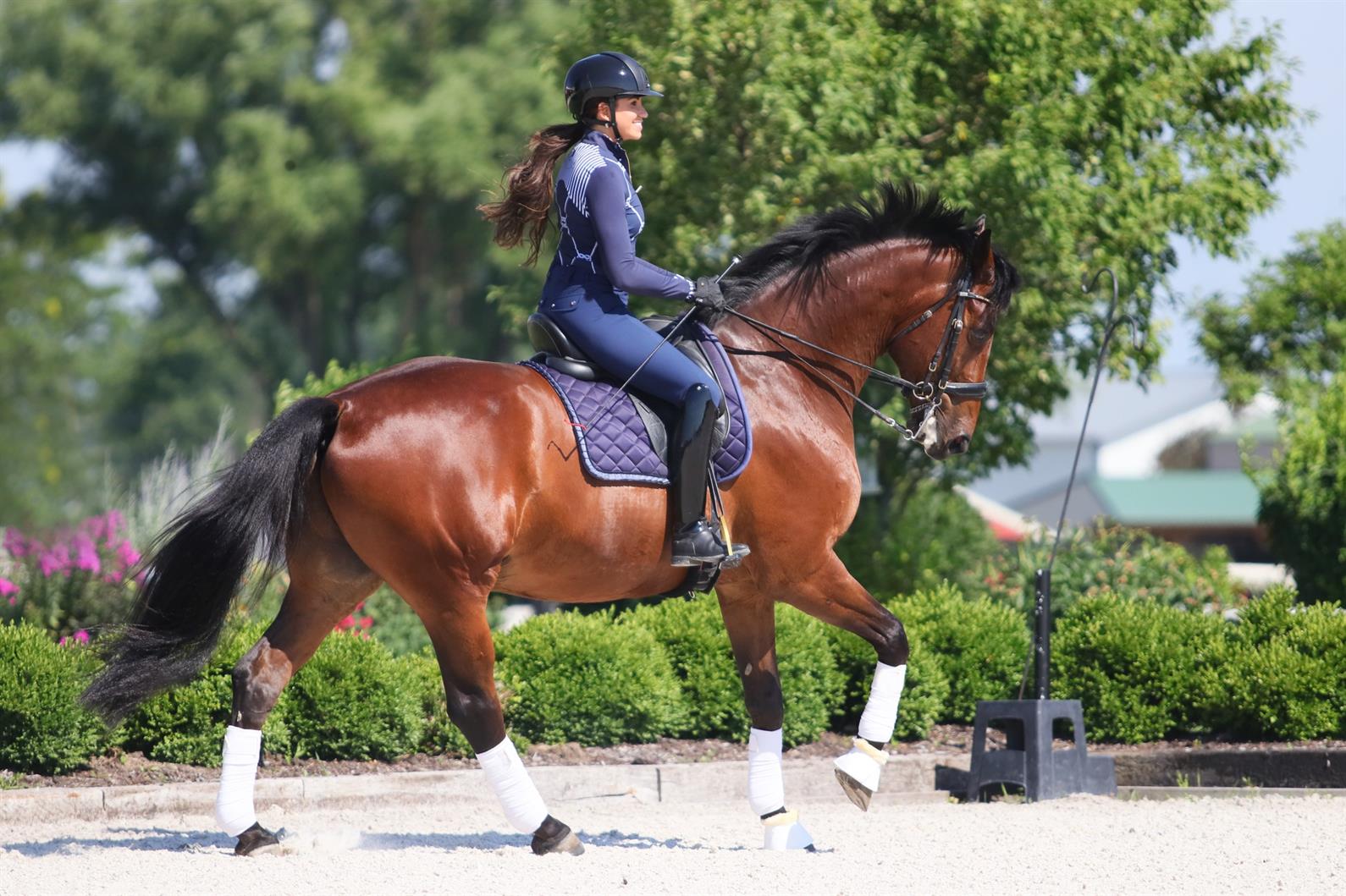
Across eight show seasons, Young taught and competed with Rayne from Training Level to Grand Prix. They earned every United States Dressage Federation medal together: Bronze, Silver and, in 2023, Gold. The last one requires successful scores at Intermediate I and Grand Prix. People had told her repeatedly they would not get there. Young believed the horse in front of her.
One partnership / upward over eight show seasons
There is no neat way to fake this kind of progression. Dressage is a chain of basics returning in more demanding forms. The apparent elegance rests on unphotogenic repetition. Young has said the sport attracts perfectionists, then teaches them the comic limits of mastery: learn a little and you discover how little you know. It is an excellent arrangement for keeping an ambitious person occupied forever.
The niche was hiding in plain sight
Warmbloods + Wine began in 2018 with a modest social problem. Young wanted to post photographs of Rayne, pretty equestrian finds and observations about riding. Friends and relatives outside the horse world did not speak the language. Rather than make them learn, she opened another room.
The name was a compact joke about fancy horses and fine wine. The account was more useful than its gloss suggested. It showed the “working woman equestrian” life - training fitted around a career, aspiration without the fantasy of unlimited time, and gear recommendations from someone actually wearing the gear. Other riders recognized themselves. The audience grew.
So did the invitations. Young took over social channels for organizations and brands including US Equestrian, USEF Network, USA Dressage and PS of Sweden. She collaborated with equestrian companies and became a published writer. But the mechanism was not mystical influence. Her summary is bracingly practical: “It was all about me approaching and asking.”
That habit matches the career advice she once offered her younger self: always take the interview and keep networking, even when the immediate goal is simply to learn. Many of her automotive roles came through referrals rather than job listings. Industries, particularly small ones, remember the people who stay curious in public.
Novella began as a series of tiny edits
Young’s apparel company did not start with a declaration that the world needed another pair of breeches. It began as marginalia. Through paid collaborations and her own shopping, she tried plenty of riding clothes and kept imagining small changes. A detail could sit better. A design could feel more personal. A product could reflect the horses riders loved rather than a generic idea of horse culture.
When pandemic-era remote work cut out advertising travel, she used the new pocket of time to research an industry she did not know. She understood what she liked to wear and how to market; manufacturing and apparel design required Google, questions and generous contacts. About a year and a half later, Novella Equestrian launched with designs based on real horses and their personalities.
“You must have a vision and drive for it. You have to start out on the right foot and make the best lasting impression.”Taryn Young on building Novella
Warmbloods + Wine provided something more durable than reach. It offered a living focus group of riders, friends, models and early customers. Young could show products to people who understood the context and cared whether the details worked. When she wanted an accomplished rider to wear a patriotic shirt, she approached Olympic team bronze medalist Kasey Perry-Glass. The answer was yes. Asking, again, turned out to be a business model.
The same instinct in a different arena
Young’s automotive career has lasted more than 14 years across the OEM, agency and vendor sides of the business. By 2022, when Auto Remarketing named her one of its Women in Retail honorees, she was vice president of marketing at iPacket. Today the company lists her as CMO.
Her criticism of automotive marketing is revealing. Dealers, she has argued, face a clutter of mandated initiatives, approved vendors and promises that do not always improve the day-to-day work. Her preferred question is plain: how can this be made easier for a dealer? iPacket’s own product lives in that question, assembling build sheets, vehicle histories, reconditioning records and other documentation into digital packets meant to make a car easier to understand.
Vehicle trust
Put scattered records into a clear presentation. Give a dealer something useful and a shopper something verifiable.
Horse trust
Repeat the basics. Listen closely. Let a partnership earn its way from a first ride to the hardest work.
The parallel should not be stretched until it squeaks. A horse is not a campaign and a customer journey does not require a half-pass. Still, Young’s instinct in both worlds is recognizably consistent. Complexity should be respected, then made navigable. Trust is not a slogan. It is what remains after promises repeatedly meet evidence.
Her own professional evidence includes the ability to move between audiences without becoming generic. An automotive buyer wants confidence in a vehicle. A rider wants clothing designed by somebody who notices where the seams land. A social follower wants to see a life close enough to recognize, not a polished fantasy from another tax bracket.
A calendar built in seasons
Young does not describe balance as a daily equality among C-suite work, parenting, riding, content and a clothing company. At the beginning of each year, she identifies priorities and conflicts. Some seasons carry heavier competition schedules. Others make more room for work or family. The allocation changes; the values do not.
Support is part of the system. Young speaks openly about the role of her husband and family in making room for the barn and her businesses. She and Kyle have two young children, Dunham and Parker. The portrait is not of one person triumphantly doing everything alone. It is of a person who knows the people and routines that allow important work to continue.
There is something appealingly unheroic about her favorite operating principle. If something matters, she figures it out. Not instantly. Not without help. The phrase leaves space for research, referrals, annual planning, eight show seasons and a horse who had to learn each movement in order.
Rayne, still at his original barn, is the best rebuttal to the idea that ambitious lives must keep replacing their old parts. Young did not trade the young horse for a finished one. She did not abandon automotive work when an equestrian audience appeared, or stop riding when the apparel company began. She developed the parts together. The result is less a balancing act than a collected gait: several forces moving forward, held in deliberate relation.
In one arena, Young helps make a vehicle’s story visible. In the other, she and Rayne have spent years writing theirs one movement at a time. Both reward the same unfashionable qualities - patience, specificity and the willingness to ask. Also, occasionally, wine.