There is a tiny act of excavation at the centre of BDO Canada's new brand. The firm did not have to import a heroic noun or mint a synthetic word. Its marketing team looked at three familiar letters and noticed that two of them already formed an instruction: do. For Tara Berze, the firm's Chief Marketing Officer, that plain verb became a way to talk about an old institution in the present tense.
The line that emerged in September 2025 was “Do more together.” It sounds simple because the work behind it was not. The refresh took nine months and drew in colleagues across Canada, clients, BDO's international network, and Fellow Human, an independent Toronto creative agency. The process was less a cosmetic exercise than a search for language sturdy enough to carry the firm's technical history and its preferred way of working.
Berze described the launch as more than a tagline. The phrase, she said, highlighted how BDO's people work with clients: “Whatever the ‘more’ is, we make it happen together.” That formulation leaves the outcome deliberately open. Tax questions, transactions, cyber risks, succession plans, or operating changes may fill in the blank. The constant is the expectation of movement.
A career built around one changing profession
Berze arrived at BDO with more than two decades in marketing and a rare set of sightlines into accounting. She had held leadership positions at EY and Deloitte, worked at CPA Ontario, then moved to Xero, the cloud-accounting company. Each stop placed her at a different boundary of the same profession: large firms delivering expertise, a regulatory body representing standards and membership, and software reshaping the daily experience of small businesses and advisers.
Five windows onto accounting
At Xero Canada, where she served as Head of Marketing from 2021 to 2024, the assignment was to build awareness of what cloud software could change for small companies and the accountants and bookkeepers who advise them. She also served as a judge for the 2023 Xero Awards in Canada, a program organized around the partner ecosystem that makes accounting software useful in practice.
Her public posts from that period carry an operator's curiosity about where a brand lives. After a 2023 week in Sydney that combined Xerocon and the FIFA Women's World Cup final, she returned to Canada with ideas for the next Xerocon in Nashville. The observation was revealing: she noticed the Xero brand “pulsating” across the city. A conference was not merely a room full of presentations. It was an environment, a network of colleagues and partners, and a feeling distributed through a place.
“The word for action, ‘do,’ is literally in our name.”Tara Berze on BDO Canada's 2025 brand refresh
The promise has to work inside
Professional-services marketing carries a peculiar constraint. The brand cannot be separated neatly from the people who deliver the work. A packaged product can look the same on every shelf. Advice arrives through conversations, judgment, documents, deadlines, and the accumulated conduct of teams. The public promise and the employee experience therefore meet every day.
In August 2026, Berze sat down with BDO Canada's Chief Human Resources Officer, Margot Lackenbauer, for a short “Cue & A” conversation about that junction. They discussed the firm's People Value Proposition, the internal counterpart to the external brand. Its three pillars begin with the same active word: do work with genuine care, do what matters with purpose, and do what's next.
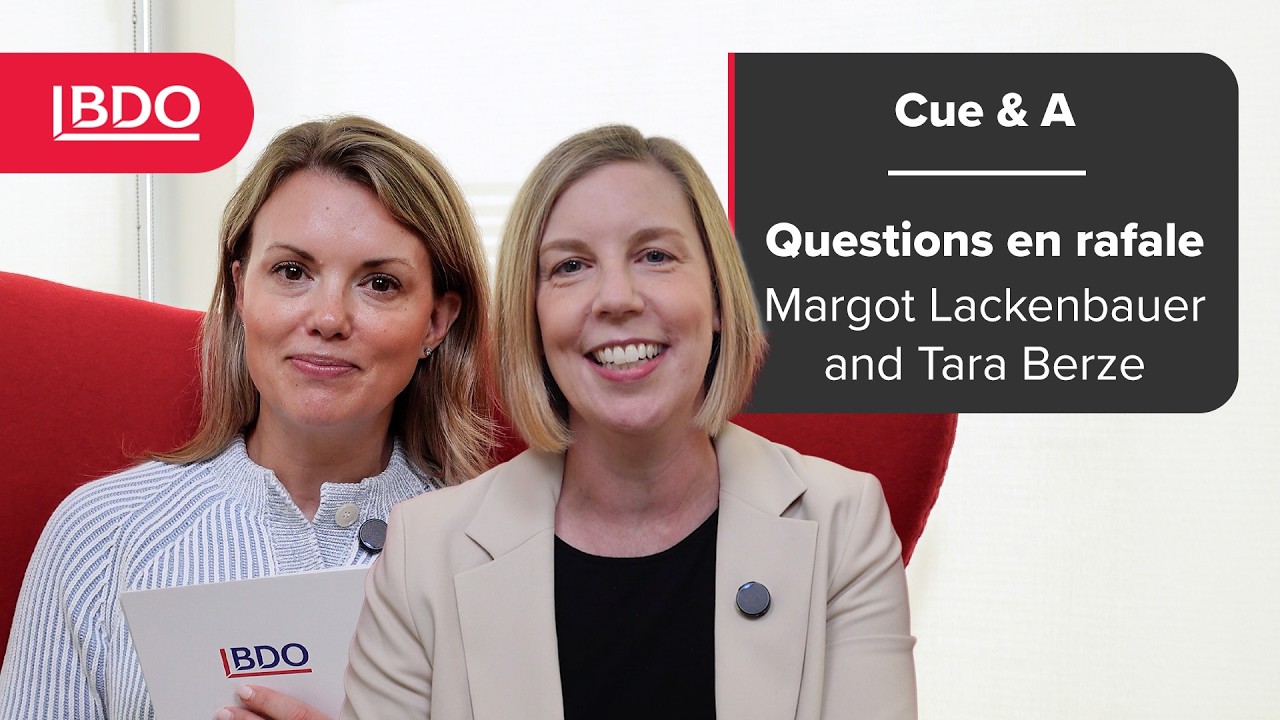
Berze's explanation was direct: “Our brand comes to life through our people.” The phrase gives the CMO's remit an unusually concrete edge. Marketing may establish the language, visual system, campaign, and partnerships, but thousands of daily interactions decide whether clients recognize the idea. Brand becomes a coordination problem with a creative surface.
In the conversation, the middle pillar is linked to adaptation, trust, and communication, while the third captures a forward-thinking readiness to face new challenges. Those ideas also describe the invisible work of a rebrand. A national firm must listen before it simplifies. Creative teams need enough freedom to find the idea, while internal teams need enough clarity to use it. Leaders have to explain why the change matters without asking history to disappear.
A week that tested the words
The brand received a practical test in 2026 when BDO Canada became the Official Professional Services Partner of the Toronto Tempo, the city's new women's professional basketball team. The partnership joined a national advisory firm to an inaugural-season sports organization, giving BDO a public platform tied to Canadian business, community, and the growth of women's sports.
Berze later recalled the compressed work behind the announcement. The teams wanted to launch on opening day and had roughly a week to assemble messaging, client experiences, and employee experiences. Brand and marketing could not work in isolation. Multiple groups had to arrive at the same moment with material that felt connected.
The anecdote matters because it makes “together” measurable. Under a deadline, collaboration stops being a value printed on a wall. It becomes a sequence of handoffs, decisions, and small acts of trust. The partnership went live; the internal process supplied its own proof point for the positioning.
A useful brand does more than describe an organization. It gives people a way to choose their next move.
There is also continuity with Berze's Xero years. In both places, an ecosystem matters. Xero's product reaches small businesses through accountants, bookkeepers, apps, and partners. BDO reaches clients through specialists across assurance, tax, and consulting, supported by local offices and a global network. The marketer's task is to make many participants legible as one experience without flattening their expertise.
The quiet craft is translation
Berze's public career is a study in adjacent moves. She did not leave accounting when she joined a technology company; she examined the profession from the software layer. She did not abandon modern client experience when she returned to professional services; she carried that expectation into a firm with more than a century of Canadian history. The connective skill is translation among specialists, clients, technologists, creatives, and employees.
That skill rarely produces a single dramatic artifact. It appears in the discipline of choosing a few words that different groups can use without twisting them beyond recognition. It shows up when an external campaign and an internal people proposition share a grammar. It becomes visible when a partnership deadline forces teams to coordinate and the finished work still resembles the idea on the strategy page.
Keeping credibility while changing the tempo
Accounting brands live with a useful tension. Clients come for precision, continuity, and confidence, yet the problems on their desks keep changing. Cloud migration, data security, regulatory reporting, automation, and cross-border work do not wait for institutions to become comfortable. A marketer in this category has to respect the authority accumulated over time while giving people a reason to believe the organization can move at the speed of the problem.
Berze's route through the industry fits that tension. EY and Deloitte represent the scale and accumulated trust of global professional services. CPA Ontario sits close to the rules, credentials, and public obligations of the profession. Xero approaches accounting through a product that small businesses and advisers use in the flow of work. BDO combines a century-old Canadian presence with the need to explain current capabilities across consulting, technology, assurance, and tax. Her career has kept the underlying subject steady while changing the lens.
That continuity helps explain why the BDO refresh did not lean on novelty for its own sake. The language is active, but it does not ask the firm to pose as a startup. “More” makes room for ambition; “together” recognizes that professional services are relational; “do” insists on an outcome. Each word has a job. None requires a client to learn a new theory of business before the meeting begins.
The approach also places a limit on marketing theatre. Once the brand says action, slow handoffs become more noticeable. Once it says together, a fragmented experience becomes harder to excuse. Once the employee proposition says care and purpose, those ideas can be tested against how projects are staffed, how colleagues communicate, and how leaders respond when priorities collide. Good positioning creates clarity, and clarity creates accountability.
This is where Berze's story becomes useful beyond accounting. Many established organizations believe they must choose between heritage and momentum. Her recent work suggests a more practical route: identify the behaviour that made the institution valuable, express it in language suited to the present, then connect that language to decisions people already have to make. The work is less about inventing a personality than recognizing one and giving it a sharper operating vocabulary.
“Do more together” contains a mild provocation for a field built on credentials. Expertise remains the price of entry, but the line places emphasis on what expertise enables. Clients bring complicated nouns: growth, risk, tax, technology, transition. BDO answers with a verb. The shift is small enough to remember and demanding enough to test.
For Berze, the next chapter is already moving inward and outward at once. The refreshed brand is being joined to a people experience built around care, purpose, and readiness for what comes next. Public partnerships offer moments to demonstrate it. Employees supply the daily evidence. The clever discovery was that “do” had been sitting inside the name all along. The operational work is making sure it keeps sounding true.