A staff schedule is a modest-looking object. Names, hours, boxes, perhaps a stripe of highlighter applied with more hope than confidence. In a long-term care facility, however, it is where several competing realities meet. A resident needs attention. An employee needs predictability. A manager needs coverage. A finance team needs labor to stay within bounds. And Tuesday, with the calm indifference of all Tuesdays, needs somebody to show up.
Tanner Thompson has built his company in that intersection. As co-founder and CEO of Covr, the Utah-based software business, he works on scheduling, staff communication, agency coordination and analytics for long-term and post-acute care. His subject is operational software, but his material is human time: who has it, where it goes, and how much of it disappears into reconciliation, phone calls and a spreadsheet that was out of date before lunch.
The appeal of the work is its specificity. Thompson’s public writing does not hover at the altitude of “transformation.” It descends into early clock-ins, shortened breaks, overtime exposure and the curious persistence of a staffing pattern simply because eight people have always appeared on Tuesday. He likes the details where a cost becomes visible and a manager can still do something about it.
The whiteboard keeps its job
Covr says it began in 2017, when operators in long-term care could not find the technology or data they needed to run their own facilities. The opening problem was familiar and stubborn: scheduling. Many facilities still relied on Excel, dry-erase boards or paper calendars fixed to nursing-station walls. The tools were cheap, legible and wonderfully incapable of warning anyone about an approaching problem.
A schedule in that form records an intention. It does not readily show whether planned hours match a labor budget, whether somebody is nearing overtime, whether an open shift has reached every eligible employee, or whether the version at one station agrees with the version at another. When a callout arrives, the scheduler becomes a human integration layer, copying changes, sending texts and trying to remember which square of the puzzle moved last.
Thompson has repeated the story of a staffing coordinator in Walla Walla, Washington, whose manual process could take up to 16 days to finalize. She described it as chaotic: a change on one piece of paper had to be repeated on another. After moving the schedule into one system, the work became a matter of placing names. The reclaimed time went to onboarding hires and checking in with employees. It is an unflashy anecdote, which is precisely why it lands. Sixteen days is not a feature request. It is a small season of someone’s working life.
A number should arrive before the excuse
The larger idea emerged from the schedule. Labor reports traditionally arrive after the useful moment. By then, an extra shift has been worked, a break has been missed, or overtime has quietly crossed the line. Thompson’s argument is temporal: the information belongs beside the decision. Show the scheduler whether the plan is over or under target while the plan is still being made.
This is the difference between a dashboard as a rear-view mirror and a dashboard as an instrument panel. The first explains last month with immaculate bars. The second makes today slightly less surprising. Covr added reporting, payroll connections, automated messages and an employee app around that premise. An open shift can reach qualified staff. A response can return to the manager. A schedule change can stop being an archaeological dig through text threads.
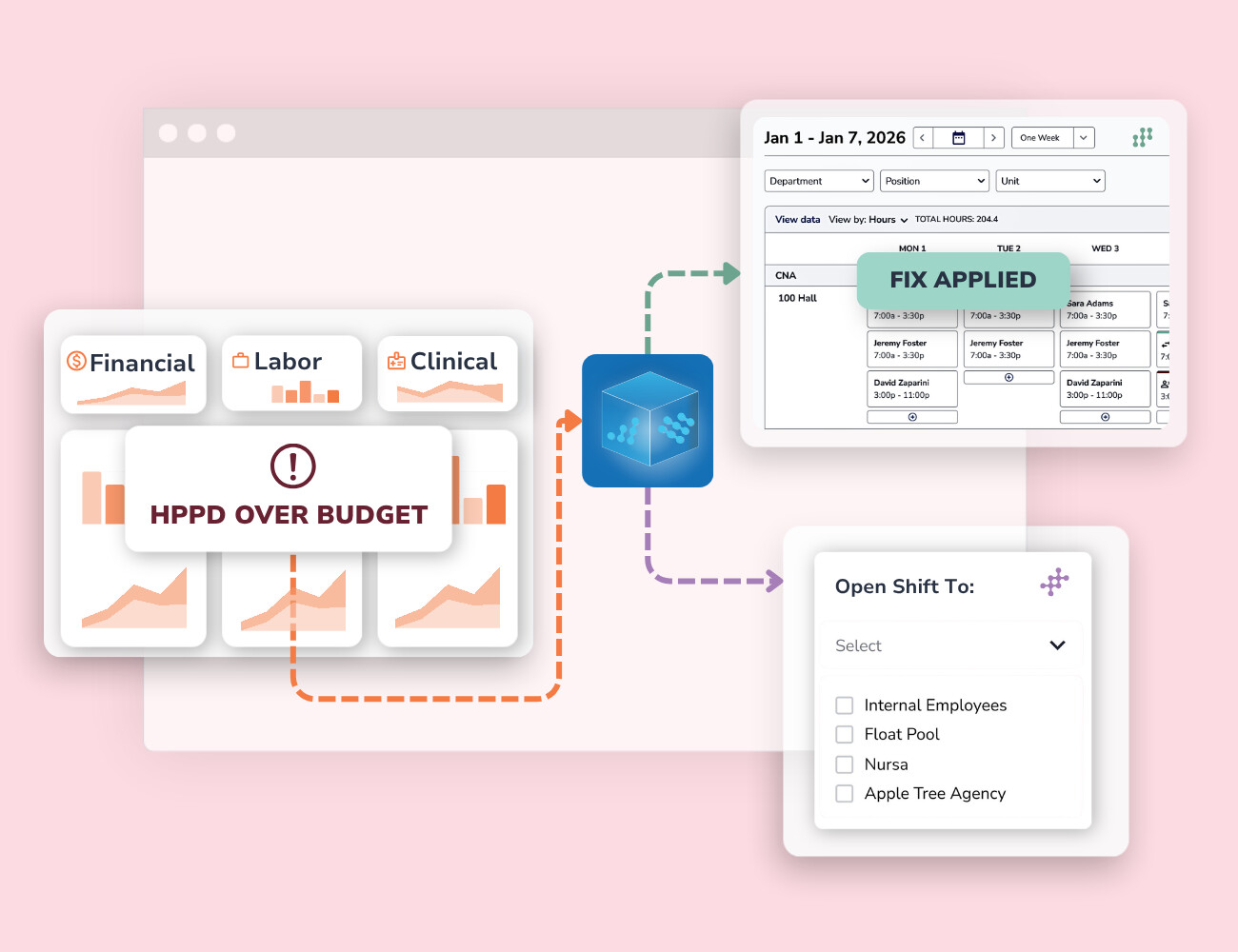
The tiny leaks make Thompson’s case for him. Covr has written about employees arriving early, leaving late or missing meal breaks. None sounds dramatic in isolation. Repeated across shifts and facilities, each becomes a pattern. In one example Thompson shared, a multi-facility operator reduced missed lunches by 69 percent after leaders set clear expectations and reviewed the behavior consistently. The intervention was not a grand restructuring. It was attention with a cadence.
That habit of zooming between an individual act and the system around it appears in a public recommendation from a former colleague, Taylor Brooks. Brooks describes Thompson moving between detailed problem-solving and high-level strategy, asking questions that expose assumptions and reveal gaps. It is a useful description of the product, too. The schedule is the close-up. The portfolio is the wide shot.
The acquisition that widened the lens
In January 2025, Covr announced its acquisition of Data IQ, a Fort Worth business-intelligence provider for skilled nursing. Covr later renamed the product View. The deal joined workforce scheduling with dashboards that draw from operational, financial and clinical systems across multiple facilities. Thompson called the analytics platform a natural addition and said the combined offering would give users deeper cross-facility analysis.
The logic is tidy. A scheduling tool sees the plan. Payroll sees what was paid. Other operating systems see their own fragments. Bring the fragments together and the operator can compare buildings, follow trends and find the source beneath a monthly total. Then connect that understanding back to the place where tomorrow’s shifts are assigned.
Creative Solutions in Healthcare, which operated 168 long-term care communities when the acquisition was announced, became the initial customer to adopt both products across its network. The commercial detail matters because it shows the intended scale. Covr was no longer merely helping one scheduler arrange one week. It was trying to let regional and corporate leaders see how hundreds of daily choices accumulate across a portfolio.
Covr now says its products are trusted by more than 2,000 long-term care facilities. Its suite spans Flow for scheduling and communication, View for analytics, and Sync for coordinating agency staffing. A company born from a whiteboard problem has become a set of connected views on labor.
Manage the exception, respect the operator
Thompson’s public comments about agency staffing show a taste for nuance. Long-term care operators often dislike agency labor because it can be expensive and can weaken continuity. But, he has argued, some markets simply do not have enough full-time workers to avoid it. The practical response is to know which shifts require outside help, compare vendors, watch rates and performance, and develop trusted relationships. An internal float pool can give a multi-facility group another option before it reaches for an outside agency.
This is less exciting than declaring war on a cost category. It is also more operationally honest. A facility still has to cover the shift. Thompson’s method is to turn the exception into something visible: when it happened, why it happened, who filled it, what it cost and whether the same pattern will return next weekend.
That posture may explain why his conference work is built around metrics. At a Washington Health Care Association program, Thompson was billed to speak about seven staffing measures operators commonly miss. His biography emphasized large-data analysis, the connection between missed breaks and overtime, and his work helping organizations build float pools. The promise was not inspiration. It was a list an operator could take back to work.
The founder in the margins
Public biographical detail about Thompson is spare. His LinkedIn profile places him in Lehi, Utah, and lists the Brigham Young University Marriott School of Business. The visible record concentrates on Covr, its customers and the operating questions in front of them. Even his social posts read more like field notes than founder mythology.
That restraint suits the company. Scheduling software rarely enters through the front door wearing a cape. It earns trust by remembering the rule, notifying the right person and producing the number before the meeting. Thompson’s recurring aspiration is correspondingly plain: give time back. The phrase avoids the usual software romance. Time reclaimed from a schedule is time that can be spent helping a new employee, speaking with a colleague or attending to the work the spreadsheet was interrupting.
There is a lesson here for builders outside care operations. Find the artifact everyone tolerates because it has always existed. Study the improvisations around it. Watch where people copy the same fact twice, where yesterday’s information arrives after today’s choice, and where a capable employee is reduced to courier between systems. The opportunity may not resemble a moonshot. It may resemble a whiteboard with a bad eraser.
Thompson’s Covr is still pursuing that opportunity, now with a broader set of tools and a larger field of view. The schedule remains at the center, ordinary as ever. Yet once it can see cost, coverage and communication together, it begins to tell a richer truth: not only who is working tomorrow, but what the organization can change before tomorrow arrives.