The schedule taped beside a nursing station looks harmless. It is boxes, names and hours. But every blank shift can become an agency bill; every early clock-in can become overtime; every missed meal can become a compliance penalty. Covr has built its business on this small, expensive truth: in long-term care, the schedule is not clerical debris. It is where the operating model becomes visible.
The Utah software company sells to skilled nursing, assisted living, senior living and post-acute operators. Its users range from the scheduler trying to cover a Saturday night to the regional executive comparing labor performance across 149 buildings. Covr says more than 2,000 facilities now use its products. The buyer is not shopping for a nicer calendar. The buyer is trying to keep enough qualified people on the floor without letting labor costs, agency dependence or reporting work run away.
That is a difficult equilibrium. A facility can be short-staffed and over budget at the same time. A manager can fill every shift yet discover that meal-break penalties, early punches and unplanned hours wrecked the week. Clinical information may live in an electronic medical record, hours in payroll, invoices in accounting and last-minute coverage in text threads. Each system can be correct while the operation remains confused.
Built after the spreadsheet lost
Covr's own history says the company began in 2017 when long-term care operators could not find the technology or data they needed to run their facilities. So they built it. That firsthand origin is the useful part of the founder story. Co-founder and CEO Tanner Thompson did not begin with a broad promise to transform health care. Covr began with a repeated, ugly workflow: assembling schedules, contacting employees and reacting to call-offs.
The first thing that failed, then, was not a Covr product. It was the industry's familiar kit: paper, whiteboards, spreadsheets, payroll reports and group texts. These tools are cheap alone and costly together. A spreadsheet cannot tell an eligible caregiver that a shift opened, compare the decision with budgeted hours, verify an agency credential and show a portfolio leader why overtime rose. Humans must supply the connective tissue, usually at the exact moment they are busiest.
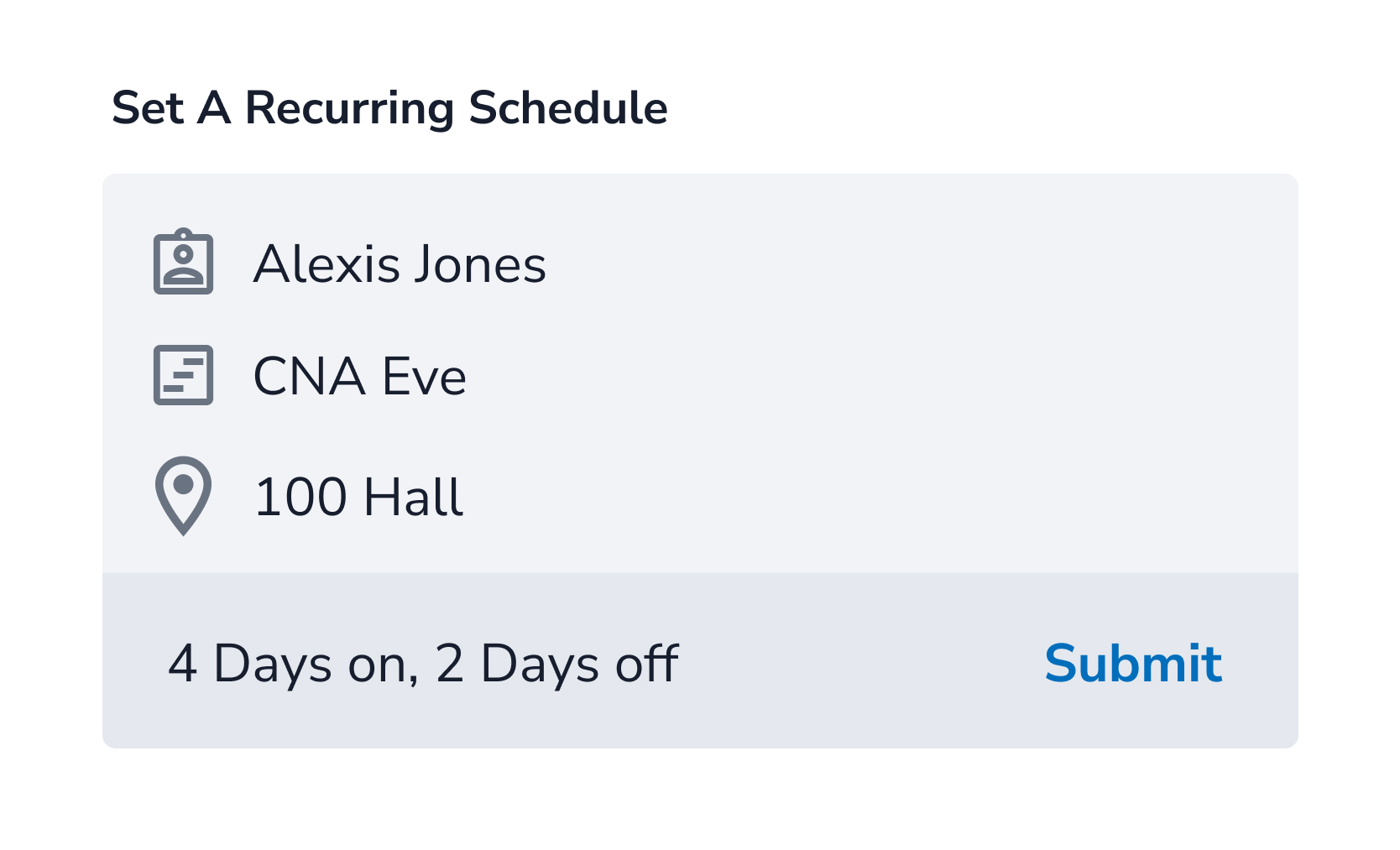
Flow is the daily-action layer. It covers scheduling, SMS messaging, an employee app, engagement surveys, labor reports, float-pool management, agency management and review of Payroll-Based Journal data submitted to the Centers for Medicare & Medicaid Services. Employees can see schedules and request open shifts; managers can spot overstaffing, missing coverage and overtime exposure before approving the plan.
Sync extends that logic to outside staffing companies. Facilities post work, agencies respond, and both sides can track credentials, approvals and hours in one place. Covr also markets a bundle with WurkNow, pairing its facility network and scheduling with WurkNow's recruiting, timekeeping and billing. The advertised bundle discount is 20 percent on each product.
The days of hours of data collecting just to know where we stand are gone.Auston Clanton, COO, Creative Solutions in Healthcare
The acquisition that changed the frame
Scheduling was the wedge, but it did not answer the executive's next question: Why is this building off target? In 2024, Covr acquired Data IQ with backing from Greenridge Growth Partners and RF Investment Partners. The amount was not disclosed. Data IQ became View, an analytics layer that connects payroll, EMR, accounting, clinical and financial data. Covr says implementation can be completed within 60 days.
The deal reveals what changed the company's mind about the size of the opportunity. A schedule can show what managers planned and what employees worked. It cannot, by itself, explain how census, resident acuity, reimbursement, quality measures and labor budgets interact. Rather than remain a point solution, Covr joined the action screen to the diagnostic screen. Flow helps someone do the work; View helps the organization understand the result.
That distinction is also Covr's clearest answer to OnShift, Smartlinx, UKG, MatrixCare tools and an entire junk drawer of spreadsheets and agency portals. Many products schedule people. Many dashboards aggregate health-care data. Covr's claim to difference is narrower and more defensible: both functions are purpose-built for long-term and post-acute care, with the agency workflow attached.
The customer cases make the value proposition less abstract, though they should be read as company-published outcomes rather than controlled studies. Creative Solutions in Healthcare says it cut overtime 54 percent and unscheduled hours 72 percent in three to four months while filling 12,000 open shifts a month. Nexion says facilities that fully adopted Covr saved an average of $77,000 a year through lower staffing intensity and overtime. The phrase “fully adopted” is doing important work: software sitting unopened cannot change a punch clock.
The cost is private. The leaks are not.
Covr does not publish a standard price card. Flow and View are sold through contact-sales pages, with a combined package offered at a better price than buying both separately. That signals an enterprise sale shaped by facility count, integrations, implementation and support. It also means a prospective buyer cannot calculate payback from the website alone.
Instead, Covr prices the argument around operational leakage. Its analysis of sampled facilities found an average 143 monthly hours excluded from PBJ counts and about $5,000 in extra pay per pay period tied to missed lunches. PACS says its participating facilities reduced overtime 47 percent and unscheduled hours 52 percent, while avoiding $11 million annually in meal-break penalties. Sinceri reports 69 percent fewer missed lunches and 16,000-plus shifts filled in a year.
The most vivid example comes from Life Care Centers of America. After the pandemic, a group of about 20 facilities was spending roughly $3 million a month on contract labor. It built a regional float pool of 65 to 75 caregivers and used Covr to let them self-schedule across participating buildings. The organization reports monthly agency spend fell to about $300,000. Covr did not summon new nurses from the cloud. The operating change was to employ a flexible internal pool, define participation rules and make that capacity easy to deploy.
Covr can reveal an avoidable agency shift. It cannot manufacture labor supply, repair poor payroll data or make managers enforce a policy they do not believe in.
What another operator can copy
The transferable lesson is not “buy a dashboard.” It is to choose a costly behavior that happens frequently, connect the relevant data before month-end and make the next action obvious. A missed lunch becomes a report and a targeted reminder. An open shift becomes a notification to eligible employees. Repeated agency use becomes a building-by-building pattern, not one line in the monthly accounts.
Start with the recurring leak
Track early punches, missed breaks, open shifts, cancellations and overtime against a baseline everyone accepts.
Put the signal near the actor
Send the exception to the scheduler or employee who can change today's outcome, not only to an executive next month.
Use internal flexibility first
Offer open work across nearby facilities before defaulting to an outside agency, with clear eligibility and minimum participation rules.
Make adoption measurable
Compare active and inactive locations, publish the variance and refresh training where use falls away.
This approach works best for multi-facility operators with repeatable processes, dependable payroll and EMR feeds, enough open shifts to justify coordination and leaders willing to use the reports. It works poorly when data arrives late, managers keep shadow spreadsheets, policies vary without explanation or the local labor market has no available caregivers at any price. A tiny facility with a stable team may reasonably decide the integrations are more machinery than it needs.
There is also a cultural condition. Covr says its mission is to give time back to caregivers. That only happens if analytics remove administrative work instead of creating another layer of surveillance and meetings. The better customer stories involve a concrete bargain: employees gain flexibility to choose shifts; managers gain visibility; residents gain more consistent coverage. If only the monitoring survives, the system will feel punitive and adoption will decay.
Covr occupies a useful middle layer in health-care software. It is not the clinical record, the payroll engine or the staffing agency. It sits among them, translating their scattered facts into staffing decisions. The company's bet is that the next important insight is already present in the schedule, if someone connects it to the rest of the building. For an industry accustomed to learning what happened after payroll closes, “before the shift starts” is a meaningful product feature.
Useful links