A caregiver misses an onboarding module. A new hire stops replying. A resident’s daughter says nobody called back. None of these moments looks dramatic on its own. In a home-care agency or senior-living community, though, each can be the first loose thread in a resignation, a complaint or a lost referral. Activated Insights has spent years turning those small signals into software.
The Idaho-based company serves more than 16,000 long-term and post-acute care provider sites across North America. Its customers range from local home-care agencies to assisted-living operators, hospices, skilled-nursing facilities and franchise networks. They buy tools to recruit caregivers, deliver compliant training, monitor the perilous first months of employment, survey staff and families, compare performance against peers, and turn strong results into awards or reviews.
That list sounds untidy because care itself is untidy. The worker, manager, client and family member experience the same service from different angles. A generic HR platform sees an employee record. A learning system sees a course completion. A survey app sees a score. Activated Insights’ pitch is that a care operator needs the whole sequence - and needs it tuned to the realities of shift work, state training rules, phone surveys and anxious families.
It measures the moment before the obvious moment
The core product logic is wonderfully unglamorous: ask sooner. Experience Management sends feedback requests by text, email, telephone, paper or a staff-assisted tablet. It can question a client at the start of care, check in after a caregiver change, or alert a manager when an employee’s answers signal flight risk. The software then slices results by location, department or service line and compares them with regional and national benchmarks.
Retain applies the same logic to the first 100 days, when a shaky handoff, silent supervisor or confusing schedule can turn a recruit into another vacancy. Recruit works one step earlier, automating applicant follow-up, qualification and interview booking before a faster employer gets there first. Training sits between acceptance and readiness, with mobile coursework, reminders, certificates and state-aware compliance reporting.
One worker, five moments
Recognition closes the loop. Strong survey results can support Best of Home Care awards, Great Place to Work certification and U.S. News-related senior-living recognition. Reputation tools help route promoters toward public reviews. In other words, operational data becomes recruiting and sales material. The provider is not merely claiming that employees or residents are happy; it can point to an outside badge and benchmark.
“What gets measured gets managed, what gets rewarded gets repeated.”Stephen Tweed, home-care strategist, on the company’s benchmark
The company is an acquisition story wearing one name tag
Activated Insights did not spring fully formed from a product workshop. Its oldest strand is Home Care Pulse, started in 2008 by former home-care operator Aaron Marcum. The business surveyed clients and caregivers, published an annual industry benchmark and built the Best of Home Care awards. In 2020 it merged with In the Know, a caregiver-training company with two decades of course-building behind it.
A second strand began in 2017, when Jacquelyn Kung built the original Activated Insights around employee and resident feedback for aging services. A conversation with Great Place to Work helped produce the first Fortune Best Workplaces in Aging Services list in 2018. Pinnacle Quality Insight, meanwhile, brought long experience in post-acute and senior-living satisfaction measurement.
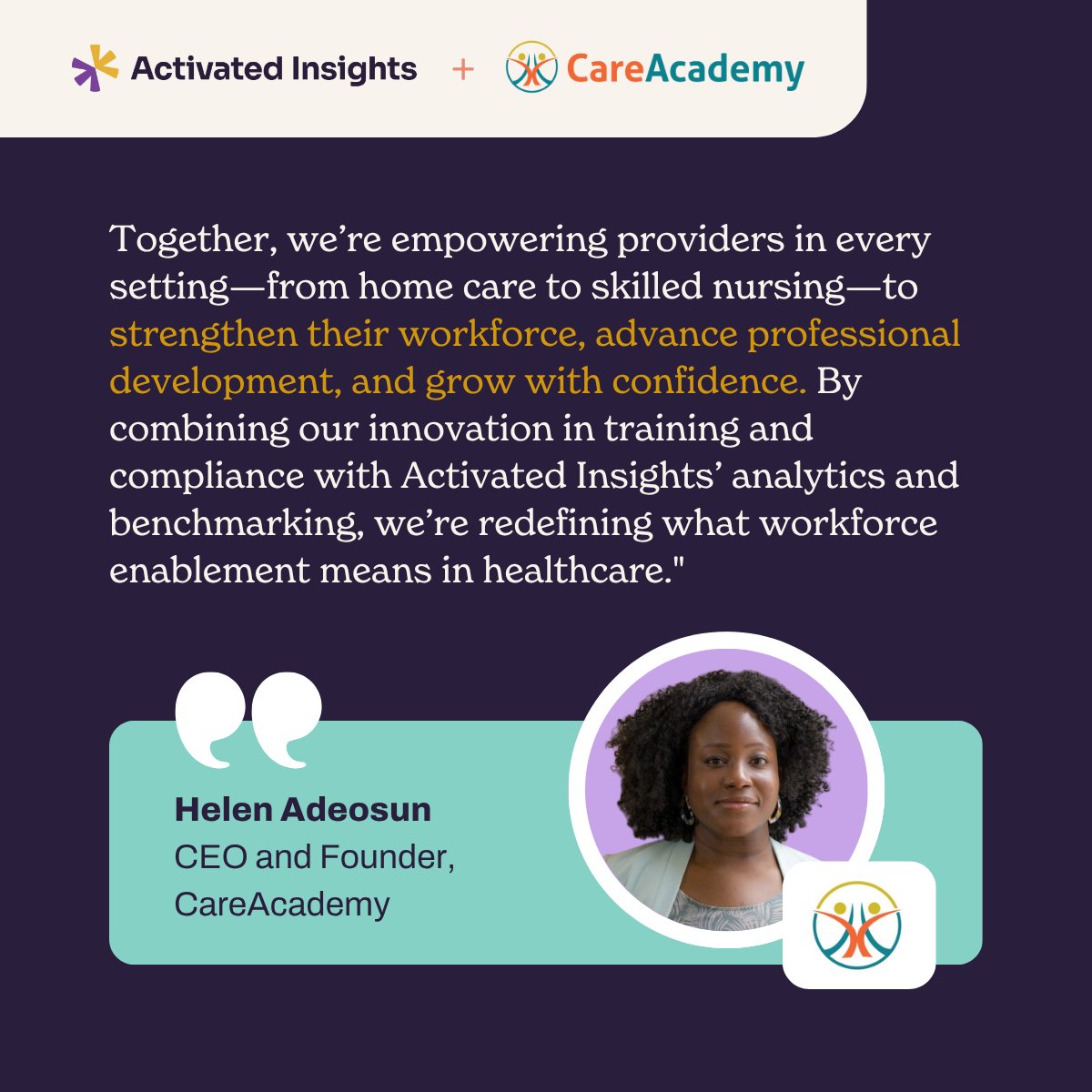
Home Care Pulse acquired both Activated Insights and Pinnacle in January 2023, in a combination backed by health-care investor Cressey & Company. In October 2024, the three identities collapsed into a single Activated Insights brand. The family kept growing: WeCare Connect, with more than 1,300 facilities, arrived in April 2025; training and compliance specialist CareAcademy followed that November.
What changed their mind: insight alone was a half-product
The revealing turn came with the In the Know deal. Home Care Pulse had become good at telling an agency what needed attention. Training added the means to do something about it. That distinction - diagnosis versus treatment - explains the later shopping list. Recruiting automation addressed the empty top of the funnel. Retention tools addressed early exits. WeCare Connect widened resident and family communication. CareAcademy deepened training and compliance automation.
The result is not a perfectly seamless operating system, at least not by declaration alone. Acquisitions create duplicate logins, overlapping data models and brand confusion before they create synergy. The 2024 name consolidation and newer single-sign-on partnerships show where the difficult work sits: connecting applications that were born in different companies and convincing busy managers that one more notification deserves attention.
What it costs - and what failure costs first
Activated Insights mostly sells through demos and custom quotes. Recruit is priced per location; Training is priced by active employee seats; broader experience, retention and recognition packages vary with footprint. Its public pricing gives a useful floor: for a 30-seat example, Training plans are listed at $239, $383 and $419 per month, with a minimum one-year contract. The digital 2026 Benchmarking Report costs $999.
The company reports more dramatic savings than its subscription bill: Recruit marketing cites a 70% reduction in hiring time, while Training cites a 95% decrease in administrative tasks. Those figures should be read as vendor-reported outcomes, not universal promises. A more grounded case comes from Dial Senior Living, which used Training and Retain across 26 communities. Activated Insights reports that new-hire turnover fell from 17% to 7% and managers saved 24 hours a month.
What failed first in that case was trust, or at least the staff’s willingness to report it. That is the point of an early measure. The first visible failure in care is often communication: an applicant hears nothing, an employee cannot find a manager, a family repeats the same concern. By the time it becomes a resignation or a one-star review, the recoverable moment has passed.
The moat is the yardstick, not the questionnaire
Qualtrics, Medallia and SurveyMonkey can ask questions. Press Ganey has deep health-care experience. Learning-management systems can serve courses; applicant trackers can chase candidates. Activated Insights’ difference is the narrowness of its map. It knows CAHPS and CoreQ surveys, home-care referral economics, caregiver churn, state compliance and the awkward fact that some respondents would rather answer a phone than tap a link.
Its annual benchmarking operation compounds that advantage. More participating agencies create a better comparison set. Better comparisons make the dashboard and report more useful. Reports, awards and workplace certification attract more agencies. The company sells both the instrument and the yardstick, then offers recognition for clearing it. That can be commercially elegant and operationally useful, provided the methodology stays credible.
Distribution now travels through industry plumbing. A 2026 AxisCare expansion covers an integration already used by more than 500 mutual customers. Senior Helpers selected the training platform for more than 410 locations and nearly 11,000 caregivers, using a WellSky integration for single sign-on and automated assignments. Argentum named Activated Insights an official Data & Insights Partner, pairing discounted member access with research and advocacy support. SAGECare adds inclusive-aging education for providers serving LGBTQ+ older adults.
What an operator can copy tomorrow
The transferable lesson is not “buy five modules.” It is to design a closed loop around moments that predict outcomes. Ask new employees how work is going before the 30-, 60- and 90-day marks. Trigger feedback after a care transition, not only at the annual survey. Give every negative response an owner and a deadline. Show location managers their result beside a fair peer group. Celebrate a good score only after the underlying behavior is repeatable.
Measure at transitions: application, first shift, caregiver change, complaint resolution and exit risk.
Connect the signal to an action - a call, schedule fix, course or manager conversation - while it is still recoverable.
Benchmarks can motivate, but a league table without local context rewards gaming and discourages candor.
Recognition is an output. If the badge becomes the objective, the feedback loop has been turned backward.
When the loop does not work
Software cannot rescue a provider whose managers ignore alerts, punish honest answers or lack the authority to fix schedules and staffing. Weak participation produces false confidence. Bad contact data makes automation noisier, not smarter. A small agency with stable staff and disciplined personal follow-up may find the full stack heavier than the problem. A hospital seeking broad clinical patient-experience analytics may prefer a larger specialist.
Integration is another condition, not a footnote. The value falls if employee rosters, course records and survey results require duplicate entry, or if supervisors must swivel between systems to understand one person’s experience. Activated Insights’ partnerships acknowledge that reality. The product succeeds when data arrives in the daily workflow, a human owns the next move and the organization can tolerate hearing an answer it dislikes.
That last condition may be the hardest. The company’s most persuasive customer story begins with a 58% trust score, not an award. Activated Insights is useful when the first bad number changes a meeting, a manager or a process. Everything after that - the benchmark, the dashboard, the gold badge - is evidence that somebody listened.