At East Tennessee Children’s Hospital, families had a question about the emergency department: why were other people being seen first? The clinical logic of a queue was not necessarily the logic visible from a waiting-room chair. Patient feedback exposed the confusion. The hospital responded with educational videos, including trivia for children. A research tool had found something a score alone could never explain.
- NRC Health helps healthcare organizations hear patients, employees, and consumers.
- Its products connect surveys and research with analysis, rounding, and follow-up.
- Hospitals buy subscriptions; the people answering the questions supply the perspective.
- The useful lesson: assign the response before you invite the complaint.
The queue that needed an explanation
The same hospital’s published case study describes a second surprise. In six months, the new system brought more than 18,270 responses and 169 alerts. Listening had become a workload. Staff developed separate processes for following up with families and for recognition, education, and coaching. The hospital reported handling the increased feedback without additional staffing.
That sequence makes a good introduction to NRC Health. Information arrives; someone must decide what to do with it. The company sells software and services for the space between a person describing an experience and an organization changing its behavior. There is plenty of room in that space for both useful technology and splendidly useless meetings.
Forty years, then a shorter question
Michael D. Hays founded the business in 1981. Its modern language is “Human Understanding,” a phrase with a registered trademark and a deceptively ordinary ambition: know something about the person receiving care. Healthcare is unusually good at producing records. A record and an understanding are different accomplishments.
Hays expresses the direction neatly: Less after-the-fact and more in-the-moment.
The business retains its research roots while putting more emphasis on conversations and what follows them. For a hospital, the practical attraction is timing. Feedback is easier to investigate when the visit is still fresh in everybody’s memory.
Consider another documented customer, Riley Children’s Health within IU Health. Its program replaced mailed questionnaires with email, texts, and automated phone outreach, trimmed the survey to six questions, and gathered feedback within 48 hours of visits. The 2019 account says pharmacy changes informed by patient comments accompanied an increase of more than 13 points in Net Promoter Score.
This was a customer implementation, rather than a controlled experiment proving that software caused the improvement. Still, the mechanism is instructive: ask sooner, make answering easier, and read enough of the answers to spot a pattern. The clever part is often the shortening.
“Less after-the-fact and more in-the-moment.”Michael D. Hays, founder
The comment gets a job
NRC Health’s real-time feedback offering combines outreach with analysis and service alerts. It uses natural language processing to categorize comments and assess sentiment. That matters because a rating can tell a manager where to look, while a sentence can suggest what to fix. The sentence is also considerably more troublesome to process at scale.
The newer Huey AI suite extends that idea. NRC Health describes nQuire as a way to explore feedback through natural-language prompts, nAct as assistance with service recovery, and MyView as a summary of what matters to an individual within the electronic health record. MyStory supplies patient-generated context. These are different jobs along one route: collecting a voice, interpreting it, and putting it somewhere useful.
- 01ListenSurvey or conversation
- 02UnderstandThemes and context
- 03AssignA person to follow up
- 04ImproveA change patients feel
Rounding brings the process closer to the bedside. Leaders already visit patients and staff to ask how things are going. NRC Health’s ambient listening offering captures those conversations and turns them into structured documentation and experience insights. The proposed advantage is less attention spent entering information while somebody is speaking.
The appeal of AI here is fairly prosaic, which is a compliment. It can help organize an untidy pile of language. A summary still deserves review; a suggested response still needs a responsible person. The company’s technology helps with the work around empathy. Whether the encounter feels empathetic remains a question for the patient.
A market outside the waiting room
The customer is usually an organization: a hospital, health system, or medical group. Inside it, patient experience leaders, marketers, workforce teams, and executives have different questions. NRC Health tries to connect those questions without pretending they are interchangeable.
Market Insights examines consumer perceptions and preferences beyond individual visits. Community Insights supports custom research and patient communities. Reputation tools monitor reviews, manage listings, and publish survey-derived ratings. A hospital can use these to investigate how people choose care, what they encounter online, and where their experience departs from expectations.
Employee experience sits beside patient experience for a sensible reason: the same organization delivers both. NRC Health’s Medallia-powered offering covers engagement, pulse checks, workforce lifecycle moments, safety culture, and nursing satisfaction. Connecting workforce and patient feedback can give leaders a better question to investigate when service falters.
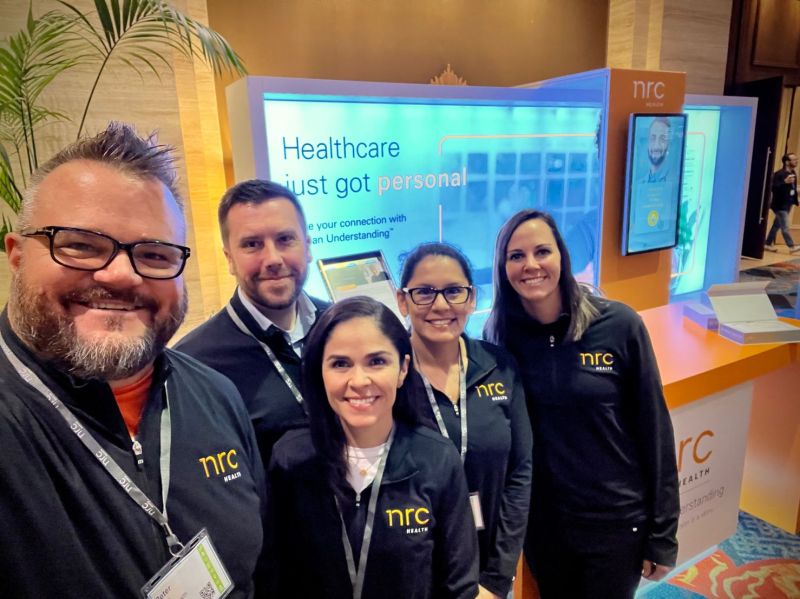
The Governance Institute adds another audience: healthcare boards and senior leaders. Education, publications, conferences, and advisory services give NRC Health a relationship with the people who set priorities, as well as those who manage the measurements.
Its competitive neighborhood includes Press Ganey and Qualtrics. NRC Health’s argument is the combination of healthcare-specific listening, market research, workflow tools, and advice. That combination is more distinctive than claiming to have a dashboard. Dashboards have become rather easy to acquire.
There is outside evidence of customer approval: NRC Health won Healthcare Experience Management in the 2026 Best in KLAS report, scoring 89.7. The award reflects provider feedback. It is useful evidence about customer experience with the vendor, not a clinical outcome guarantee.
The price of moving closer
In July 2024, NRC Health bought Nobl, bringing rounding technology into its portfolio. The disclosed price was approximately $6 million in cash at closing, plus a possible earnout of up to $1 million. That acquisition gives the strategic shift a concrete cost: the company paid to participate more directly in the conversations happening inside care settings.
Customers principally buy subscriptions, with scope and service commitments defined by contract. For a prospective buyer, the budget question extends beyond the vendor bill. Who will configure the program, investigate alerts, coach colleagues, and check whether a problem stopped recurring? A cheaper survey can become expensive if nobody has planned the response.
The financial picture deserves the same care. Full-year 2025 revenue was $137.39 million, down about 4%. In the second quarter of 2026, revenue rose 4% year over year. The company reported a $3.3 million GAAP net loss and $6.9 million adjusted net income, with adjustments primarily reflecting accelerated stock vesting and associated bonuses. Product ambitions and accounting results do not always march in step.

Green, formerly CEO of One Medical, took over in June 2025. Hays’s shareholder letter described the next step as moving beyond measuring experiences toward affecting outcomes. The direction is public; the execution remains something customers and investors can judge.
Listening needs somewhere to land
There is a transferable lesson here for any organization that asks people for feedback. Start with one consequential moment. Decide who owns the response. Make room for a comment that contradicts the score. Then check whether the promised change reached the people who raised the problem.
The approach is less useful when a team lacks the capacity or authority to act, when respondents leave whole groups unheard, or when an AI summary is accepted without checking the underlying comments. These are operating conditions, not defects a handsome interface can cure.
NRC Health’s most interesting wager is that listening can become ordinary organizational work: timely, assigned, and followed through. Back in the emergency department, the family did not need a lecture on experience management. They needed to understand the queue. A company earns its place when it helps someone notice the difference.
Website · News & ideas · Events · LinkedIn · X · Instagram · Facebook
Watch: The Experience Shift with Dr. Anthony Mazzarelli
Explore the Community Insights demo