Tanner Bell helped start a running company before he particularly liked running. That detail improves the story considerably. A founder who already loves the product can tell you why the faithful should buy it. Someone standing outside the congregation has to work out what might persuade the rest of us. Bell had friends who ran, a college roommate with an idea, and a mountain range close enough to become a course. In 2004, those ingredients became the first Wasatch Back relay.
The early event put 22 teams on a route from Logan to Park City. Twelve people to a team, a long stretch of Utah, and an overnight commitment: this was an unusually elaborate way to arrange some time with friends. It also offered a different bargain from an individual road race. The distance belonged to the group. Each runner took a share, then returned to the company of people who had an interest in how the next share went.
Bell remembered the first finish as the moment something became clear: “we knew something special happened.” The race was small. The reaction mattered. Before there was a national series, there were participants arriving at the end of an experience they had made together. Bell’s career would grow around that distinction. The event needed a course, a clock, and an organizer. Its appeal depended on the people who showed up for one another.
A borrowed dream, a very real van
The idea had a history before it became Bell’s business. His childhood friend Dan Hill had grown up hearing his father, Steve, talk about Oregon’s Hood to Coast relay. Steve wanted a comparable race through Utah’s mountains. Bell and Dan later became roommates at Brigham Young University, where the old ambition became a project they could actually attempt. Steve joined them in organizing the first race. The origin belongs to all three.
A college business venture often begins with a calculation about what it might do for its founders. An overnight relay quickly supplies a rather less abstract calculation: who runs next, and where does everyone else need to be? Ragnar’s familiar road format puts twelve runners in two vans, with each runner taking three legs. The vans move the team along the course while the running shifts from person to person. A sporting event acquires the rhythm of a traveling household.
Bell and Hill were studying and working while they built the race. Bell completed a bachelor of science degree at BYU in 2005. Their later account of staffing the early events included recruiting friends and family with iPod Shuffles. There is something pleasingly specific about that detail. Before an events business has departments, it has people willing to help and a founder trying to make the invitation attractive. In this case, apparently, a little portable music did not hurt.
The invitation was the product
By 2010, the Wasatch Back was expecting 1,050 teams, and Ragnar Events oversaw thirteen races around the country. Bell said he had once thought the country might support only seven such relays. The estimate sounds charming now, but it captures a useful uncertainty at the start: the founders could see that people enjoyed the event without yet knowing how many places would want it. The first success did not arrive with a map of every future market.
Bell’s explanation of Ragnar’s appeal centered on teammates and shared effort. People could attempt something demanding with others beside them. His own beginner’s perspective helped make room for participants who would not have described themselves as dedicated runners. “you don’t have to be a runner to run Ragnar,” he said in 2019. The invitation widened the audience without shortening the collective undertaking. You still had a job to do; you also had a group invested in your doing it.
Utah helped that invitation travel. Bell credited the state’s closely connected communities and word of mouth with accelerating Ragnar’s growth. By the 2019 account, the company held forty events a year in six countries. That is a historical snapshot of the business he helped build, rather than a claim about today’s calendar. The striking development is the distance between the original proposition and its reach: a particular Utah weekend had become an experience people elsewhere could recognize and want.
“you don’t have to be a runner to run Ragnar”Tanner Bell, 2019
A campsite changes the conversation
Ragnar expanded its format as well as its geography. In January 2013, it announced a trail relay series with Salomon. Trail teams would work from a central Ragnar Village, returning to a shared base rather than traveling through the event in vans. The setting changed the machinery of the weekend. It kept the recurring exchange: one person heads out, the group waits, the next person takes over. The intervals between runs became part of the design.
The trail announcement described eight-person teams and three loops, with participants returning to camp between their turns. That arrangement made the social space unusually visible. A tent, a meal, and time around other teams were built into the event’s structure. For Bell, expanding Ragnar involved finding another way to stage the experience that had worked on the road. A different landscape could still support a recognizable kind of company.
The business also reached beyond the registration desk. For the 2013 Wasatch Back anniversary, Ragnar projected local economic activity from hotel stays, food, vehicle rentals, and related spending. Those were forecasts, not a retrospective tally. Still, they show what producing a race entails: runners pass through towns, buy things, and depend on local cooperation. A course can be drawn on a map in a quiet room. Holding the event requires an agreement with the places it crosses.
A change of equipment
Bell’s work eventually carried him overseas as Ragnar expanded internationally. In a 2020 interview, he discussed living abroad with his family while launching the international race. At that time he was Ragnar’s CEO, married, and a father of four. The business that began during college had become part of a family’s geography. International growth sounds tidy in a company description. For the person doing it, it can also mean moving the household.
By June 2022, he was discussing Ragnar’s acquisition by FitLab and serving as its general manager of events. In March 2023, he announced a new chapter after nineteen years at Ragnar: CEO of Cardiff Snowcraft. He thanked employees, mentors, investors, partners, and the people who had run its races. He also described an enduring attachment to Ragnar. Leaving the operating role did not require him to stop identifying with the community.
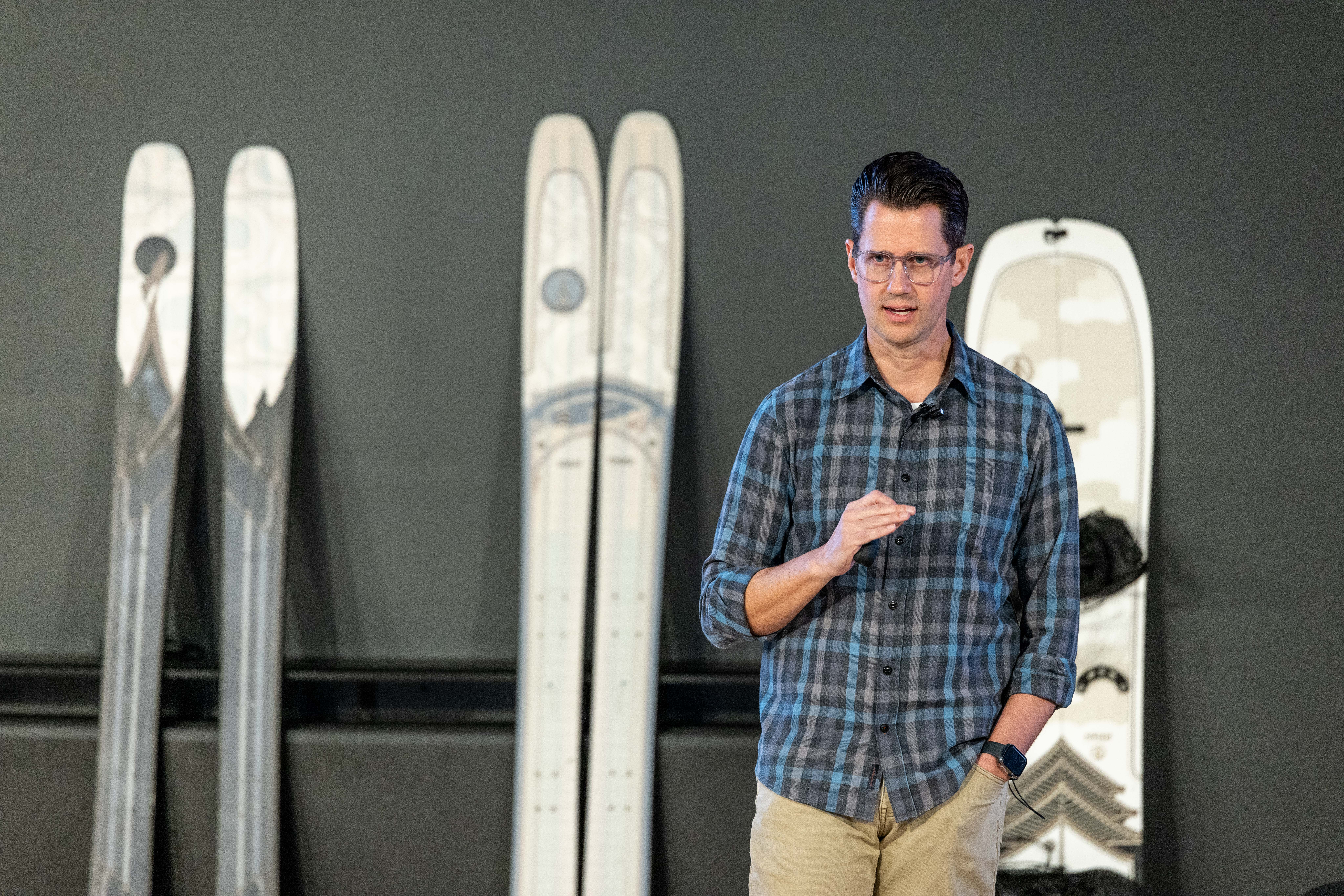
Cardiff brought a different set of objects into view: snowboards, splitboards, and skis. Bell joined Sam Bawden, Bjorn Leines, and the Green Collective as an owner. Skiing and snowboarding had long been part of his life, so the move put an existing interest beside his experience building an outdoor brand. At his April 2024 university appearance, boards stood behind him as he spoke. The props were rather more persuasive than a slide about following your passion.
Back in a room full of beginners
The university visit placed Bell in front of people closer to the beginning of the journey he had started twenty years earlier. He spoke in Utah Valley University’s Reed and Christine Halladay Executive Lecture Series on April 4, 2024. The setting suited a career with an unglamorous but useful opening: friends trying to get a first event off the ground while keeping their other obligations. A finished company can make the early improvisation difficult to imagine.
His next public affiliation continued that conversation. Bell’s profile lists a founder advisory role at Sandbox beginning in June 2024. The program supports student founding teams, and he has spoken warmly about mentoring its students and its expansion to other universities. Advice here comes with a relevant point of contact. He knows what it is to build while still a student, and to discover that an experiment can ask for much more of your life than you initially intended.
He has also worked on the organizational side of the running industry. From June 2019 to October 2023, Bell served on Running USA’s board and as vice president. His responsibilities included leading a national CEO search with the board. That work sits some distance from a race’s finish line, yet belongs in the same career. Selecting leadership and overseeing an organization are part of making an experience possible again, after the excitement of the first occasion has faded.
The next idea starts with a conversation
At Philo Ventures, Bell publicly describes his role as Founder-in-Residence. He has announced that he is exploring upcycled products across food, beverages, cosmetics, and personal care. His invitation is practical: he wants conversations with people working in brands, ingredient supply, manufacturing, and businesses that generate byproducts. These are concepts under validation. The interesting action is the inquiry itself, before a new company has a product or a name to defend.
Philo’s Explore program offers funded time for customer conversations, prototypes, and testing, with designers, engineers, and operators involved. Bell’s testimonial on its website describes entrepreneurship becoming a partnership. For a founder whose original company required a father, a son, a roommate, and many helpers, that preference has an understandable history. His current setting gives it a different structure: a place to test what people want with others already at work alongside him.
The industries may look like a departure from road races and snow equipment. The method is easier to connect. Bell is asking people with direct knowledge to help establish whether an opportunity exists. An ingredient supplier or manufacturer can answer a question that enthusiasm alone cannot settle. The new work puts him back before the first finish line, when the idea still has to encounter the world and survive what the world says.
An unfinished return
In August 2026, Ragnar returned to Bell’s public story with a more urgent question. Events faced financial uncertainty under FitLab, and Bell said he was working with investors and event industry figures on interim funding. On August 14, he reported that an agreement had been reached to fund Trail Rainier and Trail Soldier Hollow. The immediate aim was specific: allow those two races to move forward while a broader effort continued.
He also described a goal of acquiring Ragnar and preparing its future event calendar. At the time of that announcement, the acquisition remained a work in progress. Funding two events and completing a purchase are different milestones, and his account kept them separate. Later that month, Trail Wisconsin received a path forward after its outstanding county invoice was paid. The stakes had become distinctly practical: money, permissions, local partners, and a starting line people expected to reach.
There is a revealing continuity between this work and the first Wasatch Back. A shared adventure asks people to commit their time, recruit their friends, and believe that someone will hold up the organizing end of the bargain. Bell helped create that invitation as a student. More than two decades later, he was again working on the conditions that let people accept it. The story is still being written in the ordinary units of an events business: one agreement, one team, one weekend at a time.
Keep following the trail
Find Bell on LinkedIn, explore Philo Ventures, or visit Cardiff Snowcraft.