A bank can look at a person with no formal borrowing history and see a blank. Tala sees a crowded page. There is the rhythm of income and bills, the answers in a short application, the behavior inside its app and, most valuable of all, the record left by each repaid loan. From that context, the Santa Monica company decides in under two seconds whether to offer a small line of credit to a customer in an emerging market. For most approved borrowers, cash follows within minutes.
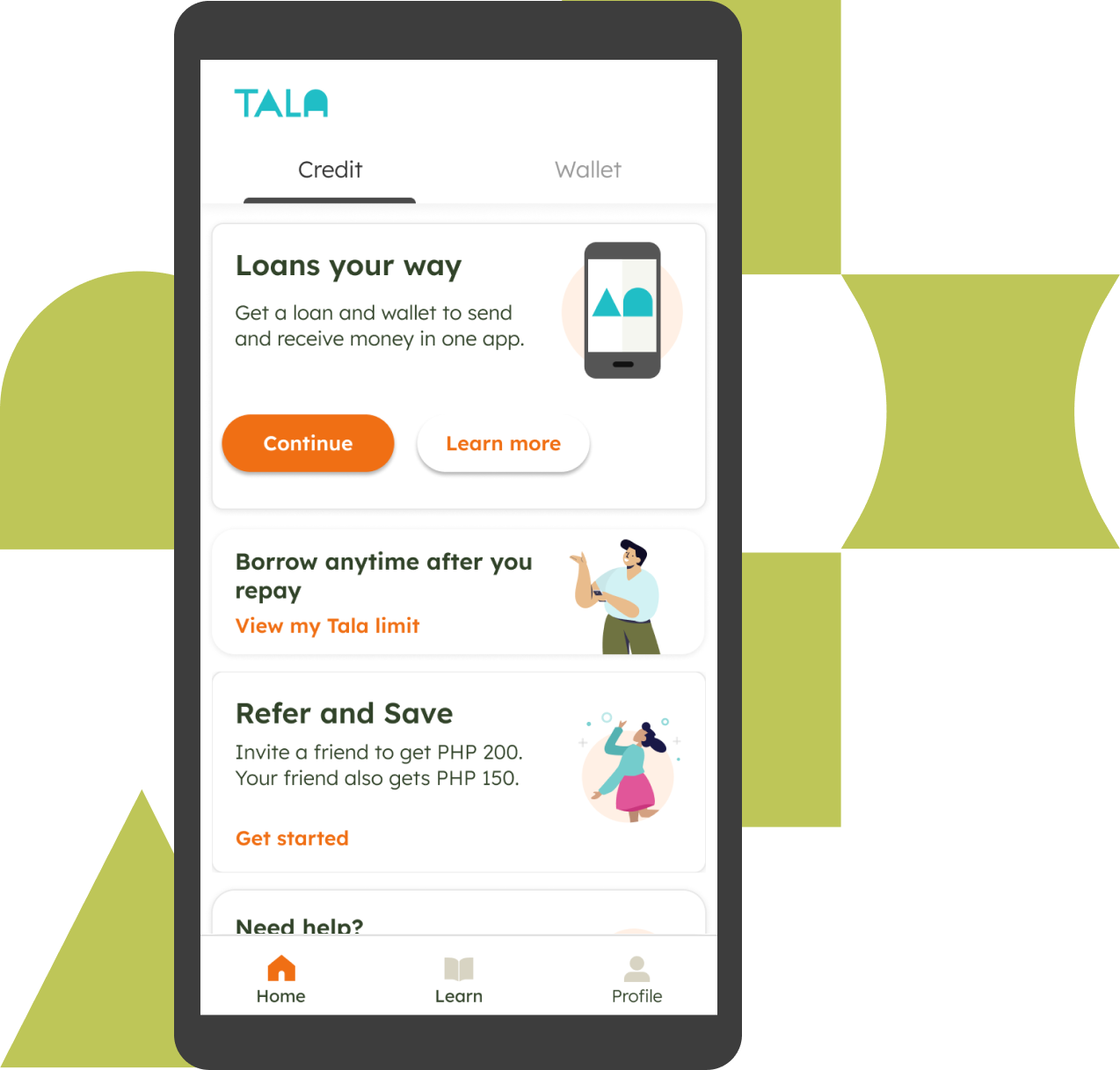
That is the practical job Tala does. It lends to people whom conventional credit systems often cannot score, primarily through a mobile app, then adjusts limits and pricing as it learns. Customers use the money to buy stock for tiny businesses, pay school fees, handle a medical shock or bridge an awkward week between a bill and a paycheck. Tala also offers combinations of payments, transfers, education and wallet features, depending on the country. The experience feels like consumer software. Underneath it is a vertically integrated lender with local compliance, capital, collections and a large appetite for risk data.
The founder started with 3,500 interviews, not a model
Shivani Siroya arrived at the idea sideways. Before founding the company in 2011, she worked in investment banking and studied microfinance and health outcomes for the United Nations Population Fund. In the field, she interviewed thousands of people about how they earned, saved, borrowed and recovered from shocks. The pattern was less “these people cannot repay” than “the system has no useful way to recognize them.” A person could run a stall, support a family and pay suppliers reliably while remaining invisible to a bureau built around bank accounts and formal employment.

The company began as InVenture, using SMS-era alternative scoring, and raised a reported $1.2 million seed round in 2013. The decisive product move arrived in Kenya in 2014: put the application, risk decision and uncollateralized loan inside an Android phone. InVenture became Tala in 2016 and expanded to the Philippines, then Mexico and India. The phone was not simply a cheaper branch. It was an identity surface, a delivery channel and, with permission, a stream of signals from people who did not have thick financial files.
The early limitation was not that the thesis failed. It was that a score alone was not a financial relationship. Customers needed disbursement points, repayment routes, useful limits, support and products that matched irregular income. Tala gradually moved from one-off microloans toward reusable credit lines, dynamic pricing and broader account features. The company’s first lesson is pleasantly unfashionable: the algorithm mattered, but the operational plumbing made it a business.
The moat is the repayment, not the download
Many fintechs can make an attractive application. Fewer can reproduce Tala’s outcome data. By May 2026, the company said it had distributed more than $8 billion to more than 14 million customers across Africa, Latin America and Asia. Every cycle supplies evidence about the relationship between a signal, an offer, a repayment and a borrower’s subsequent behavior. Tala says its models are now trained on a decade of performance among thin-file borrowers - precisely the population missing from conventional datasets.
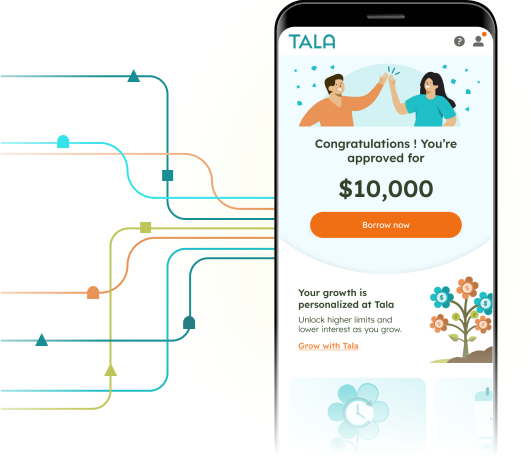
This is how Tala differs from a bank with a rigid scorecard, an informal lender with little automation or a young loan app renting the same third-party bureau file as its rivals. It owns the customer relationship, the underwriting logic and much of the servicing stack. Its newer InSight model goes a step further: instead of only predicting whether someone will repay a preset loan, Tala says it uses causal methods to estimate which limit, price and timing are most likely to produce a good result for that individual.
We spent a decade building a direct-to-consumer business that solves one of the hardest problems in global credit: identity, underwriting, and trust for thin-file borrowers.Shivani Siroya, founder and CEO
The business model is straightforward until it isn’t. Tala earns interest and fees on credit. It uses equity to build the company and debt facilities to finance loans, including a Neuberger Berman facility announced in 2025 with $75 million committed and room to draw up to $150 million for Mexico. Profit depends on the spread between customer yield, losses, servicing and the cost of capital. Better underwriting can improve that equation. A slicker interface cannot rescue bad credit economics.
Inside the company, the operating phrase is “radical trust.” Tala says its teams should reflect the customers they serve, with product and general-management staff distributed across local markets rather than treating Santa Monica as the only room where decisions count. In 2024, women held four-fifths of its executive roles. The value is appealing, but unusually testable for a lender: trust shows up in transparent terms, useful support and dignified collections, not in an office-wall slogan. Tala’s culture and its credit policy eventually meet in the same overdue account.
Access has a price tag
The company’s speed solves a real problem, but “accessible” should not be confused with “cheap.” Tala’s published terms vary by market, product and risk tier. In Kenya, public line-of-credit terms list daily interest around 0.3% to 0.6%, equivalent to 109.5% to 219% APR before applicable taxes. A published example for a KSh 4,000 loan repaid after 60 days totaled KSh 4,864 including interest and excise tax. Mexico disclosures have shown still higher annualized measures. Short terms make those annual percentages look fierce, but the cash cost is not imaginary.
For a merchant who can turn inventory quickly, that cost may unlock profitable sales. For someone rolling one expensive household loan into another, it may worsen fragility. Tala’s own impact research offers reasons for optimism: in a 2022 survey, three-quarters of borrowers reported better overall quality of life, and about 70% of surveyed Kenya customers used loans for business. Later peer-reviewed work linked access to higher transaction values, balances and mobility. These are encouraging signals, not permission to ignore price. The humane metric is not how many approvals happen. It is what remains after repayment.
What failed first was the fantasy of one universal product
Two episodes sharpen the point. When Covid-19 scrambled household income in 2020, Tala cut costs and tightened lending before returning to pre-pandemic volume. Historical data met a shock it could not wish away. Then, in April 2025, Tala deactivated its wallet in the Philippines while leaving customer credit limits intact. The credit engine could travel; every adjacent feature did not necessarily earn a permanent place in every market.
What changed their mind?
Demand during the pandemic pulled Tala toward a broader financial account, while later market experience pushed the company toward partner-led infrastructure rather than owning every feature itself.
What did it cost?
More than $500 million in reported backing, local teams and lending facilities - plus a decade of real defaults, collections and repayments that no foundation model can synthesize.

The strategy now looks less like “build the bank for everyone” and more like “make Tala’s credit intelligence portable.” In late 2025, Tala and Huma Finance announced a $50 million USDC facility on Solana to tokenize emerging-market consumer loans. In January 2026, CIMB committed to a $100 million partnership for Tala’s Vietnam launch, with the bank providing regulated lending infrastructure. In May, Tala embedded its underwriting inside Airtm so customers in Guatemala could receive USDC credit without leaving the wallet.
That is a notable change in distribution. Tala spent ten years acquiring customers directly in order to learn identity, risk and trust. Now a bank or wallet can bring the customer, a capital network can bring liquidity, and Tala can bring the decision. If it works, the company becomes a credit layer rather than merely another lender icon on a phone. The company reported a $300 million annualized revenue run rate in early 2025 and 92% repayment, suggesting the original engine had become substantial before this infrastructure turn.
The part founders can copy - and the part they cannot
The stealable idea is not “use AI on an underserved market.” That sentence has funded enough decks. Tala’s useful sequence is more specific: begin with a narrow, frequent job that produces an observable result; serve the customer directly; use each result to improve the next decision; add products only after the core loop earns trust; and expose the internal engine to partners once it works at scale.
- Start with a customer whom incumbent data describes badly.
- Design one transaction whose outcome arrives quickly and can be measured.
- Earn proprietary feedback through use, not scraped proxies.
- Build local operations beside the model: capital, compliance, support and collections.
- Only platform the capability after the direct product proves it.
The conditions for failure are equally copyable. The loop breaks when phone or behavioral data does not predict repayment, when privacy rules remove essential signals, when debt funding becomes too expensive, when local regulation forbids the structure, or when collections destroy the trust that acquisition created. It also fails in a deeper sense if faster approval merely accelerates unaffordable borrowing. On-chain settlement may reduce friction and diversify funding; it matters to the customer only if some of that efficiency becomes better availability, price or reliability.
Tala’s market sits between banks, microfinance, mobile money, neobanks and informal credit. Its expertise is translating messy, local economic behavior into a decision a capital provider can accept. Competitors can match an interface and undercut a fee. It is harder to recreate fourteen million customer histories across distinct shocks and markets. That history is Tala’s best argument - and its burden. The more confidently the machine says yes, the more precisely the company must know when saying no is the better service.