medical-robotics
(11)
Real-Time Innovations: The price of being late
A wind turbine, a surgical robot, and a car have something awkward in common: their software has to agree while the world keeps moving. RTI sells the machinery of that agreement - and a way to spend less time repairing it.

The Robot That Checks Its Map Mid-Flight
Noah Medical built a lung-biopsy robot around an awkward truth: the lung in the operating room may have moved since its CT scan. Galaxy updates the target while the doctor works, turning navigation into a question that can be checked.

Avail Built a Window Into the Operating Room. Mendaera Wants to Put a Hand Through It.
The company that made surgical expertise travel by screen ran out of money. Its technology found a second life inside a handheld robotics company that is trying to make a difficult first step in care easier to repeat.

AiM Medical Robotics
AiM Medical Robotics is a Worcester, Massachusetts medical device company building a portable, MRI-compatible surgical robot that lets neurosurgeons operate under continuous, real-time MRI guidance. Spun out of Gregory Fischer's Automation and Interventional Medicine (AIM) lab at Worcester Polytechnic Institute, the platform aims to make procedures such as deep brain stimulation lead placement, biopsy, tumor ablation and targeted drug delivery faster, more precise and less variable - reducing procedure time by up to 50% and expanding access to advanced neurosurgical care.

Angio8
Angio8 (Shenzhen Tonglu Technology, 通甪科技) is a medical robotics company building a surgical robot and treatment platform for minimally invasive vascular interventional procedures. Its system lets physicians remotely manipulate catheters and guidewires with force feedback, aiming to make interventional surgery safer, more precise, and less reliant on repeated radiation exposure for the operating team. Founded in 2021 and based in Shenzhen's Bao'an District, the company is led by co-founder and CEO Yunfei (Richard) Cao and is backed by investors including Oriental Fortune Capital, Kangyu Capital and Ruiqian Capital.

Clarapath
Clarapath is a Hawthorne, New York medical robotics company that automates one of the most manual steps in cancer diagnosis: cutting and transferring paper-thin tissue sections onto slides for pathologists to read. Its flagship system, SectionStar, combines robotics, machine vision and AI to standardize tissue sectioning, cut turnaround times and ease chronic staffing shortages in histology labs. Founded in 2014 out of neuroanatomy research at Cold Spring Harbor Laboratory, the company has raised roughly $75 million and works with partners including the Mayo Clinic and Northwell Health.

Conceivable Life Sciences
Conceivable Life Sciences is a New York-based reproductive-medicine company building AURA, described as the world's first AI-powered, automation-assisted IVF laboratory. Using robotics, machine vision, advanced optics and proprietary software, AURA standardizes the 200-plus intricate microscopic steps of in vitro fertilization - from sperm and egg preparation through robotic ICSI, embryo culture and vitrification - to reduce human variability, lower cost, and widen access to fertility care. Founded in 2022 by Joshua Abram, Alan Murray and Dr. Alejandro Chavez-Badiola, the company reported the first live birth from a digitally controlled, remotely operated ICSI system and raised a $50M Series A in 2025 to bring its lab to the U.S.

Morphle Labs Inc.
Morphle Labs is a deep-tech healthcare automation company building robotic and AI-driven imaging systems for cancer diagnostics. Founded in 2017 and now operating between Bengaluru and New York, it combines robotics, optical engineering, and neural-network AI to automate the historically manual steps of histology - from tissue sectioning to whole-slide scanning to remote reporting. Its product line spans the RoboTome robotic microtome, the MorphoLens family of whole-slide scanners, and the HemoLens hematology scanners, giving pathology labs an end-to-end digital workflow at a fraction of the cost of legacy systems.
Mendaera, Inc.
Mendaera is a Silicon Valley healthcare technology company building Focalist, a fist-sized handheld robotic system that pairs real-time ultrasound imaging with robotic needle guidance and AI to make precise, needle-based procedures more accessible across specialties. Founded in 2020 by Josh DeFonzo and Jason Wilson, both alumni of Auris Health, and backed by Intuitive Surgical and Auris co-founder Dr. Fred Moll, the company aims to move robotics beyond the operating room and into the everyday procedures that make up the bulk of medicine.
REEV
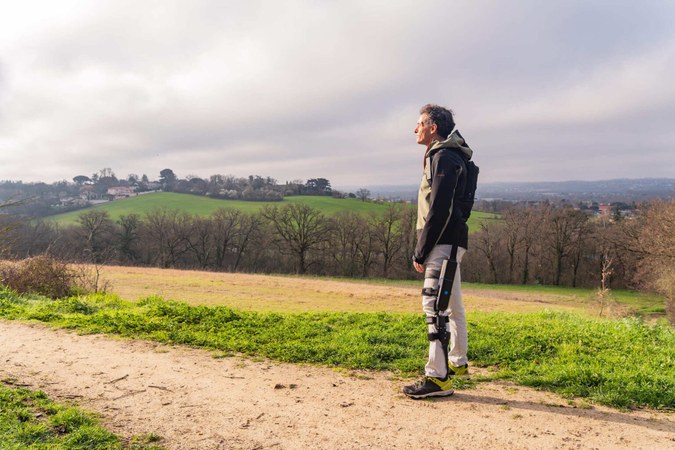
REEV is a medical robotics company building AI-powered wearable robotics to restore everyday mobility for people with neurological gait disorders after stroke, multiple sclerosis or paraplegia. Its flagship DREEVEN is a lightweight (about 3kg) motorized knee orthosis driven by electro-hydraulic actuation and real-time gait sensing, paired with REEV SENSE, an IMU wearable that turns a person's walking pattern into clinical-grade gait reports. Founded in 2021 and split between Boston and Toulouse, REEV raised $9.2M in February 2025 to finalize DREEVEN, run a clinical study at Boston University and prepare for FDA trials.

XCath Robotics
XCath Robotics is a Houston-based medical robotics company building next-generation endovascular robotic systems and steerable smart guidewires to treat stroke, brain aneurysms and other neurovascular conditions. Its flagship Iris system is the only endovascular robot in development capable of intracranial navigation, and the company is racing toward a clinical telerobot that could let a specialist perform a brain-clot removal on a patient hundreds of miles away.