$73M
Series B (2024)
Shrinking the surgical robot down to fist-size - and pointing it at the needle, the most common tool in medicine.
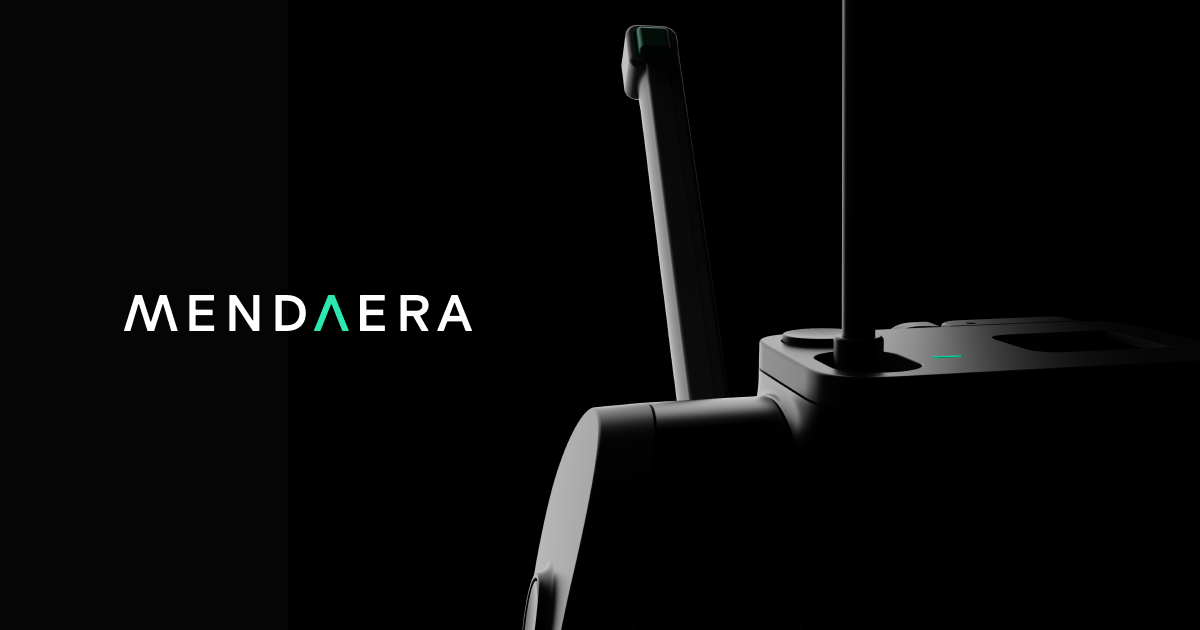
The most expensive robots in medicine live in operating rooms, cost millions of dollars, and spend a surprising amount of time idle. They are extraordinary machines for a narrow set of extraordinary procedures. Mendaera, a healthcare technology company founded in San Mateo in 2020, noticed the more interesting number: the enormous pile of ordinary procedures - the biopsies, the drains, the vascular access, the kidney-stone punctures - that are done freehand, millions of times a year, with a steady hand and a hope.
Needles are the workhorse tool of medicine, and precision with them has historically been a matter of the operator's skill on the day. Mendaera's proposition is that this is a solvable problem, and that the solution does not have to weigh a ton or fill a room. The company builds Focalist, a handheld robotic system - roughly fist-sized - that combines real-time ultrasound imaging, robotic needle positioning, touchscreen targeting, and continuous depth-tracking. You point it, you confirm the target on a screen, and the robotics handle the part where being off by a few millimeters matters.
This is a deliberately unglamorous bet. Nobody makes a movie about a device that helps a clinician hit a vein on the first try. But the economics are the whole point: a smaller, cheaper, more portable robot can go where the big systems can't, and it can address the procedures that actually make up the bulk of the day. The pitch to a hospital is not "do something you've never done." It's "do the thing you do constantly, more reliably, with fewer retries."
There's a reason to take the bet seriously beyond the elegance of the idea, and his name is Dr. Fred Moll. Moll co-founded Intuitive Surgical, maker of the da Vinci system that essentially created the surgical-robotics category, and later co-founded Auris Health, acquired by Johnson & Johnson. When the person who built the big robots writes a check for the small one, it's worth reading as a thesis: the last two decades of medical robotics were about capability and scale. The next, Mendaera is wagering, is about access.
Mendaera's co-founders did not arrive at medical robotics by accident. Both came from Auris Health, the surgical-robotics company that sold to J&J - which means they had already lived the full arc of building, clearing, and commercializing a complex medical robot before starting over with a smaller one.
Previously Chief Operating Officer at Auris Health, through its acquisition by Johnson & Johnson. Now leads Mendaera's strategy to move robotics into mainstream, needle-based intervention.
Spent nearly two years at Auris Health before co-founding Mendaera. Leads the technical development of the Focalist handheld robotic platform.
Strip away the category talk and Focalist is a device that helps a clinician put a needle exactly where they intend to. It does this by fusing three things that usually live separately: the imaging that shows where the target is, the robotics that steady and position the needle, and the software that lets the operator confirm the plan before anything moves.
Integrated ultrasound shows the target and surrounding anatomy live, so targeting is based on what's happening now - not a static picture.
The clinician selects the target on a screen; the system translates that intent into a precise trajectory for the needle.
Handheld robotics align and advance the needle, taking the millimeter-level precision out of the realm of a steady hand.
Continuous needle depth-tracking follows the tool as it advances, so the operator always knows how far, how close.
The strategy runs deeper than a single gadget. Around 2023, Mendaera acquired the technology of Avail Medsystems, a medical-telepresence company. On its face, buying video-conferencing tech is an odd move for a robotics startup - until you notice that a cloud-connected handheld robot can be supported, guided, and learned from remotely. The device is the beginning; the connected platform is the ambition.
In July 2025, Focalist earned FDA 510(k) clearance for ultrasound-guided needle placement. In healthcare, clearance is a starting line rather than a finish, and Mendaera treated it that way: by September 2025 the company had announced the world's first procedures performed with the system. At the World Congress of Endourology, urologist Dr. Karen Stern of Mayo Clinic Arizona used Focalist to achieve precise kidney access during a PCNL - the gold-standard treatment for large kidney stones, and a procedure where getting that first puncture right is the hard part. Full commercialization is targeted for 2026.
Mendaera didn't raise money to ship a product; it raised money to build a category. The roughly $97M in total funding is aimed at establishing mainstream robotic intervention - a market defined not by how impressive one procedure is, but by how many procedures the device can eventually touch.
The Series B was led by Threshold Ventures, with participation from Lux Capital, PFM Health Sciences, Founders Fund, Puma Venture Capital, and Dr. Fred Moll - the Intuitive and Auris co-founder who also backed the Series A. It's an investor list that reads less like a bet on a device and more like a bet on the people who know exactly how hard this is.
Josh DeFonzo and Jason Wilson, both from Auris Health, start the company in San Mateo to reimagine medical robotics as handheld and accessible.
Raises a $24M Series A backed by Lux Capital, Threshold Ventures and Fred Moll, and acquires Avail Medsystems' telepresence technology.
Closes a Series B led by Threshold Ventures to scale robotics and AI across mainstream medical procedures.
Earns FDA 510(k) clearance for Focalist in July and performs the world's first handheld-robotic PCNL procedures in September.
Full commercialization of the Focalist system is expected.
Focalist, a handheld robotic system that combines real-time ultrasound imaging, robotic needle positioning and AI to improve the precision of ultrasound-guided needle placement.
It was founded in 2020 by Josh DeFonzo (CEO) and Jason Wilson (CTO), both former leaders at Auris Health.
Yes. Focalist received FDA 510(k) clearance in July 2025 for ultrasound-guided needle placement, with full commercialization expected in 2026.
Approximately $97M in total, including a $73M Series B led by Threshold Ventures that closed in September 2024, and a $24M Series A.
Investors include Threshold Ventures, Lux Capital, PFM Health Sciences, Founders Fund, Puma Venture Capital, and Dr. Fred Moll, co-founder of Intuitive Surgical and Auris Health.
Interviews and demos put the device in context - including a conversation with co-founder and CEO Josh DeFonzo, and press coverage of the FDA clearance and first procedures.