data-protection
(27)
Druva Bet the Backup Business on a Radical Idea: Delete the Hardware
The company began by selling the same kind of backup software its founders had left behind. Then it rebuilt the product, the pricing and the customer bargain around one stubborn premise: backup infrastructure should be Druva's problem.
CrashPlan Killed Its Consumer Darling. Now It Wants to Back Up the Enterprise.
The backup app that once abandoned home users has returned as a broader enterprise safety net. Its second act is less about saving vacation photos and more about restoring research, email, and business continuity before a bad day becomes a board meeting.
The 3% Email Failure That Explains Echoworx's Quiet Enterprise Bet
Most security software asks people to change. Echoworx built its business around changing the route instead - and one insurer's 3% TLS gap shows why that matters.
The Backup Company That Reads Your Kids' Search History - And 7 Million People Are Fine With It
Vijay Krishna built a boring backup tool, then pointed its machine-learning at student essays and found the kids no one was watching. Here is how a Red Bank, New Jersey company turned SaaS insurance into a safety net for 1,200 school districts.
N-able
N-able built a half-billion-dollar subscription business by helping managed service providers do the unglamorous work that keeps small businesses running. Now it is stitching monitoring, security and recovery into one open system - while learning that resilience is a promise tested in public.
Iron Mountain
It began as a Cold War bunker for filing cabinets. Seventy-four years later, the same company that guards your grandmother's insurance records is quietly building the warehouses where AI lives.

Commvault
Backup used to mean making a copy. Commvault is betting the harder, more valuable job is proving an entire business can come back clean - data, identities, applications and cloud infrastructure included.

Arcserve
Arcserve has spent more than four decades preparing for the day a company cannot open its own files. Its latest bet is that lean IT teams want one recovery system - with immutable storage, broader virtualization support and a little AI - more than another sprawling security console.

Oximy
Oximy is the system of record for how enterprises use AI. It sits at the network layer to discover every AI tool employees touch (sanctioned or not), track spend across teams and vendors, and protect sensitive data - then adds a company-controlled AI workspace and a routing layer that sends each request to the best model by cost, quality, and latency. Founded in 2025 by Naman Ambavi and part of Y Combinator's W26 batch, Oximy already processes millions of requests a day for customers in financial services and healthcare.

Fortisphere
Fortisphere is a Sydney-based AI transformation, operations and advisory firm founded in 2024 by former Commvault support leader Eugene Trautwein. It helps businesses turn AI ambition into practical results through advisory, benchmarking, workflow redesign, automation and fractional operating leadership, and runs an innovation lab that incubates its own SaaS products - starting with ResumeUplift.com, a tool that helps jobseekers beat AI resume filters.
StorONE
StorONE is a New York-based enterprise storage software company founded in 2011 by Gal Naor and Raz Gordon. Its ONE Storage Platform separates storage services from hardware, delivering block, file and object storage from a single, hardware-agnostic engine. By rewriting the storage stack from scratch, StorONE combines high performance, real-time auto-tiering across flash and HDD, immutable-snapshot ransomware recovery and per-drive licensing to help enterprises cut storage costs while running on commodity servers.

Valence Security
Valence Security is a SaaS and AI security company that helps enterprises find and fix risks created by SaaS and AI sprawl. Its platform unifies SaaS discovery, SaaS Security Posture Management (SSPM), AI Security Posture Management (AI-SPM), and Identity Threat Detection and Response (ITDR), then pairs that visibility with one-click and collaborative remediation workflows that engage business users to actually close gaps. Founded in 2021 and backed by Microsoft's M12, YL Ventures, and Porsche Ventures, Valence positions itself as a leader in securing the modern, agentic SaaS estate.
Graid Technology Inc.
Graid Technology is a Silicon Valley and Taiwan storage startup that builds SupremeRAID, the first GPU-based RAID solution for NVMe and NVMe-over-Fabrics SSDs. By moving RAID processing off the CPU and onto an NVIDIA GPU sitting out of the data path, the company unlocks the full performance of modern flash-delivering millions of IOPS and tens of gigabytes per second of throughput-while protecting data for AI, HPC, cloud, and enterprise workloads.

Lookout
Lookout is a San Francisco-founded cybersecurity company focused on mobile endpoint security and threat intelligence for enterprises and government agencies. Built on one of the world's largest mobile security datasets - hundreds of millions of devices and apps - Lookout detects phishing, smishing, malicious apps, device compromise and social-engineering attacks that target the smartphones people use for work. After divesting its consumer business in 2023 and its cloud SSE business to Fortra in 2025, Lookout is now a pure-play enterprise mobile security vendor led by CEO and Chairman Jim Dolce.

Wald.ai
Wald.ai is a Palo Alto-based context intelligence company that lets enterprises use generative AI assistants like ChatGPT, Claude, Gemini and Grok without leaking sensitive data. Its context-aware DLP engine uses specialized small language models to detect and redact confidential information in real time, then restores it in the response, giving regulated industries a governed, single-pane way to adopt AI without blocking it. Founded in 2023 by Vinay Goel and Ritesh Ahuja, the company closed a $4M seed round in December 2024.
Clumio
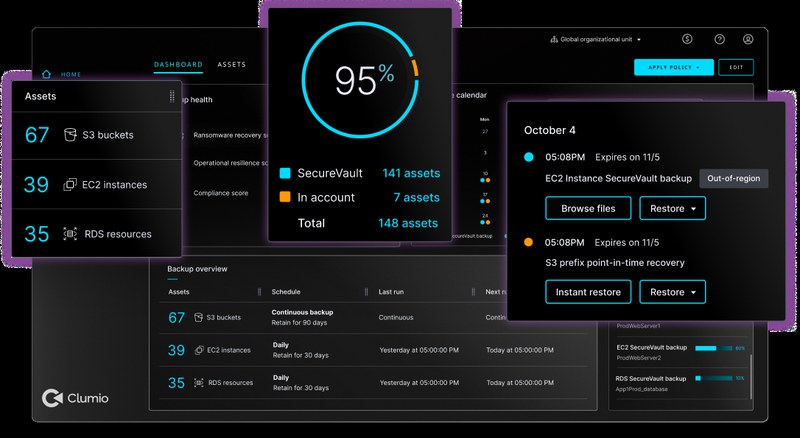
Clumio is a cloud-native, serverless backup-as-a-service platform built for AWS workloads. It protects data in Amazon S3, DynamoDB, RDS/Aurora, EC2/EBS and Apache Iceberg lakehouses with air-gapped, immutable backups and near-instant recovery at exabyte scale. Founded in 2017 by serial entrepreneur Poojan Kumar, Clumio raised roughly $261M before being acquired by Commvault in 2024, where its technology now anchors AWS cyber-resilience offerings.

NIC (NIC IT Partner)
NIC, operating as NIC IT Partner, is a Los Angeles-based managed service provider (MSP) that has delivered IT support, cybersecurity, cloud hosting, and backup and disaster recovery since 2002. Built for small and mid-sized businesses across regulated industries - healthcare, legal, finance, construction, and nonprofits - NIC runs a 24/7/365 operation with a tiered technical team, helping clients meet compliance requirements like HIPAA and CMMC while keeping their networks running.
RackWare
RackWare builds enterprise-grade software that moves and protects workloads across any cloud, virtual, or physical environment. Its flagship RackWare Management Module (RMM) automates migration, disaster recovery, and backup so organizations can shift to the cloud, recover from outages, and avoid vendor lock-in - all from one policy-driven, agentless platform. Founded in 2009 and based in San Jose, California, RackWare has migrated over a million workloads and protects hundreds of thousands more for customers ranging from Fortune 50 enterprises to SMBs across 60+ countries.

Unplugged
Unplugged is a privacy-first technology company behind the UP Phone, a de-Googled smartphone running its own UnpluggedOS - an Android fork stripped of Google Mobile Services. Built around an on-device firewall, a no-logs VPN, encrypted storage, and a hardware battery-disconnect switch, the phone is designed for people who want to keep using a modern smartphone without feeding the surveillance economy. The company sells direct-to-consumer and through Best Buy, and says it earns no revenue from customer data.
NinjaOne
NinjaOne is an Austin-based software company that makes an automated, cloud-native endpoint management platform used by IT teams and managed service providers to monitor, secure, patch, back up and control laptops, servers, mobile devices and SaaS data from a single console. Founded in 2013 as NinjaRMM, it now serves more than 30,000 customers and manages over 5 million endpoints, and in 2025 raised $500 million in Series C extensions at a $5 billion valuation while remaining founder-led and debt-free.

Wiedza i Praktyka (WIP)
Wiedza i Praktyka (WIP) is one of Poland's largest providers of specialist professional information. Founded in Warsaw in 1997, it equips accountants, HR and payroll specialists, occupational-safety officers, healthcare managers, educators, lawyers and public administrators with the practical, up-to-date guidance they need to apply constantly changing regulations. WIP blends print and e-letters, industry web portals, software tools, expert helplines, and the Educado online learning platform, plus open and in-house training through Akademia Wiedza i Praktyka. Since August 2025 it has been wholly owned by Germany's VNR Group.

Teleskope
Teleskope is a New York-based data security company that builds what it calls the industry's first agentic data protection platform. Founded in 2022 by former Airbnb security engineers Elizabeth Nammour and Julie Trias, it autonomously discovers, classifies, and protects sensitive data across cloud, SaaS, and on-premises environments, then automatically remediates risk through redaction, masking, encryption, and access fixes. The platform uses smaller, fine-tuned models to read business context, aiming to move teams beyond alert fatigue toward real action.

PreVeil
PreVeil is a Boston-based cybersecurity company, born out of research at MIT, that delivers end-to-end encrypted email and file sharing built on zero trust principles. Its data is never decrypted on any server, so it stays protected even if passwords are stolen, admin accounts are hijacked, or servers are breached. PreVeil has become the go-to compliance platform for defense contractors and other regulated industries needing to meet CMMC, NIST 800-171, ITAR, and DFARS requirements at a fraction of the cost of legacy alternatives.

Barracuda Networks
Barracuda Networks is a cybersecurity company based in Campbell, California that protects more than 200,000 organizations worldwide. It packages email protection, application and network security, data protection and managed detection and response into the AI-powered BarracudaONE platform, sold largely through a global network of managed service providers and channel partners.

Cohesity
Cohesity is a Santa Clara-based data security and management company that helps enterprises back up, protect, secure, and recover their data across on-premises, cloud, and SaaS environments. Founded in 2013 by Mohit Aron, it built a hyperscale platform to consolidate fragmented secondary data, and after merging with Veritas' enterprise data protection business in December 2024 it became the world's largest data protection software provider, serving roughly 13,000 organizations including most of the Fortune 500.

Harmonic Security
Harmonic Security helps enterprises adopt generative AI without leaking sensitive data. Using small, purpose-built language models, its AI Governance and Control platform spots risky prompts, enforces policy across browsers and desktops, and gives security teams visibility into the thousands of AI tools employees quietly use every day.

WitnessAI
WitnessAI is an enterprise AI security and governance platform that helps organizations safely deploy AI at scale. Built on three pillars - Observe, Protect, and Control - its platform provides real-time visibility into all AI interactions (employee tools, internal models, AI agents, MCP servers), detects and blocks prompt injections and jailbreaks with over 99% accuracy using intent-based ML models, and enforces behavioral policies without code changes. With $85.5M in total funding, 500% ARR growth in 2025, and customers across financial services, telecom, airlines, and automotive, WitnessAI is positioning itself as the confidence layer enterprises need to move from AI experimentation to production deployment.