crypto
(32)
The Blackstone Alum Betting That Wall Street Runs on Blockchain Next
Alex Marinier left private equity to write the earliest checks into blockchain finance. Six years and one Polymarket later, New Form Capital is raising again - and the institutions it once worked for are finally listening.

The Only Two Bets BlueYard Will Make: Utopia or Oblivion
BlueYard hands early-stage founders a check between $500K and $5M to chase problems most investors call radioactive - fusion reactors, hypersonic defense, decentralized money, engineered cells. Since 2016 it has backed Solana, Groq, IonQ and Filecoin from a partnership split between Berlin and the US.
RRE Ventures Has Been Playing the Long Game Since 1994 - and It Shows
The New York firm wrote early checks into Palantir, Datadog and Venmo, then stayed in the boardroom for the parts that actually get hard.

How a Forgotten Wallet Turned Into America's Verb for Money
Venmo turned paying a friend back into a social ritual - complete with emojis and a public feed. Fifteen years later, "just Venmo me" is how a generation moves money.
The Firm That Turned Bitcoin Into a Ticker Symbol
Grayscale spent a decade building the plumbing that lets ordinary investors own crypto without touching a wallet - then went to court to prove the SEC had to allow it.

Fliq by EthosX
Fliq is a creator-owned, mobile-first prediction market built by EthosX (YC S22), the DeFi derivatives protocol founded by ex-JP Morgan derivatives quant Deepanshu. Fliq turns trading into simple yes/no questions on sports, politics, memes and culture, letting local creators launch their own markets. Built on the Aptos blockchain with USDT settlement, it aims to onboard the ~95% of people in markets like India who have never traded, making prediction markets as engaging as short-form video.

Settle Network
Settle Network is a Buenos Aires-based fintech that builds the fiat-to-crypto rails Latin America runs on. Through its Latamex gateway and Stellar-based settlement infrastructure, it lets exchanges, businesses, and users convert local currencies like the Argentine peso and Brazilian real into crypto and stablecoins - and back again - in seconds. A Y Combinator S22 company backed by the Stellar Development Foundation, Settle became the on/off ramp behind global exchanges including Binance and OKX across the region.
Hata
Hata is a Malaysian dual-licensed digital asset exchange that lets people buy, sell, store and stake cryptocurrencies using local fiat. Founded in 2023 and launched in May of that year, it holds licences from both the Securities Commission Malaysia and the Labuan Financial Services Authority - a rare dual-regulated footprint that keeps customer assets custodied inside the country. Led by ex-Luno APAC general manager David Low, Hata grew to more than 209,000 registered users by the end of 2025 and closed an US$8 million Series A led by Bybit in April 2026.
Reku
Reku is an Indonesian investment platform that lets everyday users buy, sell and trade cryptocurrency alongside US stocks and ETFs from a single app. Founded in 2017 as Rekeningku.com and rebranded to Reku in 2022, the company positions itself as a low-fee, education-first exchange licensed by Indonesian regulators. It offers spot crypto, crypto futures, staking, OTC services and curated Reku Packs, and turned profitable in 2024 while serving hundreds of thousands of customers.
August Digital
August Digital is a New York-based institutional crypto company building on-chain prime brokerage infrastructure. Its platform gives trading desks, funds, protocols and treasuries secure smart-contract accounts, real-time risk and pricing engines, cross-margining, lending, and structured products so they can borrow, lend, trade and settle across DeFi and CeFi with any liquid collateral - all with on-chain auditability. August also operates Upshift, a vault product that opens institutional-grade yield strategies to a wider set of users. The company raised a $10M Series A led by Dragonfly in March 2025 and reports having processed roughly $45B in cumulative volume.
Blackbird Labs
Blackbird Labs is a New York-based restaurant technology company that pairs a consumer dining app with a blockchain-based payments and loyalty network. Founded in 2022 by Resy and Eater co-founder Ben Leventhal, Blackbird lets diners check in at participating restaurants, earn a rewards currency called $FLY, and pay their bill through the app, while giving restaurants lower payment-processing fees and direct ownership of their guest data. The company runs its own layer-2 network, Flynet, and operates in New York, San Francisco, and Charleston with roughly 1,000 restaurants on the platform.
CryptoQuant
CryptoQuant is a crypto on-chain and market data analytics platform founded by Ki Young Ju that collects raw blockchain data, enriches it with exchange and entity labels, and delivers it as actionable metrics, charts, alerts and APIs. Often called 'the Bloomberg of crypto,' it serves professional traders, researchers and 200-plus institutional clients, and was the first on-chain data provider listed on CME Group's DataMine marketplace.
Eisen
Eisen is a New York-based compliance operations platform that automates escheatment, disbursement, and regulatory reporting for banks, credit unions, fintechs, and crypto companies. Its software tracks state-by-state unclaimed property rules, reaches out to account holders before funds are turned over to governments, and manages payouts and 1099 tax reporting - reducing the manual, error-prone work financial institutions face when handling dormant accounts, stale checks, and account wind-downs.
Metaversal
Metaversal is a Miami-based Web3-native merchant bank for the digital culture economy. Founded in 2021 by Yossi Hasson and Daniel Schmerin, it acquires and builds around blue-chip NFT intellectual property and now originates NFT-backed art loans and on-chain GPU financing tied to the AI compute buildout. Backed by a $50M Series A led by CoinFund and Foxhaven, the firm sits at the intersection of NFTs, lending, and AI infrastructure.

Startale Group
Startale Group is a Singapore-headquartered Web3 infrastructure company building the onchain stack for finance, entertainment, and consumer applications. Led by founder and CEO Sota Watanabe - who also created Astar Network - Startale operates a vertically integrated portfolio spanning the Sony-backed Ethereum Layer 2 Soneium, the Astar Network, the Strium blockchain for tokenized securities and real-world assets, the JPYSC and USDSC stablecoins, and a consumer Startale App. Backed by Sony and SBI, the company aims to bring Web3 to billions by bridging traditional finance with onchain systems.

CoinList
CoinList is a San Francisco-based crypto platform that gives investors early access to new token sales and blockchain networks before they list on exchanges. Spun out of AngelList in 2017, it pioneered compliant token distribution with KYC/AML and accredited-investor verification, and has run primary sales for projects including Filecoin, Solana, Near and Algorand. In 2025 the company began shifting to a fully non-custodial, onchain model that delivers tokens directly into user-controlled wallets.

DELV
DELV, formerly Element Finance, was a research-driven DeFi company that called itself 'the factory for DeFi.' Founded in 2020 by Will Villanueva and Jonny Rhea, it built open-source infrastructure for fixed- and variable-rate yield - most notably the Element Protocol, the Hyperdrive AMM, and the Council on-chain governance framework. Backed by a16z, Placeholder, and Polychain Capital with about $36.4M raised, the team pursued the idea that reliable fixed rates were essential to mainstream DeFi adoption. After a March 2025 Hyperdrive vulnerability and a conclusion that the product had not found market fit, DELV wound down operations in June 2025 with no reported loss of user funds.
Hashdex
Hashdex is a crypto-focused asset manager that packages digital assets into regulated index funds and ETFs so ordinary investors can buy crypto through a brokerage account. Founded in Brazil in 2018 and now headquartered in the New York area, it co-developed the Nasdaq Crypto Index, launched the world's first crypto index ETF in 2021, and brought the first multi-asset spot crypto ETF (NCIQ) to US investors in 2025. The firm manages roughly $1 billion across products in nine countries.
Slingshot
Slingshot is a San Francisco-based crypto trading app that lets people buy, sell, and swap hundreds of thousands of tokens across multiple blockchains from a single USDC balance - hiding the usual friction of wallets, bridges, and gas fees behind a clean consumer interface. Founded in 2020 by Coinbase alum Clinton Bembry, it raised roughly $18M through a Ribbit Capital-led Series A and was acquired by NFT marketplace Magic Eden in April 2025.

Thesis*
Thesis* is a Bitcoin-focused venture production studio founded in 2014 that builds companies and protocols in-house rather than investing in outside teams. Operating under the banner "Money is power, Bitcoin is empowerment," it has incubated a portfolio spanning Bitcoin infrastructure and consumer finance - including tBTC (a decentralized, trust-minimized bridge that tokenizes Bitcoin on Ethereum), Mezo (an on-chain Bitcoin banking layer backed by the MUSD stablecoin), Fold (a Bitcoin rewards app), Acre (Bitcoin staking), and Taho (a community-owned web3 wallet). Led by CEO Matt Luongo, Thesis raised a $21 million Series A in 2021 and has become one of the most prolific studios building Bitcoin-native financial products.

Drosera Network
Drosera Network is a decentralized incident response protocol that aims to be an 'immune system for Ethereum.' It lets DeFi protocols deploy 'Traps' - small, off-chain-defined smart contracts that continuously monitor on-chain state, detect anomalies or exploits, and trigger automated emergency responses (like pausing functions) before an attack drains funds. A decentralized network of Operators watches those Traps and pushes verified responses on-chain, turning security from an after-the-fact audit into a live, programmable defense layer.
N1
N1 (formerly Layer N) is a high-performance Layer-1 blockchain built specifically for onchain finance at scale. Founded by DeFi veterans Dima Romanov, David Cao, and Sheheryar Parvaz, N1 pairs an ultra-low-latency, congestion-free execution layer with native financial primitives - an onchain orderbook, atomic transaction bundles, unified margining, and RFQ - so that trading applications that previously had to run offchain can run natively onchain. Every app runs in its own isolated environment with no state congestion, and developers can write smart contracts in TypeScript (with Python and other languages on the way). Backed by Founders Fund, Multicoin Capital, dao5, Kraken Ventures, and Arthur Hayes, the New York-based team is targeting the performance ceiling that has kept serious finance from moving onchain.
Ola Guild Games
Ola Guild Games (OLA GG) is the largest Web3 gaming community in the Spanish-speaking world, operating as a regional subDAO of Yield Guild Games. Founded by lifelong Hispanic gamers, it onboards players across Latin America and Spain into blockchain games through NFT scholarships, Web3 education, and a shared-rewards model that lets people play and earn without upfront cost. In 2022 it raised $8 million in seed funding from investors including Galaxy Interactive, BITKRAFT, and Arca.
Bluwhale
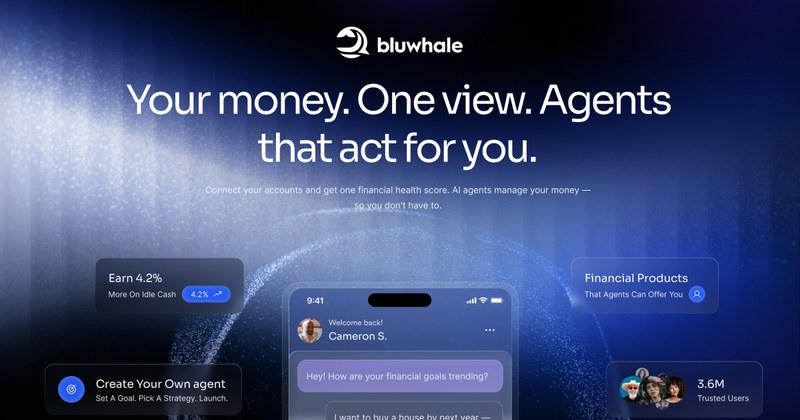
Bluwhale is a San Francisco AI and Web3 company building a decentralized intelligence layer that turns on-chain data and personal financial activity into a monetizable, user-owned asset. Its platform pairs wallet-level AI profiling with autonomous agents that act across banks, brokerages, and blockchains, giving consumers a single view of their money and a financial-health score (WhaleScore) while letting enterprises and dApps reach engaged, verified users. Founded in 2022 by repeat founder Han Jin, the company has grown to millions of users and expanded into multi-chain agentic finance backed by SBI, UOB Venture Management, Cardano, Sui, and others.

Ondo Finance
Ondo Finance is a U.S.-based blockchain company that brings traditional financial assets - U.S. Treasuries, money-market funds, stocks and ETFs - on-chain as tradable, yield-bearing tokens. Through products like OUSG (tokenized short-term Treasuries), USDY (a yield-bearing dollar token) and Ondo Global Markets (tokenized U.S. equities), it aims to make institutional-grade financial products accessible to anyone, anywhere, around the clock. The company is also building Ondo Chain, a blockchain purpose-built for regulated real-world assets.
Ostium
Ostium is an onchain perpetuals exchange built on Arbitrum that lets anyone long or short real-world assets - stocks, commodities, indices, forex and crypto - directly from a self-custodial wallet, with up to 200x leverage and no broker in the middle. Founded by Harvard classmates and former Bridgewater hands Kaledora Kiernan-Linn and Marco Antonio Ribeiro, Ostium uses synthetic perpetuals and a custom oracle system to bring traditional markets onchain. It has processed tens of billions in cumulative trading volume and raised $27.8M total, including a $20M Series A co-led by General Catalyst and Jump Crypto in December 2025.
Metrika
Metrika is a Cambridge, Massachusetts SaaS company that built the first operational intelligence and risk management platform for blockchains and digital assets. It collects, analyzes, and visualizes the health of decentralized networks in real time - tracking hundreds of risk indicators across protocols, smart contracts, and market conditions - so that protocol teams, financial institutions, and regulators can monitor performance, detect issues early, and meet compliance obligations.
Sentz Global
Sentz (formerly MobileCoin) is a San Francisco-based fintech building a free, self-custodial mobile wallet that lets people send, save, receive and earn in stablecoins. Its dollar-pegged eUSD moves money across borders in seconds for a fraction of a cent, with end-to-end encryption and full user custody. Used in 180+ countries with deep traction in Nigeria, Sentz targets freelancers, remote workers and families sending remittances, and offers up to 8% yield through Sentz Earn.

Juno
Juno (formerly OnJuno) is a crypto-friendly banking platform that lets users in the US hold cash and crypto in one account, receive paychecks in stablecoins, and on-ramp to 20+ blockchain networks without withdrawal holds. Founded by Varun Deshpande, Ratnesh Ray, and Siddharth Verma, the company raised an $18M Series A in 2022 led by ParaFi Capital.
River
River is a San Francisco-based, bitcoin-only financial services company offering brokerage, custody, mining, and Lightning Network infrastructure. Founded in 2019 by Alex Leishman and Andrew Benson, River serves individuals and businesses who want to buy, hold, earn yield on, and transact with bitcoin from a US-regulated, transparent, full-reserve institution.