Company Profile / AI & Web3
Bluwhale
The intelligence layer that turns your data into something you own - and puts AI agents to work across banks and blockchains.
The intelligence layer that turns your data into something you own - and puts AI agents to work across banks and blockchains.
Somewhere right now, a phone in someone's pocket is quietly running a node. It verifies a sliver of data, contributes a sliver of compute, and earns its owner a sliver of value. Multiply that by millions of phones and you get Bluwhale - a company betting that the most valuable thing about you online is something you should own, not something Google should rent out.
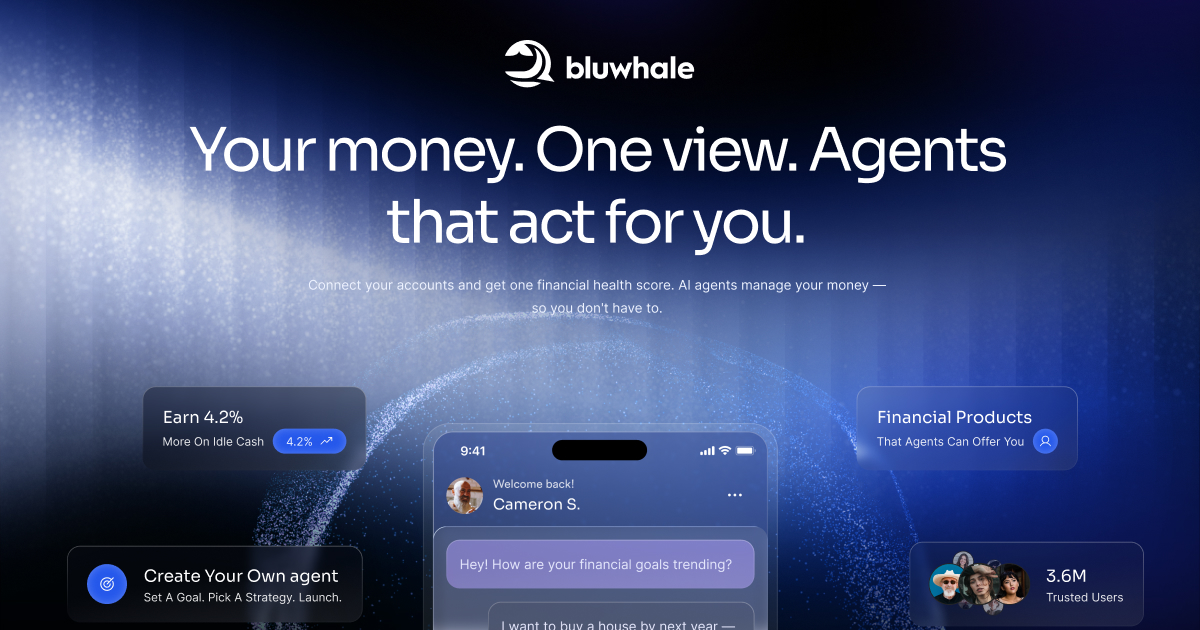
Bluwhale describes itself in eight words: Your money. One view. AI that acts for you. Under the hood, it is a decentralized AI network that reads your on-chain and financial activity, scores it, and lets autonomous agents act on it - staking here, optimizing gas there - while enterprises pay to reach the verified humans behind the wallets. The unusual part is who keeps the money. Bluwhale says more than 90% of what companies spend flows straight back to users.
"We are building a Helium network by leveraging mobile devices to decentralize AI in terms of data, storage and compute."
- Han Jin, Co-Founder & CEOFor two decades, the deal was simple and lopsided: you generate the data, a handful of platforms harvest it, and the value accrues anywhere but your bank account. It worked beautifully - for the platforms. The rest of us got free email and the nagging sense that we were the product.
Web3 promised to fix this and mostly produced jargon. Wallets were anonymous strings of characters. dApps couldn't tell a loyal user from a bot farm. Enterprises burned marketing budgets reaching no one in particular. The data was on a public ledger, technically - but nobody could read it in a way that meant anything. Transparency without intelligence is just noise with a hash.
"In Web3, much more than in Web2, it is crucial to choose the right people."
- Han Jin, on why context beats raw dataHan Jin has a habit of arriving early. Born in China, raised in Germany, trained in operations research at UC Berkeley, he started his career writing AI algorithms for big data before most people had the vocabulary for it. His first company, Lucid, built the LucidCam - a consumer 3D camera - and earned him a spot on both Forbes and Inc.'s 30 Under 30 lists in 2017. Then, with co-founder and CTO Adam Rowell, he did the unfashionable thing and pivoted toward infrastructure.
In 2022 the two founded Bluwhale. The bet was specific: the bottleneck in Web3 was never blockchains - it was intelligence. If you could contextualize on-chain data the way Web2 giants contextualize clicks, you could finally match real people with the companies that wanted them, and hand the proceeds to the people. The early product was an over-engineered AI personalization engine. After reading thousands of customer requests, the team threw most of it out and kept the part everyone actually asked for: matching. Think Tinder, but it pairs your wallet with a company willing to pay for your attention.
Strip away the token chatter and Bluwhale is three things stacked together. First, the intelligence layer - a decentralized network the company calls a Layer 3 - which orchestrates data, storage, and compute across multiple chains to power AI agents, models, and LLMs with real on-chain context. Second, the WhaleScore: a financial-health and reputation score that reads your activity across crypto and traditional finance. Third, the agents themselves, which act on your behalf - consolidating accounts into one view, optimizing yield, trimming gas fees, and executing transactions on-chain and off.
A multi-chain network orchestrating data, storage, and compute to give AI agents on-chain context.
A financial-health and wallet-reputation score used by both consumers and the enterprises courting them.
Autonomous agents handling staking, yield, gas, and money management across banks and blockchains.
AI that sniffs out fake and duplicate wallets so projects can prove their traction is human.
"Your money. One view. AI that acts for you."
- Bluwhale's product in a single breathHan Jin and Adam Rowell regroup after Lucid to attack the intelligence gap in Web3.
Led by SBI, with Cardano, Momentum6, Primal Capital, Haseeb Qureshi, Charles Huang, and Oculus founder Jack McCauley.
30,000 users on day one. 100,000 by the end of week one. The matching idea works.
An aggregate commitment - including a $75M token purchase, grants, and node-sale proceeds - to spread the intelligence layer across L1 and L2 chains.
The intelligence layer gets its native currency at its Token Generation Event.
Led by UOB Venture Management, with SBI and five top-100 blockchains: Sui, Tezos, Cardano, Arbitrum, and Movement Labs.
Skepticism is healthy, so here is the evidence. Bluwhale's user base went from a standing start in early 2024 to roughly 3.6M by late 2025. Enterprise accounts grew about tenfold to some 3,000. And the receipts aren't only internal: Delabs Games, a Korean Web3 studio with more than 9 million users, used Bluwhale to map its player base, flag Sybil wallets, and pull product insights it could show investors and exchanges.
"The investors in this round signal strong commitments from both Web2 and Web3 to a future powered by AI agents delivering financial services across blockchains."
- Han Jin, on the Series AWhile much of the industry races to build bigger, more centralized AI in fewer, larger data centers, Bluwhale is walking the other way. Its long-term plan leans on a number that is hard to argue with: roughly 7 billion smartphones already in people's pockets. If even a fraction of them contribute data, storage, and compute, you get an intelligence network owned by its participants rather than rented from Google and AWS.
It is an ambitious claim, and Bluwhale names its rivals plainly - The Graph for on-chain data, Filecoin and Aethir for decentralized storage and compute - while quietly aiming at the Web2 incumbents whose business model it wants to invert. The mission isn't subtle: break the data monopolies, and let the value flow back to the people who generate it.
"Democratize AI on blockchains - turn personal data from a liability into a paycheck."
- The Bluwhale thesis, paraphrasedAgentic finance is coming whether or not you asked for it. The open question is who controls the agents - and who profits from the data they run on. Bluwhale's answer is that both should be you. If it is right, the next decade of AI looks less like a few towering data centers and more like billions of small contributions, each one paying its owner back.
So return to that phone, still quietly running its node. A year ago it was just leaking data into a system that gave nothing back. Now it verifies, contributes, and earns. The whale didn't make the data economy disappear. It just changed who gets to keep the money.