ai-chips
(11)
Global Unichip Corporation (GUC)
The Taiwanese design house that quietly builds other people's AI chips - and reserved 60,000 CoWoS wafers to keep doing it.

Applied Materials
The company behind the machines that build almost every chip you own - and the atomic-scale materials engineering that keeps Moore's Law alive.

Teradyne
Most people never see a Teradyne machine, yet its testers stand between ambitious chip designs and the devices we trust. Now the 66-year-old Massachusetts company is applying the same factory-floor discipline to AI hardware, advanced packaging and robots that work beside people.

Broadcom
Broadcom Inc. (NASDAQ: AVGO) is one of the world's largest semiconductor and infrastructure-software companies, headquartered in Palo Alto, California. Led by President and CEO Hock Tan since 2006, it designs custom AI accelerators, Ethernet switching and routing silicon, wireless and broadband chips, and optical components, while also running a large enterprise-software business anchored by VMware, Symantec, CA and Brocade. Its products connect and power much of the modern internet, from smartphones and set-top boxes to the hyperscale data centers training today's largest AI models.
NVIDIA
NVIDIA is an American technology company that designs graphics processing units (GPUs) and the accelerated-computing platforms built around them. Founded in 1993 to chase realistic 3D graphics for video games, it turned its parallel-processing chips and the CUDA software layer into the dominant engine of the modern AI boom. Today its data-center systems train and run most of the world's large AI models, and the company sits at the center of the semiconductor industry with a market value above $5 trillion.

ESWIN Computing
ESWIN Computing is a Beijing-based chip company building system-on-chip products around the open RISC-V architecture. It designs edge-computing and AI SoCs - most notably the EIC77 series - pairs them with its own NPU and software stack, and sells them as chips and developer boards for smart home, automotive, industrial, and PC-class computing. It is the IC-and-solutions arm of the larger Beijing ESWIN Technology Group founded by former BOE chairman Wang Dongsheng.

Movellus Inc.
Movellus is a San Jose semiconductor IP company that builds the invisible plumbing of advanced chips - the clocks, sensors, droop-response systems and on-die voltage regulators that keep high-performance silicon running fast without melting or missing a beat. Its flagship Aeonic platform reimagines traditional analog blocks as synthesizable, digital IP that can be dropped into an SoC design and ported across process nodes from 40nm down to TSMC 3nm. Founded in 2014 out of University of Michigan research, the company sells to teams building everything from ultra-low-power edge-AI devices to cloud datacenter and AI accelerators, and raised a $23M Series B in 2022.
Tensordyne
Tensordyne is a Sunnyvale- and Munich-based AI hardware company building inference systems that use a hardware-native logarithmic number system to cut the cost and power of running large AI models. Formerly the computer-vision startup Recogni, it rebranded in September 2025 and in June 2026 unveiled Napier (TDN), a 3nm, air-cooled inference platform it claims delivers roughly 13x the throughput and 17x the efficiency of Nvidia's GB300 NVL72 rack. The company positions itself as a direct challenger to Nvidia in the market for profitable, high-throughput generative-AI inference.
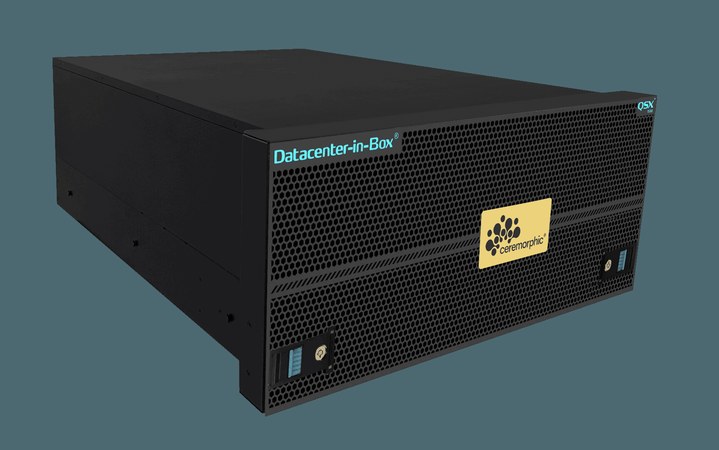
Ceremorphic, Inc.
Ceremorphic is a San Jose-based fabless semiconductor startup building energy-efficient AI supercomputing silicon. Founded in 2020 by serial entrepreneur Venkat Mattela, the company taped out a first-of-its-kind 5nm HPC/AI chip on TSMC's most advanced node and is applying the same Hierarchical Learning Processor architecture to data center AI, robotics, automotive, and analog-AI-driven drug discovery.

MatX
MatX is a Mountain View semiconductor company building chips designed exclusively for large language models. Founded in 2022 by ex-Google TPU engineers Reiner Pope and Mike Gunter, it aims to deliver an order-of-magnitude more performance-per-dollar for frontier model training and inference than current GPUs.

SambaNova Systems
SambaNova Systems is a Palo Alto AI company building purpose-built chips and a full-stack platform for fast, efficient inference on the largest open-source models, taking direct aim at Nvidia in the enterprise AI market.