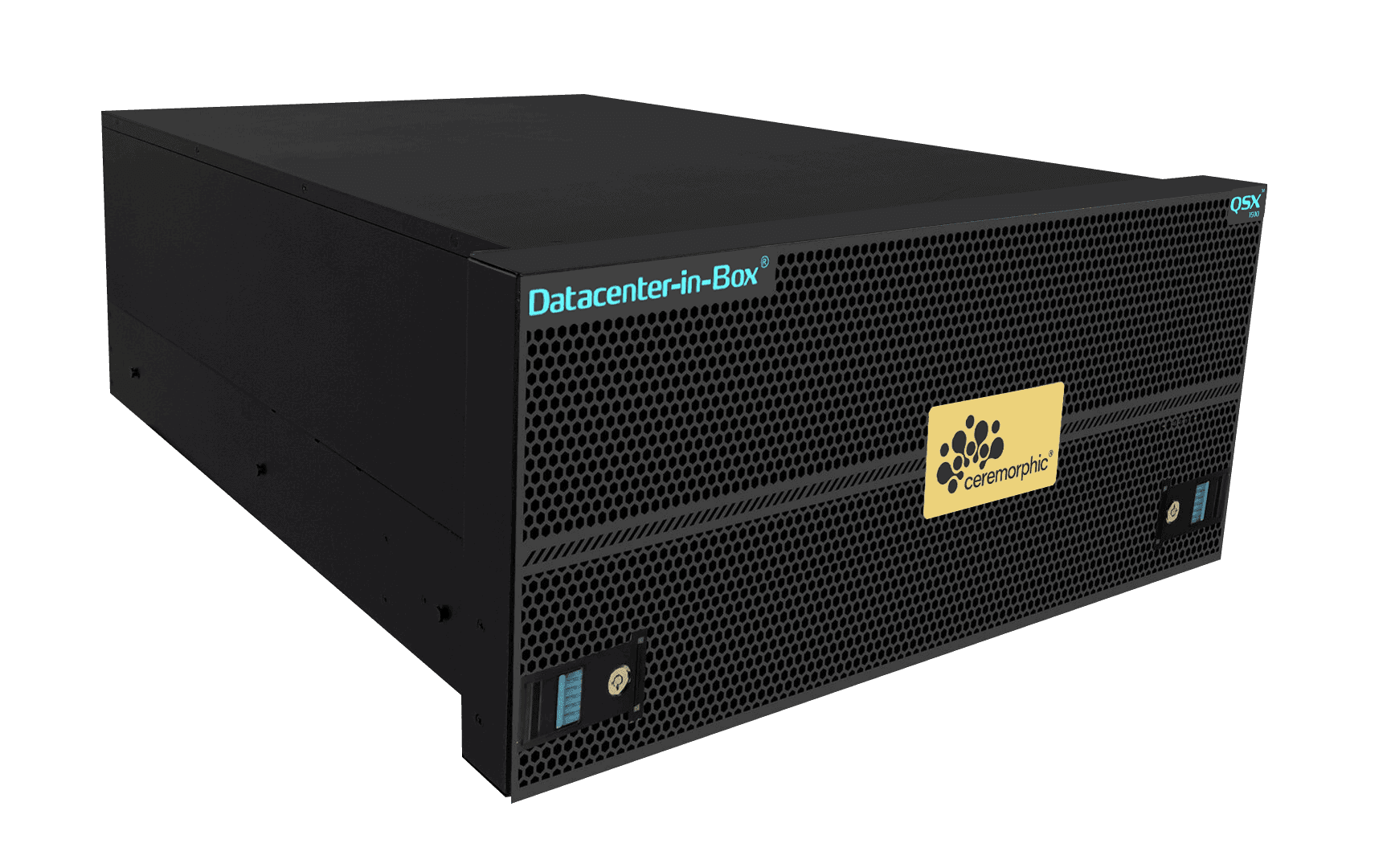
An unmarked building on North First Street.
Drive up North First Street in San Jose and you will pass the office without noticing. Suite 540 has no neon. No glass cube. No oversized logo throwing its name across the parking lot. Inside that suite, and in a 35,000 square foot design center 8,500 miles away in Hyderabad, around 160 engineers are doing one of the harder things in technology: drawing a 5nm chip, transistor by transistor, and hoping it works the first time.
The company is called Ceremorphic. They have raised $50 million. They have taped out silicon on TSMC's most advanced production node. And, in a Valley that markets a new "GPT killer" every Tuesday, they have said almost nothing about it.
That is the strange thing about Ceremorphic. The story is big. The volume is low.
AI got greedy. Power didn't.
By the time Venkat Mattela founded Ceremorphic in April 2020, a particular crisis was already taking shape inside data centers. Training runs were doubling. Power budgets were not. The chips running the boom were brilliant at math and indifferent to physics.
Everyone wanted more FLOPs. Almost no one wanted to pay the bill.
Ceremorphic's bet was that the AI silicon race would, eventually, be won by whoever solved three problems at once: performance per watt, reliability across long training runs, and an architecture flexible enough to serve more than one market. It is not a glamorous pitch. It is, however, the pitch a serial chip founder writes after he has been through this movie before.
A founder who has already done this once.
Mattela is not, by any reasonable definition, a first-timer. Before Ceremorphic he founded Redpine Signals, a wireless silicon company that grew into a global team and exited to Silicon Labs for $308 million. That is the kind of resume that lets you walk into a Sand Hill Road conference room and ask for $50 million while telling the partners almost nothing about what you are building.
Which is roughly what happened. In January 2022, Ceremorphic stepped out of stealth and announced a $50 million Series A on the same morning. Most of the industry had not heard the name the day before.
Founder note - Venkat Mattela
Ph.D., chip designer, repeat operator. Built Redpine Signals. Sold it. Took the lesson that the next decade of computing would be defined less by raw silicon throughput and more by what happens when a chip has to run forever without making a quiet mistake.
The bet inside Ceremorphic is named, with the understatement typical of the company, the Hierarchical Learning Processor - HLP for short. Most AI chips force the entire workload through a single fabric. The HLP idea is closer to a small city than a single highway: many fabrics, dispatch the work to whichever one fits, optimize for power.
One architecture. Four markets.
In October 2022, Ceremorphic did the thing that, in semiconductors, separates a pitch deck from a company: it taped out the chip. The first SoC went into TSMC's 5nm fabrication line, carrying PCIe 6.0 connectivity, CXL 3.0, 64Gbit SerDes, a custom machine learning processor and a floating point unit running at 2GHz.
That, in slightly less compressed English, is a chip built to talk fast, do math at scale, and not flinch under heat.
What the silicon goes into
Data center AI - training and inference for large models, designed for performance per watt. Robotics - perception and control with reliability assumptions borrowed from automotive. Life sciences - the analog-AI substrate behind Ceremorphic Life Sciences' BioCompDiscoverX drug discovery platform. Automotive - functional-safety-grade compute for systems that cannot afford the occasional silent flip.
The implicit argument is that the HLP, with the right packaging and software, can sell into all four. Most chip startups do one. Ceremorphic is attempting four. This is either an act of strategic confidence or a slightly worrying tell. The company seems undecided about which interpretation it prefers.
Milestones - the short version
- Apr 2020Venkat Mattela founds Ceremorphic in San Jose, post-Redpine.
- 2021Hyderabad design center opens - 35,000 sq ft, room for 350 engineers.
- Jan 2022Exits stealth. Announces $50M Series A and the HLP architecture.
- Apr 2022CEO presents at the Linley Spring Processor Conference.
- Oct 2022Tapes out first 5nm AI supercomputing chip on TSMC.
- 2023Launches custom silicon development service for HPC customers.
- 2024-2026Scales engineering team to ~160 across US and India; Life Sciences arm advances drug discovery platform.
Numbers, not narrative.
Skeptics get their turn here. Ceremorphic has not, publicly, named hyperscale customers. Most of its revenue figures travel through third party aggregators rather than press releases. Its loudest reference point remains a tapeout, not a shipping product. Fair criticisms. Hard to deny.
Ceremorphic, by the public numbers
Bars are normalized for readability, not investor accuracy. Numbers are approximate where company has not disclosed exact figures.
What Ceremorphic does have is a manufacturing relationship with TSMC at the bleeding edge, a multi-disciplinary engineering team that draws roughly a third of its Hyderabad ranks from the IITs, and a founder with a real exit on his record. None of those things guarantees a chip company succeeds. All of them are conditions of being allowed to try.
Sustainable compute, said with a straight face.
The company's mission, restated in its own words, is to deliver sustainable, energy efficient, and reliable compute infrastructure. That phrase has been said so many times by so many companies that it has almost lost meaning. Ceremorphic appears to have noticed - which is why it spends more time on the engineering footnotes than the slogan.
Its life sciences spinout, Ceremorphic Life Sciences, is a useful tell. The platform - BioCompDiscoverX - is pitched as a way to compress drug discovery economics by running models on Ceremorphic's analog and AI silicon. It is the cleanest case the company has for why "performance per watt" is not an abstraction. Drug discovery does not have time for floating-point arrogance.
What people can actually do with this
Train large AI models without bankrupting the electricity contract. Run inference for robotics and autonomous systems with the reliability profile of safety-critical compute. Use analog AI techniques for drug screening and molecular work. Build custom silicon, on advanced TSMC nodes, using Ceremorphic's IP rather than starting from scratch.
The compute bill comes due.
If the AI industry stays on its current curve, sometime in the back half of this decade the cost of training will stop being a technology question and start being a utility question. Chips that win in that environment will not look like the chips that won in 2022. They will run cooler. They will fail less. They will route work intelligently. They will look, in short, a lot like what Ceremorphic claims to be building.
Whether Ceremorphic specifically is the one to deliver that chip is a separate question. Tapeouts are not shipments. Architectures are not customers. The graveyard of AI silicon is a wide field with many tasteful headstones.
But the bet is real. And it is patient. And it was placed at a 5nm node, in a quiet office, by people who have done this once before.
Back on North First Street.
The unmarked building still has no neon. Suite 540 still does not announce itself. But somewhere inside, a die has come back from the fab, a probe is running through it, and a number on a screen tells someone in San Jose and someone in Hyderabad whether the last two years have worked. That number is the company. The press release is optional.
Links, references, further reading
- Websiteceremorphic.com
- LinkedInlinkedin.com/company/newsfromceremorphic
- X / Twitter@CeremorphicNews
- Press roomceremorphic.com/news
- 5nm TapeoutBusinessWire announcement
- Series A coverageVentureBeat
- Exit from stealthHPCwire
- Founder interviewCXOToday / Mattela Q&A
- Founder LinkedInVenkat Mattela
- Contactvenkat.mattela@ceremorphic.com
Note: product demo and interview videos are surfaced on Ceremorphic's press room and YouTube searches for "Ceremorphic Venkat Mattela" - the company does not maintain an official channel.