The revealing detail is the rice flour. In 2022, when St. Louis Magazine chose Top Sushi as its county “Hidden Gem,” the editors lingered over the tempura: chilled batter, fine rice flour, shrimp and vegetables inside a delicate crust. A restaurant with sushi in its name had caught their attention at the fryer. That is a useful place to begin.
Top Sushi serves Japanese and Korean food on Schuetz Road, in the St. Louis area covered by the magazine’s Creve Coeur and Olivette dining guide. The menu includes raw fish, elaborate rolls, hot noodles, and meat dishes. Read it closely and a second subject appears alongside the food: the small negotiations that happen whenever several people try to choose one restaurant.
Someone wants sashimi. Someone wants something hot. Someone would prefer to avoid fish altogether. The restaurant has an answer for each person. My reading of its appeal is simple: the breadth makes agreement easier, while the attention paid to particular dishes gives the sushi enthusiast a reason to suggest it in the first place.
A little place with two kinds of credibility
The tempura recognition is unusually concrete. Plenty of restaurant descriptions praise freshness or service. Here, the editors described preparation and texture, identifying something a diner could actually order and assess. Their account gives the praise a useful shape. You can follow it to the kitchen’s fried food, rather than merely arrive expecting a vaguely pleasant evening.
2022 / LOCAL EDITORS’ PICK“Hidden Gem (County)”
St. Louis Magazine · A-List Editors’ Choice Awards
The magazine’s area dining guide supplies the other half of the picture. Its Top Sushi entry calls attention to sashimi selection and cutting, then returns to tempura. Those are different kitchen tasks. Together, the two observations suggest a better way to approach the menu than simply picking whichever roll has the most entertaining name.
The setting is ordinary in a useful way. A property listing for the Schuetz Road retail center names Top Sushi alongside businesses including Subway, Edward Jones, a cat clinic, and a tattoo shop. It describes parking and a surrounding residential and commercial area. This is the geography of errands and familiar routes. Dinner can fit into an existing day.
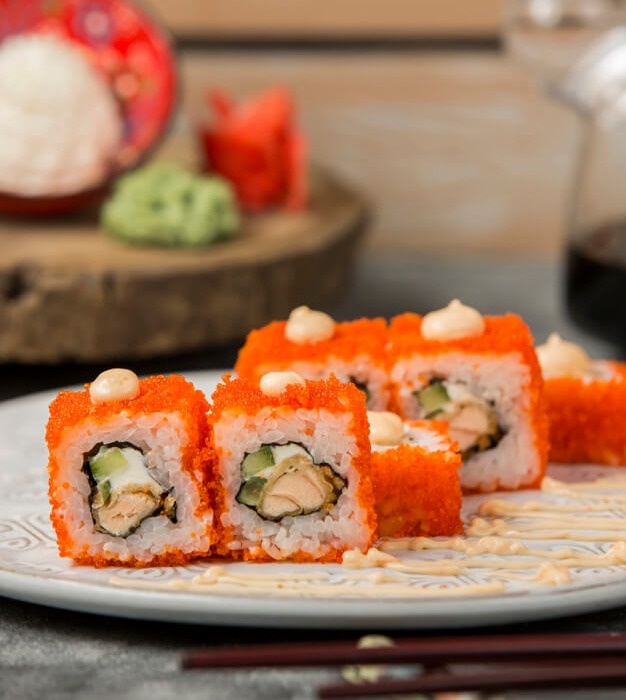
The person who doesn’t want sushi gets a vote
Start with the cooked side. Top Sushi lists teriyaki, katsu, fried rice, and both thin and thick noodle dishes. Its Korean selections include bibimbop and bulgoki, using the menu’s spellings. Ramen gets its own section. A customer can choose this restaurant and still have dinner without ordering a piece of raw fish.
There is something quietly practical about that. A very narrowly focused restaurant asks the whole party to share one enthusiasm. A broader restaurant can accommodate several. The inference here is about the menu’s design, not a claim about the owners’ private intentions: these choices reduce the number of reasons a dining companion might reject the suggestion.
The Korean dishes are substantial alternatives. The bibimbop description lists vegetables, egg, and gochujang sauce, with a stone-pot option for another $2. Bulgoki comes with vegetables and a choice of protein. These sections give a diner a meal to choose on its own merits, rather than a reluctant side order while everyone else enjoys dinner.
Vegetable options also deserve a careful reading. There are vegetable sushi choices and vegetarian noodle dishes. But the bibimbop description includes an egg, and the agedashi tofu description includes bonito flakes. An ingredient name can tell you more than a category label. Diners with specific preferences should read the descriptions and ask about the preparation they need.
A boat that does some of the choosing
The sushi menu moves between individual choices and combinations. One particularly legible offer is the Sushi Boat Special for Two: ten pieces of nigiri, a Rainbow Roll, and a Crab Rangoon Roll, listed at $52. Split equally, that is $26 per person before tax, drinks, tips, or other charges.
A combination does more than collect food on one order. It settles part of the selection problem. Instead of negotiating each item, two diners can accept a proposed assortment. Whether that assortment suits them is still a personal choice, but the starting point is clear. The restaurant has given the conversation something concrete to work with.
The Crab Rangoon Roll is a telling inclusion. The menu describes crabmeat and cheese, deep-fried, with eel sauce. Crab rangoon also appears as an appetizer. A familiar flavor therefore gets two formats, one of them placed directly alongside the nigiri in the shared meal. The contrast is part of the appeal: different textures and levels of familiarity can occupy the same order.
Price is easiest to discuss at this scale. A published dish or bundle tells a customer what a particular decision might cost. It does not require turning the restaurant into a sweeping claim about bargains across the city. At Top Sushi, the useful question is what you want to eat, how much choosing you want to do, and whether the resulting order fits your budget.
The four-mile dinner plan
The direct-delivery page makes the restaurant’s local reach tangible. It advertises a four-mile radius, a $20 minimum order, and a $2 delivery fee. Those numbers are practical boundaries. A small order may need pickup; an address beyond the service area needs a different plan. Entering the address early is more useful than discovering the restriction after choosing dinner.
The clock matters too. The official location page lists pickup until 9 p.m. Monday through Saturday. Delivery runs until 9 p.m. Monday through Thursday, but ends at 5 p.m. on Friday and Saturday. Sunday is closed. A Friday evening customer should distinguish between the restaurant being open and delivery being available.
Online ordering is advertised without compulsory registration. Customers select dishes, add them to a cart, and choose an order time. For changes to an existing order, the contact page directs customers to call because an email may not be seen quickly enough. That is a sensible division of labor: the website handles selection; a timely conversation handles a correction.
Give people a reason, then make dinner easy
For another neighborhood business, the transferable idea is to pair a specific reason to visit with straightforward ways to buy. Top Sushi’s editorial recognition points to particular food. Its menu gives companions adjacent choices. Its delivery page states limits. None of that proves a formula for growth, but each part helps a customer make a decision.
The approach has practical limits. A broad menu only helps if the available dishes suit the party. A delivery offer only helps within its area and hours. A combination only simplifies dinner when people like what it contains. Those conditions are visible enough for a customer to check before committing.
That brings us back to the tempura. The interesting detail was there before the business interpretation: a local reviewer noticed how something was made. For a first visit, that is a better invitation than an inflated promise. Read the menu, find the dishes that suit the table, and leave some room for the part that caught the editors’ attention.